
Market Expansion Prospectus The Sovereign Certifier & Trust-as-a-Service (TaaS)
1. The Global Crisis of Trust in Industrial Supply Chains
Modern industrial supply chains are paralyzed by a pervasive “Crisis of Trust.” This is not merely an agricultural friction point; it is a universal macro-economic failure. Global markets currently rely on antiquated audit models where buyers remain skeptical of producer self-reporting, and producers are burdened by the exorbitant “Trust Premium”—the high intermediary fees and operational delays associated with centralized oversight. Existing models fail because they rely on manual, infrequent spot checks vulnerable to human error and bribery. Furthermore, these models suffer from a high “Bus Factor”: if the central auditing firm or the producer faces corporate instability or bankruptcy, the historical data essential for long-term provenance often vanishes.
The strategic imperative is to resolve the tension between “Regulatory Compliance” (which mandates the protection of sensitive identity data) and “Trustless Transparency” (the market’s demand for unalterable proof of quality).
| Feature | Centralized Auditing (SGS/Bureau Veritas) | Sovereign Certifier Model |
| Cost | High (Intermediary fees + travel) | Low (Automated micro-fees/SaaS) |
| Audit Frequency | Periodic/Annual spot checks | Continuous, real-time monitoring |
| Data Integrity | Vulnerable to human error/corruption | Cryptographically secured by hardware |
| Data Persistence | Risk of loss (Centralized silos) | Sovereign Permanence (The “Bus Factor”) |
| Regulatory Fit | Manual, high-friction KYC | Built-in “Safe Harbor” (Split-Ledger) |
For strategic partners, removing these intermediaries creates immediate liquidity for remote industrial operations. By replacing manual oversight with mathematical certainty, assets can be tokenized as Real World Assets (RWAs) with institutional-grade confidence. The technological remedy for this systemic trust gap is the Split-Ledger architecture.
——————————————————————————–
2. The Split-Ledger Architecture: A Foundation for Industrial Truth
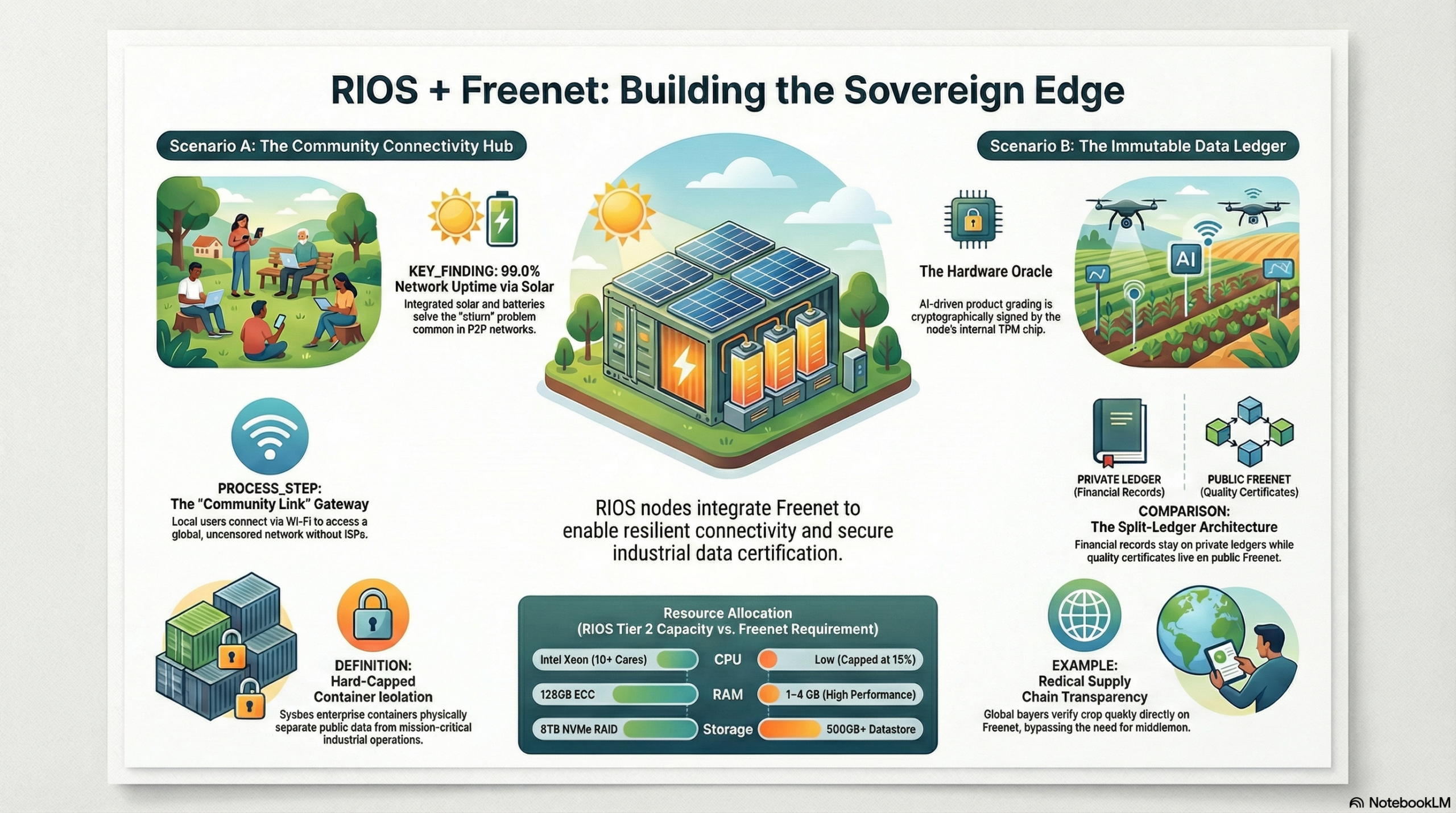
The core of our strategy is the intentional decoupling of financial data from physical attestation. This “Split” solves the privacy paradox (GDPR/PII compliance) by creating two distinct environments: The Bank (a private, permissioned ledger for financial settlement and identity) and The Library (a public, immutable registry for physical quality). This architecture ensures that while sensitive identity data remains shielded, the “History of the Object” is accessible to the global market forever.
The system is operationalized through the “Trinity Stack” integrated within the RIOS (Rural Infrastructure Operating System) hardware:
- Layer 1: Physical Ingestion (The Eye): Utilizing RIOS Tier 2 Nodes equipped with NVIDIA A2 Tensor Core GPUs, the system performs real-time AI inference (e.g., YOLOv8) to analyze physical assets, generating a raw data object.
- Layer 2: The Publisher Bridge (The Hand): A custom Rust-based middleware that sanitizes data by stripping PII and hashes the content. It requests a cryptographic signature from the node’s Hardware Root-of-Trust (TPM 2.0 using Ed25519 keys). This transforms the node into a “Hardware Oracle,” attesting that the machine itself witnessed the event at a specific time and location.
- Layer 3: The Public Registry (The Memory): The public layer utilizes Freenet (Locutus). Unlike Ethereum or VeChain, Freenet offers a “Zero Gas Fee” model, making it feasible to store high-fidelity logs and content-addressable hashes without the cost-prohibitive nature of standard blockchains.
Freenet’s technical differentiators—specifically Small World Routing and its use of a Commutative Monoid (a merge-only data type)—ensure that state updates are append-only and immune to censorship. This provides a permanent “Library of History” that survives independently of any single corporation. This framework is perfectly positioned for expansion into the remote mining sector.
——————————————————————————–
3. Vertical Expansion I: Remote Mining & ESG Compliance
In the extractive industries, ESG (Environmental, Social, and Governance) proof has shifted from a marketing elective to a strategic necessity. The Sovereign Certifier serves as the ultimate tool for “Proof of Operation,” providing mining partners with an unalterable record of their environmental impact and ore quality.
By deploying RIOS nodes as Hardware Oracles, mines can provide hardware-signed logs of operations. The node’s TPM ensures the data is signed directly at the source; the system cryptographically attests that “this specific machine witnessed this ore quality at these precise GPS coordinates.” To protect operator safety and land-rights privacy in sensitive regions, the system utilizes a 10km radius Geohash, providing mathematical proof of origin without exposing exact site vulnerabilities.
This “Sovereign Permanence” ensures that a mine’s data persists through corporate shifts or political instability. It creates a “Library of History” for the mine’s entire lifecycle, satisfying international investors who demand immutable proof of ESG compliance before unlocking capital. This same hardware-bound attestation is the key to restoring integrity to the carbon credit markets.
——————————————————————————–
4. Vertical Expansion II: Carbon Credits & The Sovereign Certifier
The voluntary carbon market is currently crippled by “garbage in” attacks and self-reporting bias. Hardware-bound attestation restores the RWA value of a credit by replacing human estimates with mathematical proof.
The “Happy Path” workflow for a carbon credit pilot utilizes a rigorous Data Schema (including batch_uuid, timestamp_unix, and gps_hash) to provide a content-addressable hash of the credit’s quality.
- Physical Ingestion: Sensors and camera logs capture real-time environmental data.
- The Split: Identity data is routed to the private ledger (“The Bank”), while the environmental metrics are prepared for the public registry (“The Library”).
- The Put Operation: The sanitized, signed payload is pushed to a Freenet contract, creating a permanent, verifiable record.
This provides a unique “Safe Harbor” for issuers. As a lead strategist, the logic is clear: Regulators care about money and people; they do not care about stalk diameter or soil carbon density.
- Regulatory Shield: By isolating physical metrics on Freenet, the issuer shields their primary financial ledger from unnecessary oversight while satisfying SEC/CFTC mandates.
- Market Confidence: Buyers can verify the mathematical proof of the credit on a public gateway without requiring access to the issuer’s internal databases.
- Immutable Quality: The use of content-addressable hashes ensures that once quality data is pushed, it cannot be manipulated or double-counted.
——————————————————————————–
5. The Business Logic: Trust-as-a-Service (TaaS) Economics
We are transitioning from a hardware manufacturer to a Tier-1 Data Infrastructure Provider. By providing the stack for “Automated Trust,” we capture high-margin recurring revenue. The marginal cost of adding a new industrial node to the Freenet network is near zero, creating a highly scalable and sticky software ecosystem.
The three-year financial proforma reflects this shift to a TaaS model:
| Metric | Year 1 (The Burn) | Year 2 (The Turn) | Year 3 (The Scale) |
| Active Nodes (Cumulative) | 20 | 100 | 350 |
| Total Revenue | $170,000 | $1,280,000 | $6,015,000 |
| Total Expenses | $464,000 | $780,000 | $1,450,000 |
| Net Income (EBITDA) | ($294,000) | $500,000 | $4,565,000 |
| Profit Margin | -172% | 39% | 75% |
The 75% profit margin in Year 3 is driven by the trifecta of Hardware Enablement Fees, SaaS Subscriptions (500/month), and Attestation Fees (10/batch). While the architecture can integrate with high-speed chains like Horizen for settlement (“The Volume Play”), the high-margin TaaS revenue is rooted in Freenet’s role as the permanent “Library of History.”
——————————————————————————–
6. Risk Mitigation & Implementation Roadmap
Moving from agricultural pilots to universal industrial white-labeling requires addressing technical and adoption gaps.
| Risk Factor | Impact | Mitigation Strategy |
| Technology Maturity (Freenet Alpha) | High | Maintain a fallback “Mirror” on S3 cloud storage for the first 12–18 months. |
| Adoption Friction | Medium | Deploy the Web2 Portal (verify.dereticular.com) to allow buyers to query Freenet data via standard browsers. |
| Regulatory Overreach | Critical | Structure all fees as “Software Licensing” and “Data Storage” to avoid securities classification. |
Three-Phase Implementation Roadmap:
- Validation (Phase 1): Deploy the Rust “Publisher Bridge” to initial anchor nodes (e.g., Arizona and Uganda). Prove the Hardware Oracle concept by verifying Freenet contract updates are visible globally.
- Commercialization (Phase 2): Release RIOS OS v3.0 with one-click Freenet integration. Launch the Web2 “Verifier App” for seamless buyer queries.
- Ecosystem (Phase 3): Open APIs for third-party industrial applications to write to the RIOS Freenet store, scaling to 350+ nodes across mining, carbon, and agriculture.
The Sovereign Certifier model represents the future of decentralized industrial finance. It replaces the vulnerability of centralized trust with the mathematical certainty of hardware-signed data. Don’t trust. Verify.