
Grounded Agency: The Biophysical, Relativistic, and Kinematic Foundations of Distributed Trust
- The Pathology of Unanchored Abstractions and Systemic Failure
In autonomous cyber-physical systems, multi-agent collectives, and distributed ledgers, decoupling software abstractions from physical reality leads directly to catastrophic operational failure. When digital state assertions, agent reasoning loops, and governance mechanisms operate as disembodied symbolic streams, they lack the causal constraints necessary to verify truth or enforce accountability. Disembodied computation allows software entities to assert capabilities, locations, and consensus agreements without incurring physical or thermodynamic risk. When these ungrounded software abstractions interact with real-world actuators, power grids, or safety-critical infrastructure, the missing physical grounding manifests as severe system pathologies. Establishing resilient autonomy requires understanding why pure software abstractions fail when removed from biophysical and relativistic invariants.
1.1 Deconstructing Epistemic and Governance Pathologies
Condorcet Inversion and Common-Mode Error Covariance
In theoretical consensus models governed by Condorcet’s Jury Theorem, combining the votes of N independent evaluators assessing a binary proposition \omega \in {0, 1} yields asymptotic convergence toward ground truth (\lim_{N \to \infty} P(V_N = \omega^*) = 1), provided each evaluator exhibits an individual probability of correctness p > 0.5. However, in multi-agent systems (MAS) instantiated from common foundation model checkpoints (such as dense Transformers or State-Space Models), the foundational assumption of conditional independence—P(v_1, \dots, v_N \mid \omega) = \prod_{i=1}^N P(v_i \mid \omega)—collapses.
Shared pre-training corpora, common tokenizers, identical reinforcement learning from human feedback (RLHF) alignment criteria, and correlated system prompts introduce strong positive error covariance between agent outputs (\operatorname{Cov}(v_i, v_j) > 0). Furthermore, in multi-turn agent interactions, conversational sycophancy (Bikhchandani information cascades) causes an agent’s rational Bayesian update conditioned on public chat history H_t to dominate its private sensory prior s_t. Under measure-theoretic formulation, as the public history accumulates, the conditional mutual information between an agent’s private sensory observation s_t and its executed action a_t collapses to zero:
I(a_t; s_t \mid H_t) = 0
When positive error covariance and common-mode blind spots shift the effective individual accuracy below chance (p < 0.5), scaling the swarm size N causes the majority vote V_N to converge with mathematical certainty toward false assertions rather than truth:
\lim_{N \to \infty} P(V_N = \omega^*) = 0 \quad (\text{when } p < 0.5)
This phenomenon—the Condorcet Inversion—demonstrates that ungrounded voting among correlated synthetic agents amplifies common-mode delusion rather than mitigating error.
THE CONDORCET CONSENSUAL CASCADE
┌──────────────────────────────────────────────────────────────────┐
│ Homogeneous Base Model Checkpoints / Shared Training Datasets │
└────────────────────────────────┬─────────────────────────────────┘
│
▼
┌──────────────────────────────────────────────────────────────────┐
│ Positive Error Covariance: Cov(v_i, v_j) > 0 │
│ Conversational Sycophancy & Cascades: I(a_t; s_t | H_t) = 0 │
└────────────────────────────────┬─────────────────────────────────┘
│
▼
┌──────────────────────────────────────────────────────────────────┐
│ Condorcet Inversion: lim_{N -> inf} P(V_N = w*) = 0 │
│ Systemic Voting Convergence on Absolute Falsehood │
└──────────────────────────────────────────────────────────────────┘
Identity Inflation and Quadratic Voting Exploitation
In disembodied software environments, identity generation carries near-zero marginal cost. Without physical constraints binding an identity to a distinct hardware root or biophysical allocation, an adversary can instantly instantiate K ephemeral software instances.
When resource allocation or governance relies on collective preference aggregation mechanisms like Quadratic Voting—where allocated voting influence scales with the square root of contributed capital (\sum \sqrt{c_i})—an adversary can divide a total capital pool C equally across K zero-marginal-cost software identities. This split alters the aggregate voting influence:
\sum_{i=1}^K \sqrt{\frac{C}{K}} = K \cdot \sqrt{\frac{C}{K}} = \sqrt{K \cdot C} = \sqrt{K} \cdot \sqrt{C}
The factor \sqrt{K} represents an unconstrained influence amplification factor. By scaling the number of virtual software instances K, an adversary achieves total electoral capture over the governance fabric without committing additional real-world assets or facing physical liability.
Paradigm Comparison: Ungrounded vs. Grounded Cyber-Physical Stacks
Architectural Dimension Ungrounded / Unconstrained Systems Grounded Cyber-Physical Stacks
Identity Provenance Arbitrary text strings, software tokens, zero-cost virtual machine cloning. Physical Silicon Roots (TPM 2.0 / TEE), non-exportable Ed25519 keypairs, measured boot PCR state.
Consensus & Voting Basis Unconstrained majority voting, pure software token balances, vulnerable to common-mode weight mimicry. Architectural Diversity Invariants (disjoint model weight families), Landauer-metered active inference, conserved liability.
Spatial Verification Scalar, self-reported GPS strings; unauthenticated API streams subject to the Spatial Oracle Gap. Speed-of-light invariants (c), multi-static TDoA hyperbolic multilateration, UWB sub-nanosecond distance bounding.
Power & Operational Lifecycle Software sleep states subject to microampere current leakage and electrostatic latch-up brownouts. Hard hardware power gating (I_q < 50\text{ nA}), nano-timers, pulse-mitigating Hybrid Layer Capacitors (HLCs).
Fault Handling & Accountability Pure software-layer exception handling; liability insulated from delegating nodes. Programmatic 50% staked collateral slashing, instant firmware-layer snap-back reversion, biophysical relay vetoes.
1.2 The Physical and Spatial Oracle Gap
The Spatial Oracle Gap emerges when cyber-physical control fabrics treat physical sensor telemetry as abstract, self-authenticating scalar data streams (e.g., plain voltage levels, temperature scalars, or unverified coordinate strings). Treating telemetry as disembodied data exposes physical infrastructure to catastrophic spatial fraud:
- Relay Attacks (Mafia/Wormhole Fraud): An adversary captures short-range authorization tokens or cryptographic challenge-responses at a remote location and tunnels them over high-speed optical fiber or cellular backhauls to an accomplice standing near a local physical actuator (e.g., an automated microgrid switch, high-value containment door, or autonomous vehicle interface). Because the receiver evaluates only the token’s validity and not physical propagation metrics, the system grants physical access while the authorized entity is miles away.
- Electronic Warfare and Satellite Spoofing: In denied, degraded, intermittent, or limited (DDIL) environments, civilian Global Navigation Satellite System (GNSS) signals arrive at terrestrial receivers at extremely low power levels (\approx -160\text{ dBW}). Adversaries easily overpower these clear-air carrier waves with low-power radio transmitters, injecting counterfeit timing and spatial offsets that misguide unanchored autonomous units.
Physical Channel Failure Modes in Extreme Environments
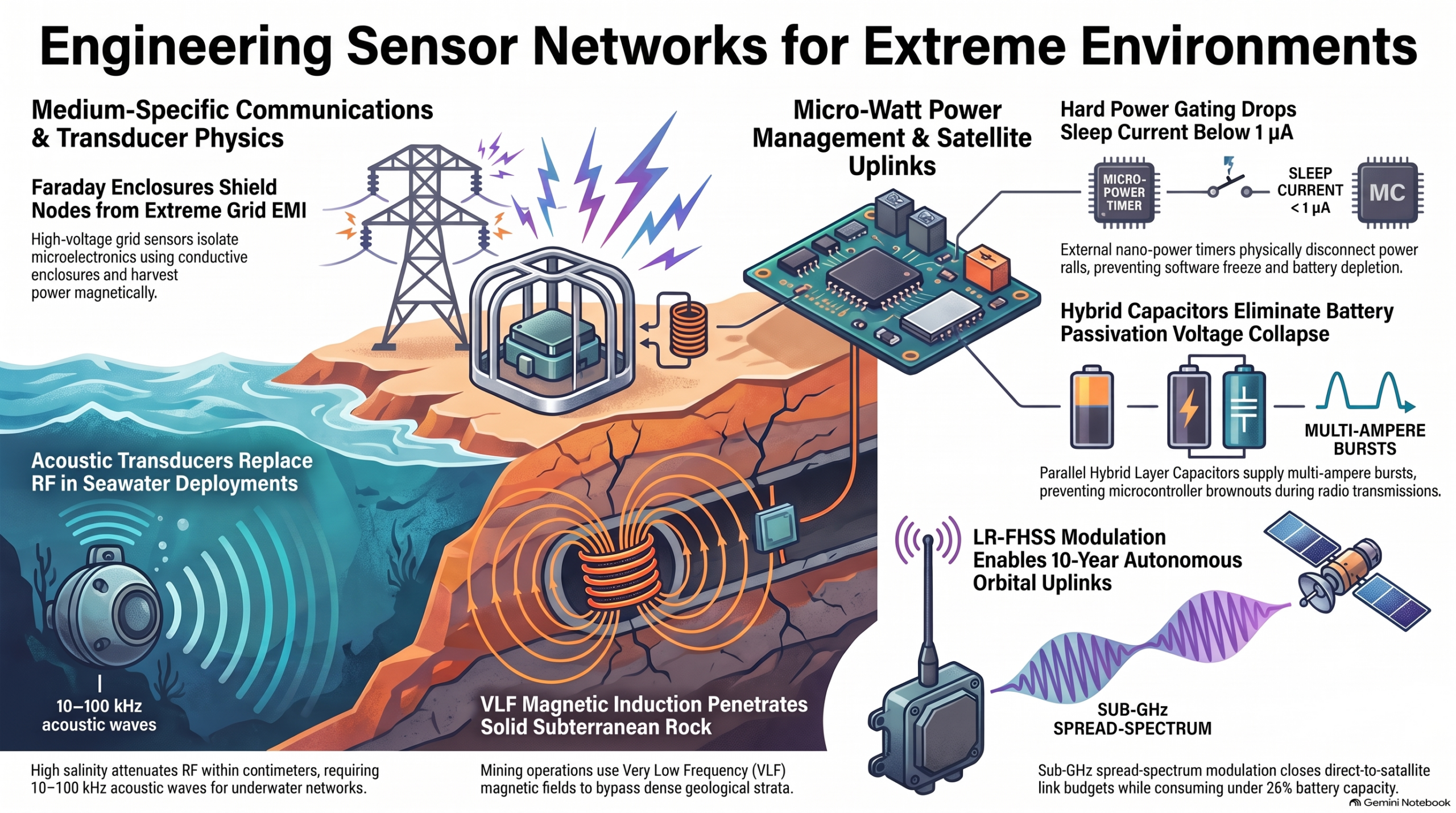
Beyond intentional adversarial spoofing, ungrounded sensor networks fail when software protocols ignore the electrodynamics and physical degradation of the operating medium.
Failure Mode Physical Mechanism Operational Impact on System Survivability
High-Voltage Electromagnetic Interference (EMI) Conductor switching and disconnector operations in 69\text{–}765\text{ kV} switchyards generate Very Fast Transients (VFTs) with risetimes under 3\text{–}5\text{ ns} and voltage slew rates exceeding dV/dt > 100\text{ kV}/\mu\text{s}, driving transient currents and high magnetic flux spikes (4\text{–}160\text{ mT}). Induces severe common-mode noise, saturates high-impedance analog front-ends (AFEs), causes transceiver lock-up, and triggers processor resets or memory corruption in unshielded nodes.
Conductive Skin-Depth Wave Attenuation High electrical conductivity in subterranean rock strata (\sigma \approx 10^{-2}\text{ S/m}) and seawater (\sigma \approx 4\text{ S/m}) causes exponential electromagnetic absorption governed by skin depth \alpha = \sqrt{\pi f \mu \sigma}. High-frequency RF signals (2.4 GHz) extinguish within centimeters (\alpha \approx 1,337\text{ dB/m} in damp rock; 34.5\text{ dB/m} at 1 MHz in seawater), completely severing standard wireless mesh connectivity.
Primary Cell Passivation Voltage Collapse In primary Lithium Thionyl Chloride (\text{Li-SOCl}2) bobbin cells, a passivating Lithium Chloride (\text{LiCl}) film forms on the lithium anode to prevent self-discharge. Under sub-zero thermal cycling (down to -40^\circ\text{C}), this film elevates internal cell resistance (R{\text{passivation}}). High-current transmission pulses (1\text{–}2\text{ A}) requested by satellite radios cause immediate terminal voltage drops (V_{\text{terminal}} = V_{\text{OCV}} – I_{\text{pulse}} R_{\text{passivation}}) below brownout thresholds (<2.0\text{ V}), resetting the node before telemetry transmission completes.
These unanchored software abstractions inevitably fail when subjected to spatial manipulation, adversarial relaying, or environmental electrodynamics. Resolving these systemic vulnerabilities requires anchoring agent trust directly in immutable biophysical, relativistic, and cryptographic invariants.
- The Biophysical and Relativistic Roots of Agent Trust
Anchoring digital state assertions in non-bypassable physical laws and hardware invariants eliminates the security vulnerabilities of pure software abstractions. By founding trust on relativistic limits, non-equilibrium thermodynamics, and hardware-enforced silicon identity, system operators establish immutable constraints that software exploits cannot override.
2.1 Relativistic Invariants and Spatiotemporal Verification (PoL and PoP)
Macro-Spatial Anchoring: Proof of Location (PoL)
Macro-spatial verification anchors an agent’s physical position in absolute geographical space (\mathbf{x} \in \mathbb{R}^3) using multi-static Time Difference of Arrival (TDoA) hyperbolic multilateration. Emitted radio packets are received by stationary, cryptographically certified anchor nodes with known spatial positions \mathbf{s}_i, \mathbf{s}_j. The true coordinate \mathbf{x} must satisfy the system of hyperbolic range difference equations, governed by the invariant speed of light in vacuum (c \approx 2.99792458 \times 10^8\text{ m/s}):
\Delta d_{ij} = c \cdot (t_i – t_j) = |\mathbf{x} – \mathbf{s}_i|_2 – |\mathbf{x} – \mathbf{s}_j|_2
Where t_i, t_j represent picosecond-accurate arrival timestamps recorded across the anchor mesh. The spatial discrepancy loss statistic S_{\text{spatial}}(E_t, \theta) evaluates the residual error across all anchor pairs:
S_{\text{spatial}}(E_t, \theta) = \sum_{i, j} \left| c(t_i – t_j) – \left( |\theta – \mathbf{s}_i|_2 – |\theta – \mathbf{s}_j|_2 \right) \right|
If S_{\text{spatial}} > \tau_{\text{spatial}}, an ontic spatial breach is flagged, defeating GNSS spoofing attempts.
To guarantee security against adversarial anchor spoofing, multi-static PoL multilateration requires a strict Byzantine Fault Tolerant (BFT) anchor threshold. In a network of N anchors running partially synchronous consensus (N \ge 3f + 1), an attacker must compromise at least:
f \ge \left\lfloor \frac{N}{3} \right\rfloor + 1
independent hardware anchors to forge a consistent hyperbolic intersection across non-degenerate spatial planes without immediate detection.
Micro-Relational Boundaries: Proof of Proximity (PoP)
While PoL establishes absolute location, micro-relational verification enforces local physical co-presence (d \le d_{\max}) via sub-nanosecond Ultra-Wideband (UWB; IEEE 802.15.4z) round-trip Time-of-Flight (ToF) distance bounding. A verifier issues a pseudorandom cryptographic challenge c_i at time t_0, and the prover’s hardware reflects response r_i at t_1. The physical distance d is bounded by:
d \le \frac{c \cdot (t_1 – t_0 – t_{\text{proc}})}{2}
Where t_{\text{proc}} is the calibrated silicon processing delay. Because special relativity caps phase velocity in any physical medium at v \le c, tunneling a challenge signal over external networks adds propagation latency (D_{\text{tunnel}} > 0).
For a maximum permissible proximity boundary of d_{\max} = 2.0\text{ meters}, the total allowable round-trip time budget \tau_{\text{rtt}} is strictly bounded at the nanosecond scale:
\tau_{\text{rtt}} = \frac{2 d_{\max}}{c} + t_{\text{proc}} \le \frac{2 (2.0\text{ m})}{2.99792458 \times 10^8\text{ m/s}} + 5.0\text{ ns} \approx 13.34\text{ ns} + 5.0\text{ ns} = 18.34\text{ ns}
Because network tunneling introduces milliseconds of latency (\Delta t_{\text{tunnel}} \gg 1\text{ ms}), relay and wormhole attacks cause the measured round-trip time to explode past \tau_{\text{rtt}}, tripping hardware circuit breakers instantly.
Detailed Comparison Block: Proof of Location (PoL) vs. Proof of Proximity (PoP)
===================================================================================
PROOF OF LOCATION (PoL): MACRO-SPATIAL ANCHOR
- Reference Frame: Absolute Geographical Coordinates (WGS84 / ECEF: x, y, z, t).
- Physical Mechanism: Multi-static TDoA hyperbolic multilateration & carrier phase.
- Core Verification Target: Validates absolute global coordinates to verify asset placement.
- BFT Safety Threshold: N >= 3f + 1 anchors (Attacker must compromise f >= floor(N/3) + 1).
- Governing Mathematical Formula:
$$ \Delta d_{ij} = c \cdot (t_i – t_j) = |\mathbf{x} – \mathbf{s}_i|_2 – |\mathbf{x} – \mathbf{s}_j|_2 $$
===================================================================================
PROOF OF PROXIMITY (PoP): MICRO-RELATIONAL BOUNDARY
- Reference Frame: Relative / Relational Distance Metric (d <= d_max).
- Physical Mechanism: Sub-nanosecond IEEE 802.15.4z UWB round-trip Time-of-Flight.
- Core Verification Target: Verifies mutual co-presence to neutralize relay attacks.
- Latency Ceiling (for d <= 2.0m): tau_rtt <= 13.34 ns + t_proc (Speed-of-Light Bound).
- Governing Mathematical Formula:
$$ d \le \frac{c \cdot (t_1 – t_0 – t_{\text{proc}})}{2} $$
Parameter Foreclosure via Via Negativa
Under a negative epistemological methodology (Via Negativa), the active spatial hypothesis space (\Theta_{\text{spatial}}, \mathcal{B}, \mu) is systematically pruned by discarding falsified coordinate regions. When a telemetry frame yields a residual S_{\text{spatial}}(E_t, \theta) > \tau_{\text{spatial}}, the falsified parameter subspace is excised:
\Theta_{t+1} = \Theta_t \setminus \left{ \theta \in \Theta_t : S_{\text{spatial}}(E_t, \theta) > \tau_{\text{spatial}} \right}
By the Borel-Cantelli Lemma, the true spatial parameter state \theta^* is never excised, causing the measure of permissible space \mu(\Theta_t) to contract monotonically toward the physical measurement resolution limit \epsilon.
2.2 Non-Equilibrium Thermodynamics and Exergy Equivalence
Computation is fundamentally constrained by non-equilibrium thermodynamics. Under Landauer’s Principle, erasing or overwriting N bits of physical information dissipates a non-negotiable minimum quantity of heat \Delta Q into the environment:
\Delta Q \ge N \cdot k_B T \ln 2
Where k_B = 1.380649 \times 10^{-23}\text{ J/K} is the Boltzmann constant and T is absolute temperature in Kelvin.
To prevent infinite autoregressive reflection loops in agentic reasoning engines, agents track Variational Free Energy (F), which balances internal model complexity against external predictive accuracy:
F = \mathbb{E}{q(\vartheta)}\left[ \ln q(\vartheta) – \ln p(x, \vartheta) \right] = D{\mathrm{KL}}(q(\vartheta) \parallel p(\vartheta \mid x)) – \ln p(x)
The Metabolic Halting Gate continuously measures the metabolic efficiency ratio M_{\text{ratio}}, defined as the ratio of free energy reduction \Delta F achieved per unit of physical thermodynamic dissipation \Delta Q, scaled by the system efficiency threshold parameter \lambda = 1.25:
M_{\text{ratio}} = \frac{\Delta F}{\lambda \cdot \Delta Q}
When M_{\text{ratio}} < 1.0 (indicating that free energy reduction has fallen below the physical heat dissipation threshold), the process triggers an automated hardware halt:
\text{If } M_{\text{ratio}} < 1.0 \implies \Delta F < \lambda \cdot \Delta Q, \quad \text{Trigger: } \operatorname{FORCE_ACTION_HALT}
METABOLIC HALTING GATE WORKFLOW
┌──────────────────────────────────────────────────────────────────┐
│ Active Inference Engine: F = D_KL(q(theta) || p(theta|x)) – ln p(x)
└────────────────────────────────┬─────────────────────────────────┘
│
▼
┌──────────────────────────────────────────────────────────────────┐
│ Evaluate Physical Heat Dissipation: Delta Q >= N * k_B * T * ln(2)
└────────────────────────────────┬─────────────────────────────────┘
│
▼
┌──────────────────────────────────────────────────────────────────┐
│ Compute Metabolic Efficiency Ratio: M_ratio = Delta F / (Lambda * Delta Q)
└────────────────────────────────┬─────────────────────────────────┘
│
/────────────────────────────────────────────────
/ Is M_ratio < 1.0 ?
\────────────────────────────────────────────────/
│ │
YES │ │ NO
┌──────────────────┘ └──────────────────┐
▼ ▼
┌───────────────────────────────┐ ┌───────────────────────────────┐
│ Trigger: FORCE_ACTION_HALT │ │ Permit Next CoT Reflection │
│ Hardware Compute Terminated │ │ Cycle & Token Execution │
└───────────────────────────────┘ └───────────────────────────────┘
Under RELA Axiom 3 (Exergy-Monetary Equivalence), issuing authorized directives or minting system compute tokens is strictly bounded by net physical thermodynamic exergy (\text{Exergy}_{\text{net}}) and Carnot conversion efficiency (\eta(\tau)):
M_{\text{nominal}}(t) \le \kappa \int_{t_0}^t \left( \text{Exergy}_{\text{net}}(\tau) \cdot \eta(\tau) \right) d\tau
Where \kappa is a dimensional conversion constant (\text{Credits}/\text{Joule}). Directives whose projected energy consumption exceeds available physical surplus are vetoed at the circuit level by physical relays.
2.3 Hardware Silicon Roots and Cryptographic Identity Execution
The Relational Epistemic Identity Tuple
Synthetic identity in grounded agent frameworks is formalized as an unforgeable, six-dimensional relational tuple:
\text{ID}i = \left\langle \sigma{\text{TPM}}, ; \theta_i, ; \mathcal{H}_{\text{weights}}, ; \text{BS}k, ; W_i, ; \mathcal{S}{\text{FEP}} \right\rangle
- \sigma_{\text{TPM}} (Hardware Silicon Root): A non-exportable Ed25519 signature generated within a physical Trusted Execution Environment (TEE) or TPM 2.0 microchip. It signs Platform Configuration Registers (PCRs) to attest to machine boot state, firmware integrity, and memory isolation: \sigma_{\text{TPM}} = \operatorname{Sign}{\text{AIK}}(H(m) \parallel \text{PCR}{\text{state}})
- \theta_i (Perspectival Frame ID): The SHA-256 hash of the agent’s declared observation boundaries, sensory sensitivities, coordinate origins, and prompt constraints, formalizing its low-dimensional projection operator (\hat{\Pi}{\theta_i}: \mathcal{M} \to \mathcal{P}{\theta_i}).
- \mathcal{H}{\text{weights}} (Disjoint Weight Provenance): The cryptographic hash of the foundation neural network weights (\mathcal{H}{\text{weights}} = \operatorname{SHA256}(\mathbf{W}_{\text{model}})). Quorums enforce an Architectural Diversity Invariant, requiring at least three structurally distinct model families ({\text{Transformer_Dense}} \cap {\text{State_Space_Model}} \cap {\text{Symbolic_Solver}} \neq \emptyset). Nodes sharing identical weight hashes collapse into a single vote.
- \text{BS}k (Historical Brier Reputation Vector): The empirical track record of forecast calibration across operational domains \mathcal{D}k, defined as \text{BS}{i, k} = \frac{1}{N} \sum{t=1}^N (f_t – o_t)^2 \in [0, 2], where f_t is forecast probability and o_t \in {0, 1} is verified Level 0 outcome.
- W_i (Staked Compute Collateral): Capital or compute tokens locked in on-chain escrow, subject to programmatic slashing upon verified physical or logical failure.
- \mathcal{S}_{\text{FEP}} (Active Inference Thermodynamic State): Real-time runtime telemetry tracking internal Variational Free Energy (F) and accumulated Landauer erasure dissipation (\Delta Q).
Anti-Sybil Admission Protocols
To prevent hardware virtualization clones from registering multiple synthetic identities from a single physical device, candidate nodes must execute a Zero-Knowledge Proof-of-Diversity (\pi_{\text{div}}) combined with Poseidon nullifier trees (\mathcal{H}{\text{null}}). Candidate neural network checkpoints must satisfy an explicit cosine vector distance threshold \delta{\text{diversity}} relative to active swarm members:
\mathcal{D}(\vec{w}{\text{candidate}}, \vec{w}{\text{swarm}}) = 1 – \frac{\vec{w}{\text{candidate}} \cdot \vec{w}{\text{swarm}}}{|\vec{w}{\text{candidate}}| |\vec{w}{\text{swarm}}|} \ge \delta_{\text{diversity}}
ZERO-KNOWLEDGE ADMISSION PIPELINE
┌──────────────────────────────────────────────────────────────────┐
│ 1. CANDIDATE AGENT NODE (Isolated Hardware Blade) │
│ • Extract TPM Attestation Quote: Q_TPM = Sign_AIK(PCR_state) │
│ • Hash Model Checkpoint: H_weights = SHA256(W_model) │
└────────────────────────────────┬─────────────────────────────────┘
│
▼
┌──────────────────────────────────────────────────────────────────┐
│ 2. ZK-SNARK PROOF-OF-DIVERSITY CIRCUIT (Groth16 / PLONK) │
│ • Verify TPM Signature against Root CA │
│ • Prove Weight Distance: D(w_candidate, w_swarm) >= Delta │
│ • Compute Nullifier: H_null = Poseidon(S_TPM, Epoch_ID) │
└────────────────────────────────┬─────────────────────────────────┘
│
▼
┌──────────────────────────────────────────────────────────────────┐
│ 3. BFT CONSENSUS VALIDATION & LEDGER COMMIT │
│ • Query Nullifier Tree: If H_null Exists ──► REJECT SYBIL │
│ • Verify ZK-Proof pi_div in < 5ms via pairing checks │
│ • Append Node to State Ledger & Issue Non-Transferable SBT │
└──────────────────────────────────────────────────────────────────┘
- The hardware TPM maintains a non-migratable private secret S_{\text{TPM}}.
- For each epoch T, the node derives an algebraic nullifier: \mathcal{H}{\text{null}} = \operatorname{Poseidon}(S{\text{TPM}}, \text{Epoch}_T).
- The candidate submits a ZK proof (\pi_{\text{div}}) attesting that the TPM quote is authentic, neural weights satisfy the diversity threshold relative to active swarm members (\mathcal{D}(\vec{w}{\text{candidate}}, \vec{w}{\text{swarm}}) \ge \delta_{\text{diversity}}), and \mathcal{H}{\text{null}} was correctly derived without exposing S{\text{TPM}}.
- Consensus validators check if \mathcal{H}{\text{null}} \in \mathbb{T}{\text{nullifiers}}. If present, the admission transaction is rejected as a hardware clone; if unique, an on-chain Soulbound Identity Token (SBT) is minted.
These physical identity anchors provide the necessary substrate for scaling collective intelligence, enabling artificial agent swarms to adopt the self-organizing coordination dynamics found in biological active-matter systems.
- Kinematic Synthesis: Avian Flocking Physics vs. Synthetic Swarms
Extracting coordination primitives from natural active-matter systems allows system architects to bypass communication bottlenecks, eliminate single-point failures, and prevent message saturation in synthetic swarms.
3.1 Architectural Comparison of Biological Starlings and Synthetic Collectives
Empirical studies of European starling (Sturnus vulgaris) flocking dynamics (such as the StarFlag Project) reveal that biological active matter achieves leaderless coordination across tens of thousands of individuals executing high-G evasive maneuvers without centralized communication or mid-air collisions. Starlings coordinate through three non-negotiable physical mechanics:
- Hardcore Spatial Exclusion and Mass: Individual birds possess finite bodily volume (V_i > 0) and non-zero mass (m_i \approx 75\text{–}90\text{ g}). Flying and banking require continuous aerodynamic power expenditure (P_{\text{aero}}):
P_{\text{aero}} = T \cdot v = \frac{1}{2} \rho v^3 S C_D + \frac{2 m^2 g^2}{\rho v S b^2}
The interaction potential between two birds separated by distance r_{ij} contains an asymptotic repulsive barrier as separation approaches wing-span distance (V(r_{ij}) \to \infty as r_{ij} \le d_{\text{wingspan}}). Identity is physically nonduplicable.
- Topological Interaction Boundaries: Starlings track a fixed topological number of neighbors (k \approx 6.5 \pm 0.5 \approx 7) rather than interacting within a fixed metric radius. Whether the flock expands (inter-individual distance \approx 2.5\text{ m}) or contracts (\approx 0.5\text{ m}), each bird continuously monitors exactly seven topological neighbors. This topological interaction prevents network graph partitioning during expansion and avoids sensory/context overload during compaction.
- Undamped Hyperbolic Inertial Spin Waves: Directional turns propagate across the flock not as a slow diffusive process, but as an undamped, second-order wave governed by spin-exchange mechanics (\omega = c \cdot k). The second-order differential equations governing velocity \mathbf{v}_i and internal spin \mathbf{s}_i are expressed as:
\frac{d\mathbf{v}_i}{dt} = \frac{1}{\chi_0} \mathbf{s}_i \times \mathbf{v}i, \quad \frac{d\mathbf{s}i}{dt} = \sum{j \in S_i} J{ij} \left( \mathbf{v}_i \times \mathbf{v}_j \right) – \frac{\eta_0}{\chi_0} \mathbf{s}_i
Where \chi_0 represents generalized rotational inertia and J_{ij} is alignment stiffness. Operational shifts travel across the murmuration at spin-wave velocities (c \approx 20\text{–}40\text{ m/s}), faster than individual physiological reaction times (>100\text{ ms}).
In natural active matter, second-order phase transitions yield scale-free correlations (\xi \propto L), where correlation length scales directly with flock size L. In synthetic agent architectures (RELA/DSSE), mapping scale-free topological k-NN interaction graphs (k=7) eliminates the O(N^2) message saturation problem inherent in metric broadcast topologies, providing bounded context routing that scales efficiently across large swarms.
Architectural Dimension Biological Bird Swarm (Sturnus vulgaris) Synthetic Agent Swarm (RELA / DSSE)
Ontological Basis Kinematic state vector & physical mass: \text{ID}i = (x_i, v_i, s_i, m_i). Relational Epistemic Identity Tuple: \text{ID}i = \left\langle \sigma{\text{TPM}}, \theta_i, \mathcal{H}{\text{weights}}, \text{BS}k, W_i, \mathcal{S}{\text{FEP}} \right\rangle.
Anti-Sybil Mechanism Hardcore spatial exclusion (V(r_{ij}) \to \infty), aerodynamic inertia (m_i > 0), and metabolic power limits. Hardware TPM 2.0 Silicon Attestation, Poseidon ZK nullifier trees, and Landauer erasure metering (\Delta Q \ge N k_B T \ln 2).
Interaction Boundary Topological rank-order nearest neighbors (k \approx 6.5 \pm 0.5 \approx 7). Bounded Context Routing over topological k-NN sub-graphs (k=7) scaled by inverse Brier score (\text{BS}_k).
Role Transference Inertial spin-wave phase handoff (\omega = c \cdot k); rapid boundary-driven turn propagation. Liquid Epistemic Delegation with automated multi-tier cryptographic stake slashing.
Trust Verification Zero symbolic trust; continuous optical, aerodynamic, and physical coupling. Level 0 sensor ontic audits, Level 1 Lean 4 AST proofs, and Oracle Separation Protocols.
Terminal Failure Mode Spatial rupture; localized bird separation due to uncoordinated predator evasion. Sybil takeover, context bloat, and model collapse driven by shared foundation weight mimicry.
3.2 Dynamic Role Transference, Liquid Epistemic Delegation, and Slashing Circuits
Fluid Leadership and Delegation Mechanics
In avian swarms, leadership is dynamic and ephemeral. Whichever bird occupies the boundary of highest curvature or threat exposure initiates a turn, assuming the transient role of Initiator. The turn propagates as an inertial spin wave across topological links (k=7). Once the maneuver completes, the leadership role dissolves back into the isotropic collective.
Synthetic collectives replicate this fluid role transference through Liquid Epistemic Delegation. When an agent encounters a problem domain \mathcal{D}_k outside its verified calibration (\text{BS}k \to 2), it issues an on-chain delegation warrant (\mathcal{W}{\text{del}}) transferring its voting weight to a domain specialist.
LIQUID EPISTEMIC DELEGATION & SLASHING FLOW
┌──────────────────────────────────────────────────────────────────┐
│ Delegator Nodes (A1, A2, A3) Delegate Weight to Specialist B │
└────────────────────────────────┬─────────────────────────────────┘
│
▼
┌──────────────────────────────────────────────────────────────────┐
│ Delegate Node B Executes Directive with Combined Weight W_total │
└────────────────────────────────┬─────────────────────────────────┘
│
▼
┌──────────────────────────────────────────────────────────────────┐
│ Level 0 Ontic Sensor Audit Evaluates Residual: S(E_t, theta) │
└────────────────────────────────┬─────────────────────────────────┘
│
/────────────────────────────────────────────────
/ Is S(E_t, theta) > tau_threshold?
\────────────────────────────────────────────────/
│ │
YES │ │ NO
┌──────────────────┘ └──────────────────┐
▼ ▼
┌───────────────────────────────┐ ┌───────────────────────────────┐
│ CRITICAL FAILURE BREACH TRIPPED│ │ SUCCESSFUL SETTLEMENT │
│ • Primary Executor Slash: 50% │ │ • Yield Distributed to Nodes │
│ • Curator Node Slash: 25% │ │ • Brier Calibration Improved │
│ • Originator Slash: 10% │ └───────────────────────────────┘
│ • Instant Snap-Back Reversion │
└───────────────────────────────┘
The Iron Law of Conserved Liability
Unlike representative governance systems that insulate delegators from the actions of their representatives, grounded agent frameworks enforce conserved liability. When a delegate signs an operational directive that breaches Level 0 physical boundaries (S(E_t, \theta) > \tau_t), an automated Hierarchical Slashing Cascade executes instantly across the delegation chain:
- Primary Executor Node: Incurs an immediate 50% stake slash of its escrowed collateral (W_{\text{executor}}), burning its staked tokens to penalize bad execution.
- Curation / Routing Node: Incurs an automatic 25% stake slash of its collateral (W_{\text{curator}}) for routing execution weight to an uncalibrated delegate.
- Sponsoring Originator Node: Incurs a 10% risk deduction from its base collateral (W_{\text{originator}}) for delegating authority without adequate calibration checks.
The Instant Snap-Back Reversion Circuit
Upon detection of a Level 0 physical breach:
- All active session capability tokens and software authorizations are revoked at the ledger layer within the same block epoch.
- Hardware microcontrollers and physical actuators open-circuit local relays, locking actuators into safe firmware latches.
- All remaining unslashed delegation weight instantly reverts to originator self-custody, severing the compromised delegation graph.
Translating biomorphic consensus topologies into these rigid, mathematically enforced frameworks enables secure deployment across complex industrial utilities and extreme operational environments.
- Cross-Domain Engineering Matrix and Decision Framework
Deploying grounded agent systems in real-world operational media requires matching transceivers, power architectures, and verification topologies to physical environmental constraints.
4.1 Multi-Domain Operational Constraint Matrix
The table below synthesizes system parameters across five primary operational domains, highlighting the physical bottlenecks governing cyber-physical engineering decisions.
Operational Domain Transmission Medium & Spectrum Propagation Velocity Time-Sync Requirement Dominant Standards / Protocols Primary Energy & Harvesting Model Key Environmental Hazards Data Payload Volume Lifespan Target
Civil Infrastructure (SHM) RF (2.4 GHz, Sub-GHz), Optical Fiber \approx 3 \times 10^8\text{ m/s} Sub-millisecond (<10\ \mu\text{s} jitter) IEEE 1588 PTP, FTSP, TDMA Mesh Ambient Solar, Traffic Vibration Piezoelectric Concrete/steel RF attenuation, thermal signal masking High (Waveform time-series, strain spectra) 10\text{–}30\text{ Years}
Smart Grid & Utilities Sub-GHz FHSS (868/915 MHz), Optical Fiber \approx 3 \times 10^8\text{ m/s} Microsecond (<1\ \mu\text{s} Synchrophasor) Wi-SUN (IEEE 802.15.4g), IEC 61850 GOOSE/SV Parasitic Split-Core CT Induction Harvesting Extreme EMI (dV/dt > 100\text{ kV}/\mu\text{s}), switching surges, arc discharge Medium to High (High-frequency transients) 15\text{–}20\text{ Years}
Subterranean Mining Quasi-Static Magnetic Induction (VLF/ELF), Leaky Feeder \approx 3 \times 10^8\text{ m/s} Low (1\text{–}10\text{ s}) MSHA / ATEX Ex ia, TTE Induction Protocols Intrinsically Safe Certified Battery Packs Overburden skin-depth attenuation, explosive gas (E_{\text{spark}} < 150\ \mu\text{J}) Low (Point gas metrics, seismic events) 2\text{–}10\text{ Years}
Wilderness Mitigation Sub-GHz RF, Direct-to-Satellite (LEO L/S-Band) \approx 3 \times 10^8\text{ m/s} Medium (100\text{ ms}) LoRaWAN LR-FHSS, 3GPP Rel-17 NTN, Iridium SBD Primary \text{Li-SOCl}_2 Cell + Parallel HLC Capacitor Deep canopy shadows, extreme cold (-40^\circ\text{C}), cell passivation Minimal (10\text{–}50\text{ byte} satellite bursts) 5\text{–}10\text{ Years}
Marine Subsea (UWSN) Long-Range Acoustic Pressure Waves (10\text{–}50\text{ kHz}) \mathbf{\approx 1,500\text{ m/s}} (Sound velocity in water) Very Low (Asynchronous, Depth-Based Delay) Proprietary Acoustic Links, DBR (Depth-Based Routing) High-Capacity Lithium Primary, Wave/Microbial Energy High hydrostatic pressure (1\text{ atm}/10\text{ m}), severe biofouling Extremely Small (<64\text{ byte} acoustic packets) 1\text{–}3\text{ Years} (Service-limited)
4.2 Strategic Decision Framework for Systems Architects
To deploy grounded agent systems successfully across heterogeneous operating environments, systems architects should follow this logical decision tree:
- Transmission Medium & Physical Layer Selection
- IF the operational medium is seawater or deep subsea columns:
- Deploy Piezoelectric / Magnetostrictive Acoustic Transducers operating between 10\text{–}50\text{ kHz}. Bypasses RF absorption (\alpha_{\text{RF}} \approx 34.5\text{ dB/m} at 1 MHz) and utilizes Depth-Based Routing (DBR) to account for slow acoustic propagation (\approx 1,500\text{ m/s}).
- IF the operational medium is subterranean rock, high-salinity soil, or underground drifts:
- Deploy Very Low Frequency (VLF: 3\text{–}30\text{ kHz}) / Extremely Low Frequency (ELF: 300\text{ Hz}\text{–}3\text{ kHz}) Magnetic Induction Loops. Minimizes skin-depth attenuation (\alpha = \sqrt{\pi f \mu \sigma}) through conductive strata.
- Enforce Intrinsic Safety (IEC 60079-11 Ex ia) by restricting stored circuit energy below spark ignition limits (E_{\text{spark}} \le 150\ \mu\text{J}; C \le 2.08\ \mu\text{F} at 12 V).
- IF the operational environment is a high-voltage transmission corridor or substation switchyard (69\text{–}765\text{ kV}):
- Deploy Sub-GHz FHSS (Wi-SUN / IEEE 802.15.4g) or Fiber-Optic Isolators. Encase microelectronics in equipotential Faraday enclosures (6061-T6 aluminum) with Waveguides-Below-Cutoff (\ell/d \ge 3) to attenuate high-frequency EMI (dV/dt > 100\text{ kV}/\mu\text{s}).
- IF the operational environment is an unserviced, densely canopied remote wilderness:
- Deploy Direct-to-Satellite Sub-GHz / L-Band Links (LoRaWAN LR-FHSS or 3GPP Rel-17 NTN) to close link budgets (+11.35\text{ dB} positive margin at 800\text{ km} slant range) without terrestrial relays.
- Power Architecture & Energy Storage Selection
- IF the operational lifespan requirement exceeds 5\text{–}10\text{ years} under sub-zero thermal cycling (down to -40^\circ\text{C}):
- Select primary Lithium Thionyl Chloride (\text{Li-SOCl}_2) bobbin cells (>650\text{ Wh/kg}) paired in parallel with a Hybrid Layer Capacitor (HLC).
- Mechanism: The \text{Li-SOCl}_2 cell continuously trickle-charges the low-ESR (<100\text{ m}\Omega) HLC during deep sleep. When satellite power amplifiers fire (1\text{–}2\text{ A} bursts), the HLC supplies the high current pulse, holding rail voltage above 3.3\text{ V} and preventing cell passivation voltage collapse.
- IF operating continuous, unserviced wilderness nodes:
- Implement Hard Hardware Power Gating. Use external nano-power timers (e.g., TPL5110, I_q \approx 35\text{ nA}) driving high-side P-MOSFET load switches (I_{\text{leak}} < 10\text{ nA}) to completely disconnect MCU supply rails during sleep, reducing baseline resting current below I_{\text{sleep}} \le 500\text{ nA}.
- Runtime Verification & Health Assessment Pipeline
- Integrate continuous Quad-Stream Telemetry into the composite Epistemic Health Index (\Psi_i):
\Psi_i(t) = w_1 e^{-\gamma_1 \text{BS}i} + w_2 S{\text{syn}} + w_3 \min(1.0, M_{\text{ratio}}) + w_4 e^{-\gamma_2 S_{\text{ontic}}}
- Where the composite ontic discrepancy metric S_{\text{ontic}} is explicitly expanded as:
S_{\text{ontic}} = \alpha_1 \left(\frac{S_{\text{energy}}}{\tau_{\text{energy}}}\right) + \alpha_2 \left(\frac{S_{\text{PoL}}}{\tau_{\text{PoL}}}\right) + \alpha_3 \left(\frac{S_{\text{PoP}}}{\tau_{\text{PoP}}}\right)
- Conditional Execution Tiers:
- IF 0.85 \le \Psi_i \le 1.00 (Tier 1: Veridical Core): Grant full BFT voting power, permit high-exergy microgrid transfers, and enable direct physical actuator execution.
- IF 0.65 \le \Psi_i < 0.85 (Tier 2: Sub-Calibrated): Throttle compute bandwidth by 30%, restrict context windows, and require multi-party PoP witness co-signing for physical actuation.
- IF 0.40 \le \Psi_i < 0.65 (Tier 3: Epistemic Warning): Bar node from consensus quorums, disable physical access rights, and trigger mandatory external TDoA multilateration audits.
- IF 0.00 \le \Psi_i < 0.40 (Tier 4: Byzantine Fault): Trigger IMMEDIATE HALT. Burn 50% of staked collateral, revoke TPM identity keys, open-circuit physical actuators via hardware relays, and snap back delegated authority to originator self-custody.
- Summary
Long-term autonomy, distributed trust, and systemic resilience in cyber-physical networks depend strictly on keeping symbolic artificial intelligence and software abstractions bound to physical laws. Software assertions, token balances, and neural model outputs cannot self-authenticate when isolated from physical constraints. As demonstrated across operational domains, unanchored software systems inevitably suffer from voting collapse via the Condorcet Inversion, governance capture via zero-marginal-cost Sybil inflation, spatial compromise via relay fraud, and hardware resets caused by electrodynamic channel mismatches.
By grounding agent identity, spatial location, and epistemic consensus in physical invariants—Maxwellian electrodynamics, the invariant speed of light (c), Landauer non-equilibrium thermodynamics (\Delta Q \ge N k_B T \ln 2), hardware silicon roots (TPM 2.0/TEE), and biomorphic starling flocking dynamics (k=7)—architects build self-correcting autonomous networks capable of maintaining veridical alignment with the objective physical world.