
From Biomass to Bank: The Trash Banker Lifecycle Narrative
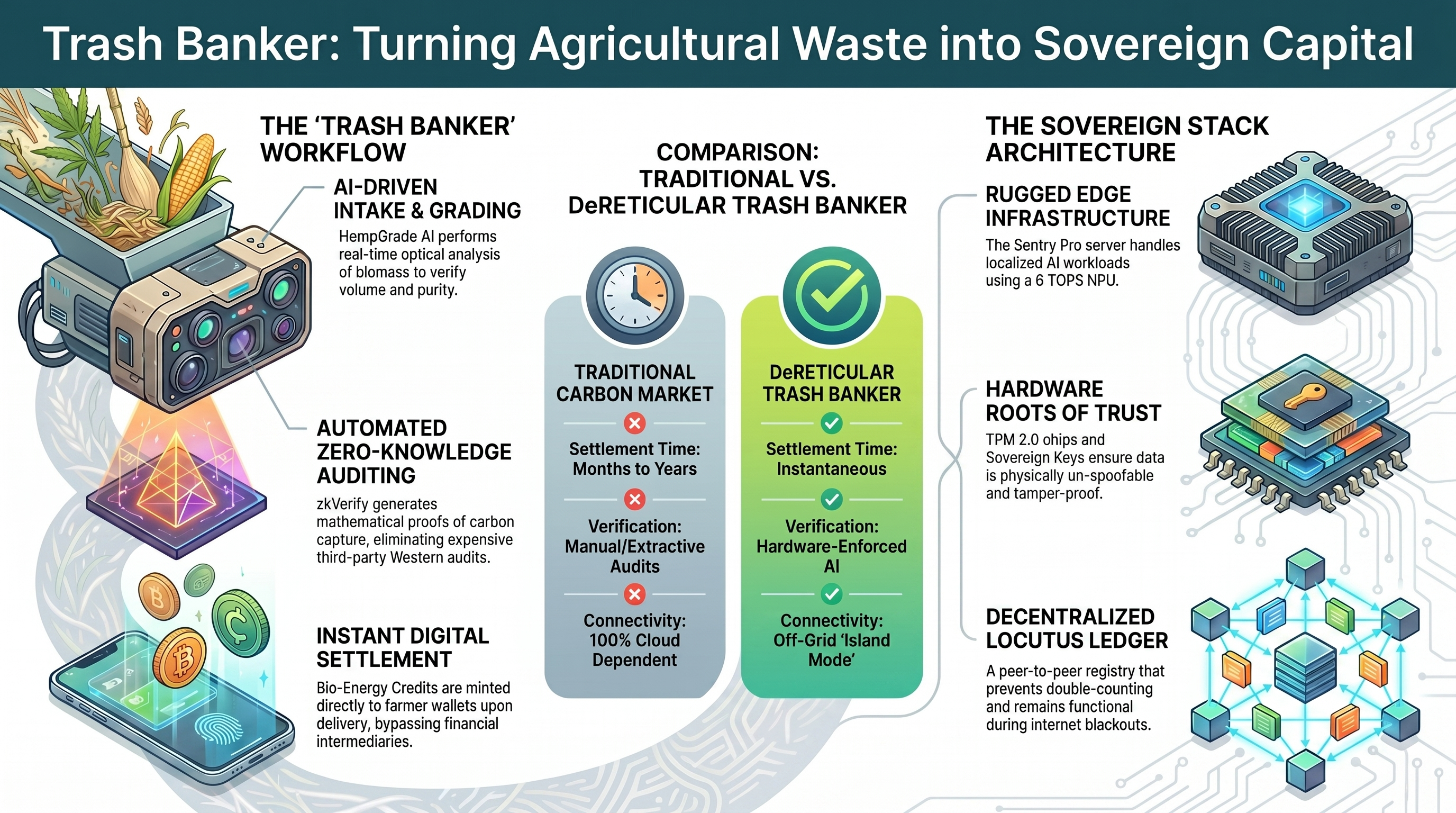
1. Introduction: The Concept of “Dead Capital”
In the current global economic landscape, rural smallholders are trapped in a state of “Dead Capital.” This term, synthesized from the failure of traditional finance, identifies assets—specifically agricultural residues like hemp stalks and corn stover—that possess high carbon-sequestration value but zero financial liquidity. In rural Uganda or the Amazon Basin, this biomass is a liability that rots, releasing methane, because two systemic barriers block its monetization:
video
- The Collateral Barrier: Commercial banks refuse to recognize decomposing crop waste as valid collateral, demanding formal land titles that many smallholders lack.
- Extractive Auditing Costs: Legacy carbon markets require manual, retrospective audits by Western firms. These overheads frequently consume 30% to 40% of project margins, ensuring that climate finance never reaches the actual stewards of the land.
The “Trash Banker” model, engineered by DeReticular, replaces these extractive dependencies with Spherical Resilience—a decentralized infrastructure that scans, values, and converts waste into sovereign digital assets at the point of origin.
| Feature | Traditional Banking (Exclusionary) | DeReticular Trash Banker (Sovereign) |
| View of Biomass | Worthless rotting waste/methane source. | High-density, carbon-rich sovereign asset. |
| Collateral Requirement | Formal land titles or fiat reserves. | The physical biomass (Hard Physical Attestation). |
| Verification | Subjective, slow manual audits. | Automated Edge-AI and zkVerify proofs. |
| Asset Liquidity | Multi-year “trickle-down” aid. | Instant Bio-Energy Credits via P2P Mesh. |
The transition from the economic theory of dead capital to physical wealth begins at the edge of the industrial frontier, where the Sovereign Stack bypasses the linear failures of centralized grids.
2. Step One: The Physical Entry — Arrival at Node 4
The lifecycle manifests at Project Umoja (Node 4) in Kaabong, Uganda. This carbon-negative industrial park functions in “Island Mode,” operating entirely independently of the fragile national electricity grid. This is made possible by the Sovereign Stack, a three-pillar industrial architecture where each component is technically interdependent:
- The Muscle (Agra Dot Energy): The industrial core featuring advanced Plasma Gasifiers. It performs waste-to-energy conversion to provide the 24/7 baseload power required to run the site’s Sentry nodes and recharge the autonomous logistics fleet.
- The Motion (Kurb Kars): A fleet of autonomous logistics vehicles that handle material movement, ensuring feedstock is delivered to the intake hopper without human error or fossil-fuel dependency.
- The Mind (DeReticular RIOS): The Rural Infrastructure Operating System. This AI-native environment manages the energy load and orchestrates the OpenClaw agents that govern the intake.
As a farmer delivers a cart of hemp hurd to the hopper, they are not merely disposing of waste; they are interfacing with a high-integrity intake system that functions as a “Digital Airlock,” isolating raw sensor telemetry from the vulnerabilities of the public cloud.
3. Step Two: The Intelligence Layer — AI Evaluation and Grading
As biomass enters the hopper, it is analyzed by the Industrial Foreman AI and HempGrade AI. This intelligence layer resides on the DR-SENTRY-PRO-CDR-INT, a hardened industrial node. Unlike generic IoT devices, this Sentry Pro utilizes a Rockchip RK3588 Octa-core SoC with an integrated 6 TOPS NPU.
Equipped with 32GB of LPDDR4x RAM, the system performs Edge Inference on quantized 8B parameter models (Llama 3). This allows the system to execute complex reasoning locally, maintaining operational capacity during internet blackouts. The AI performs three critical layers of verification:
- Purity Verification: Optical sensors classify botanical structures to distinguish approved sustainable feedstocks from restricted virgin hardwoods or contaminants like plastics and stones.
- Moisture & Caloric Evaluation: The NPU computes the real-time surface-area-to-volume ratio and moisture content to calculate the exact dry-matter mass and energy potential.
- Volume Calculation: Spatial vision algorithms determine the precise cubic volume, translating physical bulk into a standardized digital metric for the ledger.
Once the biomass is graded and understood by the local AI, the resulting data must be anchored in a cryptographic framework that precludes any possibility of fraud.
4. Step Three: The Cryptographic Anchor — Building the “Carbon Oracle”
To eliminate human auditing, the system functions as a trustless Carbon Oracle. This is achieved by combining hardware roots of trust with zero-knowledge cryptography to generate an unalterable record of sequestration.
- TPM 2.0 (Hardware Root of Trust): The Sentry Pro’s dual TPM 2.0 chips sign the RIOS kernel and AI model weights. If a bad actor attempts to modify the HempGrade AI to “fake” biomass volumes, the hardware automatically locks its cryptographic keys.
- The Sovereign Key (Proof of Presence): The operator must utilize a physical DR-BADGE-IPLC-SEC token. The system verifies their presence using Direct ADC Sampling, fingerprinting the unique RF transient of the badge’s hardware to prevent Sybil attacks or virtual node spoofing.
- zkVerify: The system compiles the sensor data into a Zero-Knowledge Proof (ZKP). This mathematically proves the carbon was processed without exposing proprietary industrial telemetry to external registries.
This protocol utilizes the TPM 2.0 to sign the OS kernel, ensuring a “sterilized” path from raw camera feeds to the final data payload. It generates a Quality Certificate—a Hard Physical Attestation—which is committed to the Locutus Ledger via WebAssembly (Wasm) contracts. This ensures the data is immune to the DNS poisoning or administrative corruption common in centralized cloud registries.
Once the Carbon Oracle has secured the data, the system initiates the final settlement of value directly to the producer.
5. Step Four: Instant Liquidity — Settlement and Utility
The Trash Banker settles the transaction by bypassing predatory financial intermediaries. The RIOS platform instantly mints Bio-Energy Credits (utility tokens) anchored directly to the physical energy output of the plasma gasifier.
Transactions move via the TriFi Mesh, a local off-grid network using Isotonic Regression routing to optimize data propagation across high-latency peer-to-peer links. To ensure network integrity, the Sentry node uses RF Fingerprinting to authenticate every device on the mesh. These minted credits provide four immediate local utilities:
- Power: Direct exchange for 24/7 carbon-negative electricity generated on-site.
- Water: Access to clean water filtration systems managed by Node 4.
- Fertilizer: Credits can be redeemed for biochar and organic fertilizer, the physical byproducts of the gasification process.
- Regional Currency: The tokens serve as a stable, local medium of exchange for goods and services within the TriFi Mesh ecosystem.
This journey from the field to the digital wallet represents a complete cycle of value recovery, transforming a rotting liability into a foundation for regional self-reliance.
6. Conclusion: From Aid to Sovereignty
The Trash Banker lifecycle represents a strategic pivot from “colonial-style philanthropy” to Sovereign Assets. While traditional models rely on Legacy Avoidance Credits—often trading at <$5/tonne due to soft baselines—the DeReticular model generates High-Integrity Removals that meet the rigorous standards of Article 6 of the Paris Agreement and CORSIA.
In the wake of the U.S. 2025-2026 Regulatory Schism—marked by the “One Big Beautiful Bill” Act (OBBBA) rolling back federal tax credits and the EPA’s rescission of the Endangerment Finding—sovereign cryptographic systems provide the only viable bridge to global compliance markets. By replacing human auditors with mathematical certainty, we ensure that the value of climate stewardship remains with the communities who perform the work.
| Dimension | Traditional VCM Carbon Projects | DeReticular Trash Banker |
| Financial Settlement | Months/Years; dependent on brokers. | Instantaneous via Wasm-driven P2P settlement. |
| Verification Auditing | Extractive, manual Western audits. | Automated zkVerify (Zero-Knowledge) proofs. |
| Asset Class Definition | Volatile “Avoidance” Credits (<$5/t). | High-Integrity Removals (22–220+/t). |
| Community Agency | Passive recipients of corporate aid. | Active owners of Sovereign Infrastructure. |
This process bridges the gap between local climate stewardship and global carbon finance, proving that a sovereign system can transform the “trash” of the old world into the “bank” of the new.