
Enterprise Security & Regulatory Compliance Framework for Zero-Knowledge Spatial Verification Systems
- Executive Context & Systemic Threat Landscape
Establishing unforgeable, physics-grounded spatial trust represents a foundational imperative for modern digital finance, decentralized physical infrastructure, and autonomous mesh networks. As financial transactions, machine commerce, and regulatory compliance workflows migrate to distributed architectures, asserting physical presence in real time without relying on centralized or client-reported intermediaries becomes critical. Legacy spatial models treat target devices as self-contained coordinate resolvers, asking client software to collect and report its own location data. In institutional environments, this target-resolved paradigm introduces severe structural vulnerabilities, enabling adversaries to manipulate spatial state for financial gain, regulatory evasion, or network exploitation.
Within the broader architecture of the Sovereign Infrastructure Consortium (SIC) 5-layer stack, DeReticular operates specifically as the Layer 3 (Mesh Communications & Prime Authority) engine, providing the cryptographic and spatial trust foundations that interface between Layer 1 baseload power generation, Layer 2 kinetic mobility, Layer 4 SCADA/cognitive intelligence, and Layer 5 governance rails. Grounding spatial verification within this multi-layered framework reveals why client-side location assertions fail under systemic stress. The structural vulnerability of any client-reported location mechanism can be formalized under Noel’s Law of Structural Vulnerability:
\mathcal{V}{\text{system}} = \kappa \cdot \prod{i=1}^n \left( \frac{\mathcal{L}i}{\lambda_i} \right)^{\alpha_i} \cdot \exp\left( \sum{j=1}^m \delta_j \right)
where \mathcal{L}_i represents the effective spatial or logical length of the dependency line (e.g., kilometers of signal transit or network routing hops to remote satellites or cloud servers), \lambda_i is the characteristic attenuation constant of the medium, \alpha_i \ge 1 is the hyper-coupling factor of cascading failure across interdependent networks, and \delta_j \ge 0 is the sovereignty deficit coefficient reflecting external administrative or vendor control. As dependency line lengths grow (\mathcal{L}_i \to \infty), the structural vulnerability of client-resolved positioning scales exponentially, rendering traditional location reporting inherently fragile.
Deconstructing Client-Side Positioning Vulnerabilities
Client-reported spatial mechanisms rely on unauthenticated external broadcasts or operating system APIs, making them susceptible to adversarial manipulation. The table below systematically evaluates the primary failure modes across modern positioning mechanisms:
Positioning Mechanism Primary Adversarial Exploitation Vector Impact on Spatial Trust Integrity
Global Navigation Satellite Systems (GNSS/GPS) Low-cost Software-Defined Radio (SDR) RF injection (e.g., HackRF) broadcasting synthetic satellite ephemeris signals at power levels overriding authentic downlinks (typically -130\text{ dBm} to -160\text{ dBm}). Complete spatial displacement. Adversaries can arbitrarily set receiver coordinates, altitude, and velocity, allowing remote actors to bypass location gates or falsify physical coverage.
Terrestrial Cellular & Wi-Fi Multilateration User-injected BSSID beacon frame forgery, software-defined cell tower emulation, operating system-level beacon injection, and commercial residential proxy/VPN routing. Trivial position spoofing. Systems relying on observed network IDs or IP geolocation accept spoofed terrestrial footprints, invalidating regional geofencing and sanctions enforcement.
OS-Level Mocking & Kernel Exploits API memory injection via developer hooks, jailbroken operating system kernels, virtualized runtime environments, and hooked sensor abstraction layers. Sensor layer bypass. Software applications receive synthetic coordinate vectors generated directly inside memory, completely decoupling application state from physical radio reality.
Institutional KYC/AML Structural Inefficiencies
Modern identity verification and regulatory compliance frameworks—enforced under Financial Action Task Force (FATF) standards, US Bank Secrecy Act/FinCEN regulations, European Anti-Money Laundering Directives (AMLD 5/6), and Office of Foreign Assets Control (OFAC) mandates—suffer from systemic operational and economic friction:
- Financial Burden: Legacy identity providers, credit bureaus, and human review operations impose variable fees ranging from $2.00 to $5.00 for automated document OCR and facial liveness checks, and up to $15.00 to $35.00+ for enhanced due diligence (EDD) and manual verification.
- Temporal Decay: A utility bill or government ID verification provides static, point-in-time validation. It offers zero visibility into a user’s location at the point of a high-value financial transaction, failing to prevent transactions originating from sanctioned jurisdictions post-onboarding.
- Privacy Liabilities & Centralized Honeypots: Archiving sensitive identity documents, tax identification numbers, and residential utility bills creates centralized data honeypots, exposing institutions to severe regulatory fines under the General Data Protection Regulation (GDPR Article 4(1)) and California Consumer Privacy Act (CCPA) upon data breach.
- Vulnerability to Synthetic AI Forgery: Real-time deepfake video injection and generative document forgery engines render traditional document-and-selfie checks obsolete, allowing malicious actors to scale identity fraud programmatically.
The Paradigm Inversion Thesis
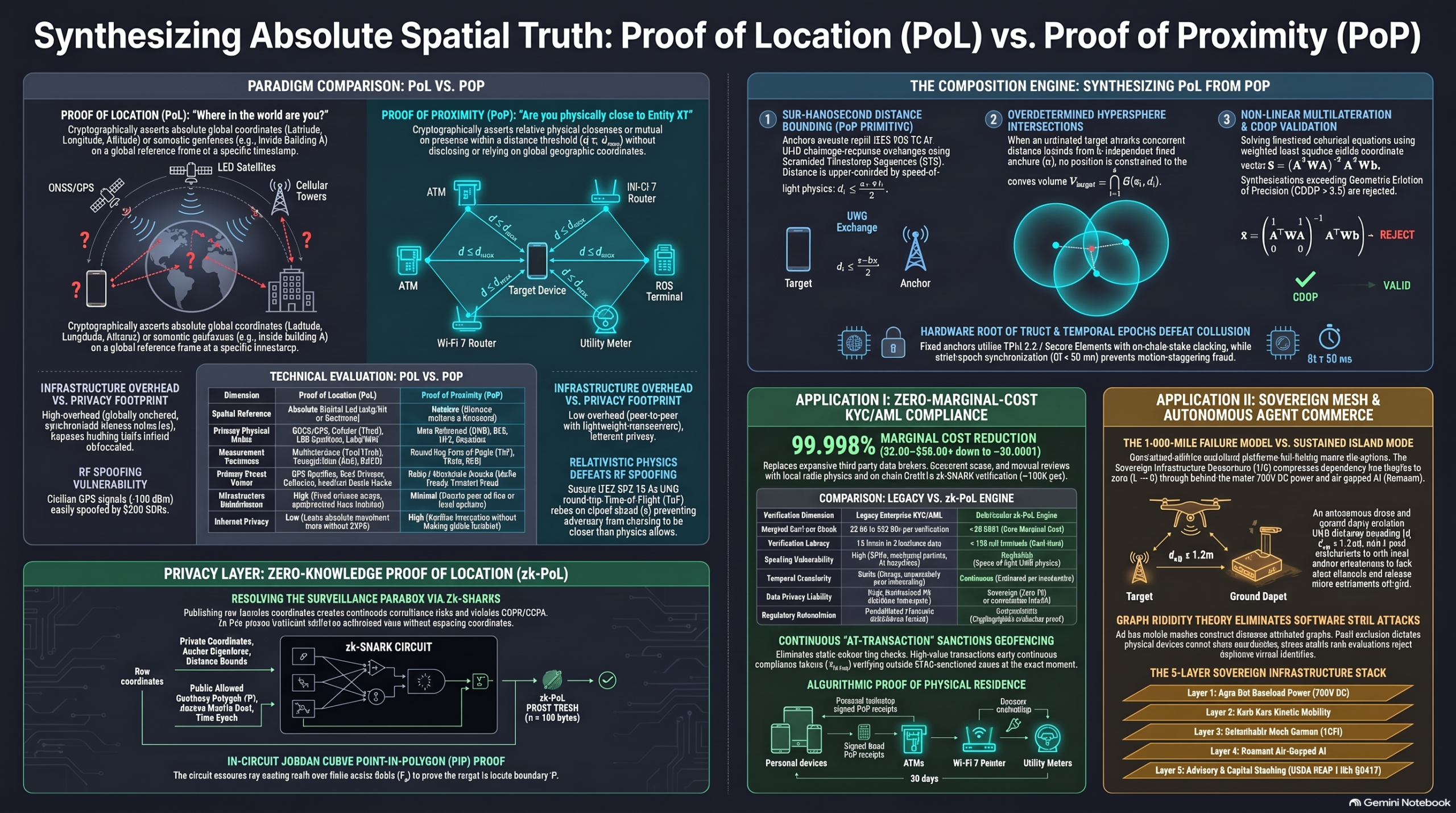
To solve the systemic vulnerabilities of client-reported location, the DeReticular architecture executes a paradigm inversion: Proof of Location (PoL) and Proof of Proximity (PoP) are not disjoint or competing models. Rather, Proof of Proximity is the fundamental atomic physical primitive from which secure, spoof-resistant Proof of Location is synthesized.
By delegating global coordinate awareness entirely to an infrastructure perimeter of authenticated, geographically surveyed anchors, untrusted client targets remain lightweight and agnostic of their own global position. Spatial truth is derived not from target claims, but by measuring relativistic physical invariants across an overdetermined anchor perimeter.
While target-resolved positioning relies on unauthenticated client assertions, grounding spatial integrity in physical reality requires moving from software-reported coordinates to relativistic distance bounding at the radio frequency layer.
- Physical & Cryptographic Mitigation Architecture
Cryptographic identity claims and digital signatures are fundamentally insecure when asserting spatial presence unless grounded in relativistic physical invariants. An adversary possessing valid cryptographic keys can easily transmit signing payloads across transcontinental networks or virtual tunnels. To anchor digital assertions to physical space, the system must enforce physical-layer measurement techniques where the laws of special relativity bound spatial claims.
Mathematical Formulation of Relativistic Distance Bounding
The security of atomic distance bounding relies on the constant propagation speed of electromagnetic radiation in free space: c \approx 299,792,458 \text{ meters per second} \quad (\approx 0.3 \text{ meters per nanosecond})
Let an authenticated verifier anchor be positioned at certified coordinates \mathbf{s}i \in \mathbb{R}^3, and an untrusted prover target be located at \mathbf{x} \in \mathbb{R}^3. The true geometric distance between them is d_i = |\mathbf{x} – \mathbf{s}i|2. During a physical challenge-response exchange, the verifier emits a challenge bit sequence at time t_0, which arrives at the prover at t{\text{arr}}. The prover processes the challenge over internal hardware latency t{\text{proc}} and emits a response at t{\text{resp}}, returning to the verifier at timestamp t_1.
The measured Round-Trip Time-of-Flight (ToF) duration is: \Delta t_i = (t_1 – t_0) – t_{\text{proc}}
The verifier establishes an unforgeable physical upper bound on distance: \hat{d}_i \le \frac{c \cdot \Delta t_i}{2}
Proof of the Speed-of-Light Invariant (Impossibility of Distance Reduction)
An adversary cannot make its apparent distance to an anchor appear shorter than its physical separation without predicting challenge bits before they arrive.
The earliest time a physical challenge signal reaches an adversary at distance d is t_{\text{arr}} = t_0 + \frac{d}{c}. Even assuming an optimal adversary with zero internal processing delay (t_{\text{proc}} = 0), the earliest valid response transmission time is t_{\text{resp}} = t_{\text{arr}}, arriving at the verifier at t_1 = t_0 + \frac{2d}{c}.
To claim a reduced distance \tilde{d} < d, the adversary must ensure its response arrives at time \tilde{t}1 = t_0 + \frac{2\tilde{d}}{c} < t_1. This requires emitting a response at: \tilde{t}{\text{resp}} = \tilde{t}1 – \frac{d}{c} = t_0 + \frac{2\tilde{d} – d}{c} < t_0 + \frac{d}{c} = t{\text{arr}}
Because \tilde{t}{\text{resp}} < t{\text{arr}}, the adversary must transmit its response prior to observing the incoming challenge. If the challenge bitstream C consists of m uniformly random bits with entropy H(C) = m, the probability of guessing the response without observation is: P(\text{Success}) = 2^{-m}
For m \ge 128, P(\text{Success}) \le 2^{-128} \approx 2.93 \times 10^{-39}, which is cryptographically negligible. Physical distance cannot be artificially reduced.
   VERIFIER / ANCHOR (s_i)                           PROVER / TARGET (x)
 [Certified Root of Trust]                               [Untrusted]
             |                                                |
             | -------- Phase 1: Cryptographic Setup -------> |
             |          (Payload, Session Nonce N_v)          |
             |                                                |
             | <------- Phase 2: Prover Ephemeral Nonce ----- |
             |                    (N_p)                       |
             |                                                |
Timestamp t_0 | ======== Phase 3: Rapid Bit Exchange ========= |
(Transmit STS) | ——– Cryptographic Challenge C ———-> |
| | Process
| | Delay
| | t_proc
Timestamp t_1 | <——- Physical-Layer Response R ———– |
(Receive STS) | |
| |
| ——– Phase 4: Verification & Signing —-> |
| Compute: \Delta t = t_1 – t_0 – t_proc|
| Bound: d_i <= (c * \Delta t) / 2 |
| Emit: PoP_i Attestation Receipt |
v v
Physical-Layer Radio Standards Comparison
Legacy proximity mechanisms relying on Bluetooth Low Energy (BLE) or Wi-Fi Received Signal Strength Indication (RSSI) fail against basic adversarial manipulation. RSSI models distance based on path loss equations: \text{RSSI}(d) = \text{RSSI}(d_0) – 10n \log_{10}\left(\frac{d}{d_0}\right) + X_\sigma
An adversary easily manipulates RSSI by deploying high-gain directional antennas, increasing power output, or utilizing low-noise RF amplifiers, making a device 100 meters away appear within centimeters.
To eliminate physical-layer manipulation, DeReticular standardizes on IEEE 802.15.4z Ultra-Wideband (UWB) across dedicated radio channels:
- Operating Frequencies & Channels: Utilizes UWB Channels 5 and 9 with center frequencies f_c = 6.4896\text{ GHz} and f_c = 7.9872\text{ GHz}, operating over RF bandwidths B \ge 499.2\text{ MHz}.
- Pulse Shaping & Timing Resolution: Employs Root-Raised Cosine (RRC) pulse shaping generating pulse durations \approx 2\text{ ns}. Coupled with hardware Time-to-Digital Converters (TDCs), the physical layer achieves timing resolution \le 15.65\text{ picoseconds}, resolving multipath reflections down to sub-centimeter spatial intervals.
- Scrambled Timestamp Sequence (STS): IEEE 802.15.4z integrates a cryptographically random binary pulse sequence directly into the physical RF frame. Governed by a CSPRNG keyed with ephemeral session key K_{\text{session}}, the STS prevents preamble injection, pulse-injection, and cycle-slip attacks at the PHY layer.
Distance-Bounding Protocol Lifecycle
The atomic Proof of Proximity exchange follows a four-phase lifecycle:
- Commitment & Nonce Exchange: Verifier anchor A_i generates random challenge nonce N_v \in_R {0,1}^{128}. Target T generates ephemeral key pair (sk_T, pk_T) and nonce N_p \in_R {0,1}^{128}. T transmits a signed commitment: \text{Com}T = \text{HMAC}{\text{SHA256}}(pk_T \parallel N_p, N_v).
- Rapid Hardware-Level Challenge-Response: Both nodes derive ephemeral session key K_{\text{session}} = \text{HKDF}(N_v \parallel N_p) and configure physical UWB STS baseband generators. A_i transmits m discrete challenge bits c_j \in C. Target T reflects response bits r_j = c_j \oplus k_j at the physical layer, where k_j is derived from K_{\text{session}}. High-precision hardware registers capture transmit and receive timestamps (t_{0,j}, t_{1,j}).
- Timestamp Recording: A_i computes the bounded distance metric: \hat{d}i = \frac{c}{2} \cdot \left( \frac{1}{m} \sum{j=1}^m (t_{1,j} – t_{0,j} – t_{\text{proc}}) \right)
- Signed Attestation Receipt Generation: A_i constructs and signs a Proof of Proximity receipt: \text{PoP}i = \left( \text{ID}{A_i}, \text{ID}T, \mathbf{s}i, \hat{d}i, t{\text{epoch}}, \sigma{A_i} \right) \sigma{A_i} = \text{Sign}{sk{A_i}}\Big( \mathcal{H}\big( \text{ID}_{A_i} \parallel \text{ID}_T \parallel \mathbf{s}_i \parallel \hat{d}i \parallel t{\text{epoch}} \parallel N_v \parallel N_p \big) \Big) where \mathcal{H} represents a Poseidon or BLAKE3 hash, and signing uses Ed25519 or secp256k1 keys.
Single-anchor distance bounding establishes a strictly local, relativistic radius around a single verifier; transforming these relative bounds into absolute global positioning requires synthesizing multiple concurrent distance constraints geometrically.
- Spatial Synthesis Engine: Composing PoP into Spoof-Resistant PoL
By aggregating multiple atomic distance-bounding receipts from an overdetermined set of geographically surveyed reference anchors, the spatial synthesis engine transforms localized relational constraints into an absolute global coordinate vector.
                   Anchor s_1 (x_1, y_1, z_1)
                               *
                             /   \
                            /     \  Radius d_1
                           /       \
                          /    *    \
  Anchor s_2             /  Target x \              Anchor s_3
(x_2, y_2, z_2) *-------+--- (x,y,z) -+-------*  (x_3, y_3, z_3)
                \     /               \     /
                 \   /  Intersection   \   /
                  \ /    Volume V_tgt   \ /
                   *                     *
                    \                   /
                     \                 /  Radius d_4
                      \               /
                               *
                   Anchor s_4 (x_4, y_4, z_4)
Formulating Non-Linear Multilateration
Each signed attestation \text{PoP}_i defines a closed Euclidean ball \mathcal{B}(\mathbf{s}_i, \hat{d}_i) = { \mathbf{x} \in \mathbb{R}^3 \mid |\mathbf{x} – \mathbf{s}_i|_2 \le \hat{d}_i } centered at anchor position \mathbf{s}_i. When the target T executes distance-bounding exchanges across k independent anchors within a synchronized temporal window, its physical position is constrained to the convex intersection volume:
\mathcal{V}{\text{target}} = \bigcap{i=1}^k \mathcal{B}(\mathbf{s}_i, \hat{d}_i)
To extract a deterministic coordinate estimate \mathbf{x} = [x, y, z]^T, we expand the non-linear spherical equations for each anchor i \in {1, \dots, k}: (x – x_i)^2 + (y – y_i)^2 + (z – z_i)^2 = \hat{d}_i^2
Expanding the quadratic terms yields: (x^2 + y^2 + z^2) – 2x_i x – 2y_i y – 2z_i z + (x_i^2 + y_i^2 + z_i^2) = \hat{d}_i^2 |\mathbf{x}|^2 – 2\mathbf{s}_i^T\mathbf{x} + r_i^2 = \hat{d}_i^2 \quad \text{where } r_i^2 = |\mathbf{s}_i|^2 = x_i^2 + y_i^2 + z_i^2
To eliminate the non-linear target norm term |\mathbf{x}|^2 = x^2 + y^2 + z^2, we subtract the reference equation for anchor 1 (|\mathbf{x}|^2 – 2\mathbf{s}_1^T\mathbf{x} + r_1^2 = \hat{d}_1^2) from the equation for anchor i: \left( |\mathbf{x}|^2 – 2\mathbf{s}_i^T\mathbf{x} + r_i^2 \right) – \left( |\mathbf{x}|^2 – 2\mathbf{s}_1^T\mathbf{x} + r_1^2 \right) = \hat{d}_i^2 – \hat{d}_1^2
The quadratic norm |\mathbf{x}|^2 cancels out completely: -2\mathbf{s}_i^T\mathbf{x} + 2\mathbf{s}_1^T\mathbf{x} + r_i^2 – r_1^2 = \hat{d}_i^2 – \hat{d}_1^2 2(\mathbf{s}_i – \mathbf{s}_1)^T\mathbf{x} = (\hat{d}_1^2 – \hat{d}_i^2) + (r_i^2 – r_1^2)
Expanding this scalar equation into explicit coordinate components gives: 2(x_i – x_1)x + 2(y_i – y_1)y + 2(z_i – z_1)z = (\hat{d}_1^2 – \hat{d}_i^2) + (r_i^2 – r_1^2)
Stacking these k-1 linear equations for i = 2, \dots, k yields the matrix system \mathbf{A} \mathbf{x} = \mathbf{b}: \mathbf{A} = 2 \begin{bmatrix} x_2 – x_1 & y_2 – y_1 & z_2 – z_1 \ x_3 – x_1 & y_3 – y_1 & z_3 – z_1 \ \vdots & \vdots & \vdots \ x_k – x_1 & y_k – y_1 & z_k – z_1 \end{bmatrix}, \quad \mathbf{b} = \begin{bmatrix} (\hat{d}_1^2 – \hat{d}_2^2) + (r_2^2 – r_1^2) \ (\hat{d}_1^2 – \hat{d}_3^2) + (r_3^2 – r_1^2) \ \vdots \ (\hat{d}_1^2 – \hat{d}_k^2) + (r_k^2 – r_1^2) \end{bmatrix}
Using the Moore-Penrose pseudoinverse, the weighted least-squares solution resolves to: \hat{\mathbf{x}} = (\mathbf{A}^T \mathbf{W} \mathbf{A})^{-1} \mathbf{A}^T \mathbf{W} \mathbf{b} where \mathbf{W} = \text{diag}(\sigma_1^{-2}, \sigma_2^{-2}, \dots, \sigma_k^{-2}) represents the inverse-variance covariance matrix of anchor ranging errors.
Dimensionality & Geometric Dilution of Precision (GDOP)
System solvability mandates structural geometric requirements:
- Planar Resolution (2D): Requires k \ge 3 non-collinear anchors (\text{rank}(\mathbf{A}) = 2).
- Volumetric Resolution (3D): Requires k \ge 4 non-coplanar anchors (\text{rank}(\mathbf{A}) = 3).
Anchor geometry directly affects spatial accuracy. Defining unit direction vectors \mathbf{u}_i = \frac{\hat{\mathbf{x}} – \mathbf{s}_i}{|\hat{\mathbf{x}} – \mathbf{s}_i|_2}, the design matrix \mathbf{H} and covariance tensor \mathbf{Q} are: \mathbf{H} = \begin{bmatrix} \mathbf{u}_1^T & 1 \ \mathbf{u}_2^T & 1 \ \vdots & \vdots \ \mathbf{u}_k^T & 1 \end{bmatrix}, \quad \mathbf{Q} = (\mathbf{H}^T \mathbf{H})^{-1}
Geometric Dilution of Precision is derived via the trace of \mathbf{Q}: \text{GDOP} = \sqrt{\text{Tr}(\mathbf{Q})} = \sqrt{\sigma_x^2 + \sigma_y^2 + \sigma_z^2 + \sigma_t^2}
Synthesized spatial proofs yielding \text{GDOP} > 3.5 are automatically rejected to eliminate collinear anchor configurations that introduce positional ambiguity along unconstrained axes.
Anchor Trust Architecture & Temporal Synchronization
Anchor integrity is maintained through hardware security, cryptographic staking, and tight timekeeping:
- Hardware Root of Trust: Anchors operate dedicated STMicroelectronics Common Criteria EAL6+ Secure Elements or TPM 2.0 modules. Keys (sk_{A_i}) are generated internally and non-exportable. Physical enclosure breach activates continuous micro-fine mesh circuits that zeroize volatile key memory in < 10\text{ ns}.
- On-Chain Registry & Slashing: Anchors register coordinates \mathbf{s}_i on-chain and stake native collateral tokens. Signing conflicting, fraudulent, or physically impossible attestations triggers automated on-chain stake slashing via fraud proofs.
- Continuous Geodetic Self-Auditing: Anchors monitor physical stability via multi-frequency carrier-phase Real-Time Kinematic (RTK) GNSS. Any physical displacement exceeding \Delta \mathbf{s} > 5\text{ cm} revokes the anchor’s active signing certificate.
- Temporal Epoch Management: Time is partitioned into discrete validity epochs E_n = [n \cdot \Delta T, (n+1) \cdot \Delta T) with \Delta T \le 50\text{ ms}, synchronized across anchors via PTP (IEEE 1588). All constituent \text{PoP}_i receipts must share an identical epoch identifier: \text{epoch}(\text{PoP}_1) = \text{epoch}(\text{PoP}_2) = \dots = \text{epoch}(\text{PoP}_k) = E_n This window forces target interaction across anchors within 50\text{ ms}, preventing motion-staggering fraud where a target travels sequentially between distant anchors to forge intermediate location claims.
Even with ideal multi-anchor geometry and synchronized timekeeping, the synthesis engine must be explicitly evaluated against targeted adversarial physical attacks.
- Adversarial Threat Modeling & Security Invariants
Robust spatial verification requires defining adversarial capabilities under formal physical and cryptographic attack models.
- RELAY / WORMHOLE ATTACK (MAFIA FRAUD)
Target ———— High-Speed Optical Tunnel ————> Target Appears
(Sanctioned Zone) (Latency added >= d/c) (Valid Zone)- DEFENSE: Speed of light adds delta t, violating ToF upper bound.
- TERRORIST FRAUD
Dishonest Prover — Shares Session Nonces —> Local Accomplice Node- DEFENSE: Ephemeral keys bound to long-term identity via secret sharing.
- SYBIL ANCHOR VIRTUALIZATION
Single Physical Node Emulates Multiple Virtual Anchors in Software- DEFENSE: TPM 2.0 Hardware Endorsement + On-Chain Inter-Anchor Cross-Auditing.
Dissecting Relay Fraud & Physical Countermeasures
Mafia Fraud (Relay Attacks)
An adversary deploys RF transceivers near an honest target in a remote location and tunnels physical-layer signals over high-speed fiber or RF links to an accomplice near an anchor array.
- Mitigation: Tunneling introduces physical propagation delay \tau_{\text{relay}} = \frac{D_{\text{tunnel}}}{v_{\text{medium}}} \ge \frac{D_{\text{tunnel}}}{c}. For a 300-meter tunnel, latency increases by \Delta t_{\text{relay}} = \frac{2 \cdot 300\text{ m}}{3 \times 10^8\text{ m/s}} = 2,000\text{ ns}. Sub-nanosecond UWB STS timing resolution detects this delay (\Delta t_{\text{measured}} \gg \Delta t_{\text{max}}), invalidating the relay exchange.
Terrorist Fraud
A dishonest target outside an authorized zone collaborates with a local accomplice inside the zone, sharing ephemeral credentials to pass distance bounding without disclosing its master private key.
- Mitigation: The protocol binds ephemeral challenge responses to the target’s long-term identity key sk_{\text{identity}} via algebraic secret sharing: k_j = sk_{\text{identity}} \cdot \mathcal{H}(N_v \parallel j) + N_p Providing an accomplice with real-time response capability (k_j) allows the accomplice to mathematically solve for and reconstruct sk_{\text{identity}}. Dishonest provers cannot assist accomplices without surrendering full control of their master key, funds, and on-chain identity.
Sybil Anchor Collusion & Virtualization
Adversaries may spin up virtualized anchor instances on a single machine to sign fraudulent spatial attestations.
- Hardware Endorsement Certificates: Public keys pk_{A_i} are bound to endorsement certificates burned into TPM 2.0 silicon during manufacturing.
- Inter-Anchor Spatial Cross-Auditing: Anchors continuously execute distance-bounding exchanges with neighboring anchors, publishing the measured inter-anchor matrix \mathbf{D}_{\text{matrix}}[i,j] = |\mathbf{s}_i – \mathbf{s}_j|_2 on-chain. If virtualized anchors claim distinct coordinates \mathbf{s}_i \neq \mathbf{s}j but exhibit zero internal propagation latency (\Delta t{ij} \approx 0), the anomaly triggers automated stake slashing.
Prove Distance Manipulation Asymmetry
Theorem 2: Impossibility of Multi-Anchor Coordinate Spoofing via Response Delay
An adversary cannot shift its resolved position to an arbitrary spoofed location \mathbf{x}{\text{spoofed}} \neq \mathbf{x}{\text{true}} purely by introducing positive transmission delays.
Proof: Let the target’s true position be \mathbf{x}{\text{true}} and the desired spoofed position be \mathbf{x}{\text{spoofed}}. For multi-anchor multilateration to yield \mathbf{x}_{\text{spoofed}}, every measured distance must satisfy: \hat{d}i = |\mathbf{x}{\text{spoofed}} – \mathbf{s}_i|_2, \quad \forall i \in {1, \dots, k}
Because physical signals cannot travel faster than light, an adversary can only add delay (\delta_i \ge 0), making distances appear larger: \hat{d}i \ge d{i, \text{true}} = |\mathbf{x}_{\text{true}} – \mathbf{s}_i|_2, \quad \forall i \in {1, \dots, k}
Combining these constraints requires: |\mathbf{x}_{\text{spoofed}} – \mathbf{s}_i|2 \ge |\mathbf{x}{\text{true}} – \mathbf{s}_i|_2, \quad \forall i \in {1, \dots, k}
This condition requires \mathbf{x}{\text{spoofed}} to be simultaneously farther away from every anchor than \mathbf{x}{\text{true}}. When anchors form a convex hull surrounding \mathbf{x}{\text{true}}, no displacement vector \mathbf{v} = \mathbf{x}{\text{spoofed}} – \mathbf{x}{\text{true}} can increase Euclidean distances to all anchors simultaneously. By the separating hyperplane theorem, there exists at least one anchor A_m in the directional half-space of \mathbf{v} where: \nabla{\mathbf{v}} |\mathbf{x} – \mathbf{s}_m|2 < 0 \implies |\mathbf{x}{\text{spoofed}} – \mathbf{s}_m|2 < |\mathbf{x}{\text{true}} – \mathbf{s}_m|_2
Matching \mathbf{x}{\text{spoofed}} at anchor A_m requires negative delay (\delta_m < 0), violating causality. The resulting sphere intersection set is empty (\mathcal{V}{\text{target}} = \bigcap_{i=1}^k \mathcal{B}(\mathbf{s}_i, \hat{d}_i) = \emptyset), multilateration fails to converge, and proof generation is aborted. \blacksquare
Enterprise Threat Matrix
Threat Vector Adversarial Mechanism Physical/Cryptographic Defense System Security Invariant
GNSS/GPS Spoofing High-gain SDR broadcasting synthetic satellite ephemeris (>-130\text{ dBm}). Inversion Paradigm: Absolute positioning is delegated to anchored ground perimeters. Target position is derived from local UWB ToF, ignoring satellite signals.
Mafia Fraud (Relay) Fiber/RF tunneling of physical signals between remote target and local anchor. Sub-nanosecond IEEE 802.15.4z UWB STS Time-of-Flight timestamping. \tau_{\text{relay}} \ge \frac{D_{\text{tunnel}}}{c} introduces detectable ToF delay; invalidates proof.
Terrorist Fraud Prover shares ephemeral session credentials with local accomplice node. Ephemeral responses bound to sk_{\text{identity}} via algebraic secret sharing. Sharing execution capability exposes long-term master identity key to accomplice.
Sybil Anchor Virtualization Software emulation of multiple anchor nodes on single hardware platform. TPM 2.0 Silicon Endorsement + On-chain inter-anchor distance cross-auditing matrix. \Delta t_{ij} \approx 0 for claimed \mathbf{s}_i \neq \mathbf{s}_j triggers automated stake slashing.
Motion-Staggering Fraud Target collects sequentially signed PoPs across distant anchors at different times. Epoch-bounded validity windows (\Delta T \le 50\text{ ms}) synchronized via PTP (IEEE 1588). All constituent PoP receipts must share an identical epoch identifier (E_n).
While spatial synthesis and threat modeling establish unforgeable coordinate vectors, broadcasting raw coordinates creates corporate surveillance risks and violates consumer privacy laws.
- Zero-Knowledge Privacy Architecture (zk-PoL)
Asserting raw spatial coordinates produces sensitive metadata trails, leaking operational logistics and violating data privacy mandates such as Article 4(1) of the GDPR (which classifies raw location data as protected Personal Data). Zero-knowledge cryptography resolves this “Surveillance Paradox” by allowing a prover to demonstrate that its multilaterated coordinates satisfy regulatory geofencing boundaries without revealing exact location coordinates or anchor identities.
PRIVATE WITNESSES (Secret to Prover)
- Target Absolute Coordinates: x = (x, y, z)
- Anchor Positions: {s_1, s_2, …, s_k}
- Distance Bounds: {d_1, d_2, …, d_k}
- Anchor Signatures: {\sigma_1, \sigma_2, …, \sigma_k}
|
v
+———————————————————————–+
| ARITHMETIC CIRCUIT CONSTRAINTS (R1CS) |
| |
| 1. Merkle Membership Proof: |
| Verify(Root_R, Hash(pk_A_i), Path_i) == 1 |
| |
| 2. Anchor Signature Verification: |
| VerifySig(pk_A_i, \sigma_i, Hash(x, d_i, Epoch)) == 1 |
| |
| 3. Relational Distance Bounding: |
| ||x – s_i||^2 <= d_i^2, \forall i \in {1…k} |
| |
| 4. Point-in-Polygon (Jordan Curve Ray-Casting): |
| RayCast(x, Polygon_P) == 1 (Inside Approved Region) |
+———————————————————————–+
|
v
PUBLIC INPUTS
- Epoch Identifier: E_n
- Anchor Registry Merkle Root: Root_R
- Allowed Geofence Polygon: Polygon_P
OUTPUT: Succinct Proof \pi (130-384 bytes, O(1) Verification)
Specifying Arithmetic Circuit Constraints (R1CS Formulation)
The zero-knowledge Proof of Location pipeline converts physical attestations into Rank-1 Constraint System (R1CS) arithmetic circuits.
Circuit Witness & Instance Definitions
- Private Witness Inputs (\mathbf{w}):
- Target coordinate vector: \mathbf{x} = [x, y, z]^T \in \mathbb{F}_p^3.
- Anchor position vectors: \mathbf{s}_i = [x_i, y_i, z_i]^T \in \mathbb{F}_p^3, \quad \forall i \in {1, \dots, k}.
- Measured distance limits: \hat{d}_i \in \mathbb{F}_p, \quad \forall i \in {1, \dots, k}.
- Anchor digital signatures: \sigma_i, \quad \forall i \in {1, \dots, k}.
- Merkle inclusion proof paths: \text{Path}_i, \quad \forall i \in {1, \dots, k}.
- Public Instance Inputs (\mathbf{x}_{\text{pub}}):
- Authorized geofence boundary polygon: \mathcal{P} = {\mathbf{v}_1, \mathbf{v}_2, \dots, \mathbf{v}_m} \subset \mathbb{F}_p^2.
- Anchor registry Merkle root: \mathcal{R}_{\text{anchors}} \in \mathbb{F}_p.
- Active temporal epoch: E_n \in \mathbb{F}_p.
In-Circuit Constraint Logic
- Anchor Key Inclusion: Enforces that each anchor public key pk_{A_i} is a verified member of the active anchor registry: \text{MerkleVerify}\left( \mathcal{R}{\text{anchors}}, ; \mathcal{H}{\text{poseidon}}(pk_{A_i}), ; \text{Path}_i \right) == 1, \quad \forall i \in {1, \dots, k}
- Anchor Signature Validation: Verifies anchor signatures over Poseidon-hashed distance and epoch claims: \text{EdDSAVerify}\Big( pk_{A_i}, ; \sigma_i, ; \mathcal{H}_{\text{poseidon}}(\mathbf{s}_i \parallel \hat{d}_i \parallel E_n) \Big) == 1, \quad \forall i \in {1, \dots, k}
- Euclidean Distance Checks: Enforces relational physical distance bounds over field \mathbb{F}_p: \Delta x_i = x – x_i, \quad \Delta y_i = y – y_i, \quad \Delta z_i = z – z_i (\Delta x_i \cdot \Delta x_i) + (\Delta y_i \cdot \Delta y_i) + (\Delta z_i \cdot \Delta z_i) = D_i D_i + \text{Slack}_i = \hat{d}_i^2 \quad \text{where } \text{Slack}_i \in [0, 2^{32}] \text{ enforces range-decomposition}
- Point-in-Polygon (PiP) Containment: Evaluates 2D target projection \mathbf{x}{\text{proj}} = (x, y) inside polygon \mathcal{P} via an in-circuit ray-casting algorithm based on the Jordan Curve Theorem. To ensure complete loop closure, edge segments connect consecutive vertices with cyclic boundary wrap-around (\mathbf{v}{m+1} \equiv \mathbf{v}1 \pmod m): \text{Inside}(\mathbf{x}{\text{proj}}, \mathcal{P}) = \bigoplus_{j=1}^m \text{EdgeIntersect}\Big( (x, y), \mathbf{v}j, \mathbf{v}{(j \bmod m) + 1} \Big) == 1 \text{EdgeIntersect} \iff \Big( (y_j > y) \neq (y_{j+1} > y) \Big) \land \left( x < \frac{(x_{j+1} – x_j)(y – y_j)}{y_{j+1} – y_j} + x_j \right)
Succinct Proof Tokens & Verification Complexity
The circuit yields a succinct proof token \pi_{\text{zk-PoL}} = (\mathbf{A} \in \mathbb{G}_1, \mathbf{B} \in \mathbb{G}_2, \mathbf{C} \in \mathbb{G}_1) under Groth16, or equivalent polynomial commitments under Halo2. Proof size is \approx 130\text{ bytes} for Groth16 and \approx 4\text{–}8\text{ KB} for Halo2.
Verification evaluates a bilinear pairing equation over BN254 or BLS12-381 elliptic curves: e(\mathbf{A}, \mathbf{B}) = e(\alpha, \beta) + e\left( \sum_{i=0}^l x_{\text{pub}, i} \cdot \gamma_i, ; \delta \right) + e(\mathbf{C}, \delta)
Verifier complexity is O(1), executing in < 3\text{ ms} on standard CPUs or consuming \approx 150,000\text{ gas} on Ethereum Virtual Machine (EVM) execution layers, regardless of polygon vertex count m or anchor count k.
Recursive Proving via Nova Folding (IVC)
Accumulating continuous spatial attestations (e.g., proving 30-day residency across 720 hourly checks) inside a monolithic zk-SNARK generates tens of millions of constraints, exceeding mobile device RAM limits. DeReticular implements Incrementally Verifiable Computation (IVC) using the Nova folding scheme over a cycle of pairing-friendly curves (Pasta cycle: Pallas and Vesta).
Nova defines an augmented step function \mathbb{F}{\text{step}}(z_i, \omega_i) \to z{i+1} that folds step i’s execution into a running relaxed R1CS accumulator Acc_i without generating full SNARK proofs at each step.
Step i-1 Step i Step i+1
+———–+ +———–+ +———–+
| Folded | | New PoP | | New Folded|
| Instance | | Receipt | | Instance |
| Acc_i-1 | ———–> | PoP_i | ————–> | Acc_i |
+———–+ +———–+ +———–+
\ / /
\ / /
v v v
+———————————-+
| STEP VERIFICATION CIRCUIT |
| * Validate Anchor Sig: \sigma_i |
| * Verify Epoch: t_i \in E_i |
| * Assert: ||x_i – s_i|| <= d_i |
| * Check Polygon: x_i \in Poly_J |
+———————————-+
|
v
Produces Single Compact Proof (\pi) at Step N
Verifiable in O(1) Time on Settlement Layer
The public state vector z_i tracks continuous coordinate commitments across step transitions: z_i = \left( i, ; \text{AccTime}{\text{inside}}, ; \mathcal{H}{\text{state}}(\mathbf{x}i), ; \mathcal{R}{\text{anchors}}, ; E_i \right) where \mathcal{H}_{\text{state}}(\mathbf{x}i) represents the running Poseidon state commitment tracking spatial coordinate history over time. Edge devices fold hourly distance attestations locally, consuming micro-joules of energy, and emit a single compact proof \pi{\text{residency}} at the end of the 30-day period.
Transforming zero-knowledge spatial proofs into automated institutional compliance requires integrating these succinct verification tokens directly into enterprise transaction settlement rails.
- Institutional Compliance Engine: Continuous Zero-Marginal-Cost KYC/AML
The zk-PoL architecture converts regulatory compliance from a high-variable-cost operational tax into a continuous, zero-marginal-cost cryptographic invariant embedded at the transaction layer.
LEGACY KYC/AML: $2.00 – $35.00+ per check, Stale, Invasive
[User] –> [Upload Passport & Utility Bill] –> [Human / Third-Party SaaS]
|
Cost: $15.00; Latency: 24-72 Hours
Storage: Centralized PII Honeypot
DERETICULAR zk-PoL: $0.0001 per check, Real-Time, Zero PII Exposure$0.0001); Latency: <100ms
[Target Device] <— UWB Distance Bounding —> [Ambient Anchors]
| (ATMs, Wi-Fi 7, PoS)
| Compile Private Witness
v
[zk-SNARK Circuit] —> Outputs: Proof \pi (130 bytes)
|
+————-> [DeFi Protocol / Bank Settlement Rail]
Cost: O(1) Gas (
Privacy: Zero PII or Location Metadata Stored
Deriving Economic Cost Reduction Mechanics
Let total compliance expenditure C(Q) over transaction volume Q be modeled as: C_{\text{legacy}}(Q) = \text{CapEx}{\text{IT}} + Q \cdot \left( C{\text{vendor}} + C_{\text{review}} + C_{\text{storage}} + C_{\text{breach_risk}} \right) where legacy vendor queries (C_{\text{vendor}}) cost $1.50\text{–}$5.00 and manual reviews (C_{\text{review}}) cost $5.00\text{–}$30.00.
Under DeReticular’s zk-PoL engine: C_{\text{DeReticular}}(Q) = \text{CapEx}{\text{anchor}} + Q \cdot \left( C{\text{compute}} + C_{\text{verification}} \right)
By deploying anchor software across existing dual-use commercial footprints (ATMs, retail POS terminals, Wi-Fi 7 access points), initial anchor capital costs are amortized across pre-existing operations (\text{CapEx}_{\text{anchor}} \to 0).
Variable operational costs reduce to:
- C_{\text{compute}} \approx \text{Local client electricity for zk-proof generation} \approx 0.002\text{ mAh} \approx $0.0000004.
- C_{\text{verification}} \approx \text{EVM L2 gas cost for Groth16 pairing check} \approx 150,000\text{ gas} \times 0.05\text{ Gwei/gas} \approx $0.000075.
The marginal compliance verification cost evaluates to: MC = \frac{\partial C_{\text{DeReticular}}}{\partial Q} \approx $0.0001 \quad \text{per verification query}
By reducing marginal verification expenditure from variable SaaS service fees to deterministic O(1) on-chain gas execution (MC \approx $0.0001), the framework achieves a 99.998% operational cost compression.
At-Transaction Sanctions Geofencing Protocols
Rather than relying on static onboarding checks or easily bypassed IP proxies, transactions embed an ephemeral zk-PoL token directly within the payload: \text{Payload} = \left{ \text{TxBody}, \text{Amount}, \text{Recipient}, E_n, \pi_{\text{zk-PoL}} \right}
The EVM smart contract below illustrates programmatic, sub-second compliance settlement. To prevent mempool front-running and proof replay attacks, the contract explicitly binds nullifier directly inside the publicInputs array passed to the zero-knowledge verifier circuit:
// SPDX-License-Identifier: MIT
pragma solidity ^0.8.24;
interface IZkVerifier {
function verifyProof(
bytes calldata proof,
uint256[4] calldata publicInputs
) external view returns (bool);
}
contract SanctionsComplianceSettlement {
IZkVerifier public immutable zkVerifier;
bytes32 public immutable compliantGeofencePolygonHash;
bytes32 public anchorRegistryRoot;
uint256 public constant EPOCH_THRESHOLD = 60; // 60 seconds max age
mapping(bytes32 => bool) public usedNullifiers;

event TransactionSettled(address indexed sender, uint256 amount);

constructor(address _verifier, bytes32 _polygonHash, bytes32 _anchorRoot) {
    zkVerifier = IZkVerifier(_verifier);
    compliantGeofencePolygonHash = _polygonHash;
    anchorRegistryRoot = _anchorRoot;
}

function executeCompliantTransaction(
    bytes calldata txBody,
    uint256 amount,
    uint256 epochTimestamp,
    bytes32 nullifier,
    bytes calldata zkProof
) external {
    // 1. Enforce temporal freshness
    require(block.timestamp - epochTimestamp < EPOCH_THRESHOLD, "Stale Spatial Proof");

    // 2. Prevent proof replay / mempool front-running attacks
    require(!usedNullifiers[nullifier], "Nullifier Already Spent");
    usedNullifiers[nullifier] = true;

    // 3. Formulate public inputs array including circuit-bound nullifier:
    // [Epoch, AnchorRoot, PolygonHash, Nullifier]
    uint256[4] memory publicInputs = [
        epochTimestamp,
        uint256(anchorRegistryRoot),
        uint256(compliantGeofencePolygonHash),
        uint256(nullifier)
    ];

    // 4. Verify zero-knowledge spatial proof in O(1) time
    bool isCompliant = zkVerifier.verifyProof(zkProof, publicInputs);
    require(isCompliant, "OFAC Sanctions / Geofence Non-Compliance Detected");

    // 5. Execute immediate settlement
    emit TransactionSettled(msg.sender, amount);
}
}
Algorithmic Proof of Residence vs. Static Document Verification
DeReticular replaces forgeable paper utility bills with passive spatial accumulation:
- Target devices collect signed \text{PoP}i receipts from local residential anchors (utility meters, transit hubs, domestic Wi-Fi 7 access points) over an observation window \tau{\text{residency}} = 30\text{ days}.
- The device generates an aggregate Nova folding proof \pi_{\text{residency}} proving that target position \mathbf{x}(t) resided within municipal district polygon \mathcal{P}_{\text{district}} for \ge 65% of nighttime hours (22:00–06:00).
- Institutions verify physical residence deterministically without acquiring or storing the user’s specific street address, unit number, or identity documents.
Institutional Comparative Matrix
Compliance Metric Legacy Enterprise KYC/AML DeReticular zk-PoL Engine Economic & Operational Impact Regulatory Determinism
Cost per Verification $2.00\text{–}$35.00+ per query \approx $0.0001 per query 99.998% operational cost compression Programmatic O(1) gas settlement
Verification Latency 12 hours to 5 business days < 150 \text{ milliseconds} Instant transaction clearance Sub-second deterministic execution
Spoof Resistance Vulnerable (VPNs, GPS Mocking, AI) Physics-Enforced (UWB STS ToF) Eliminates synthetic fraud vector Relativistic physical invariants
Temporal Granularity Static (Decays instantly post-check) Continuous (Transaction-time) Eliminates post-onboarding evasion Real-time geofence enforcement
Privacy Liability High (Centralized PII databases) Zero-Knowledge (Zero PII stored) Complete removal of GDPR/CCPA risk Cryptographic proof of inclusion
While enterprise financial rails utilize zk-PoL for regulatory geofencing, autonomous edge machines require spatial trust to execute off-grid commerce without relying on centralized cloud servers.
- Autonomous Edge Trust & Machine Commerce (A2A Mesh Topologies)
Autonomous Machine-to-Machine (M2M) and Agent-to-Agent (A2A) networks—such as delivery drones, utility EVs, robotic supply chain rovers, and edge compute nodes—frequently operate in off-grid, GPS-denied, or RF-contested environments. In these operational theaters, machines cannot query centralized Web2 identity providers (OAuth/PKI) or satellite positioning systems.
Formulating Ad-Hoc Spatial Trust Graphs
When autonomous machines encounter one another off-grid, they form unweighted, distance-attributed relational graphs \mathcal{G} = (\mathcal{V}, \mathcal{E}) where vertices represent agent radio transceivers and edges e_{ij} = (\Delta t_{ij}, \hat{d}_{ij}) represent measured UWB distance bounds.
                            [Anchor s_1]
                            /      \
                           /        \
                          /   d_1A   \
                         /            \
                    [Agent A] <======> [Agent B]
                         \    Mutual    /
                          \   PoP      /
                     d_2A  \  d_AB    / d_2B
                            \        /
                             \      /
                            [Anchor s_2]
To resolve global coordinates without external connectivity, agent swarms leverage Graph Rigidity Theory:
- Laman’s Theorem (2D Rigidity): A graph \mathcal{G} = (\mathcal{V}, \mathcal{E}) with |\mathcal{V}| = n vertices is minimally rigid in \mathbb{R}^2 if and only if |\mathcal{E}| = 2n – 3 and every subgraph \mathcal{G}’ = (\mathcal{V}’, \mathcal{E}’) satisfies |\mathcal{E}’| \le 2|\mathcal{V}’| – 3.
- 3D Rigidity Rank Condition: In \mathbb{R}^3, the stress matrix \mathbf{S} derived from the rigidity matrix \mathbf{R}(\mathcal{G}, \mathbf{p}) must satisfy \text{rank}(\mathbf{R}) = 3n – 6.
If an ad-hoc graph contains at least k \ge 4 non-coplanar anchored reference points with pre-certified coordinates, the spatial topology of the entire swarm collapses into absolute global coordinates.
Physical Sybil Suppression
In an ad-hoc mesh, a single malicious compute node could spin up virtual agent identities to manipulate resource auctions. However, because a single physical radio chassis occupies only one unique coordinate vector at time t, distance-attributed graphs enforce Physical Sybil Suppression: any virtual clones sharing identical ranging and bearing vectors (\mathbf{u}{i, A_1} \equiv \mathbf{u}{i, A_2}) are flagged as spatial anomalies and rejected.
Spatial Hash Time-Locked Contracts (S-HTLCs)
For machine commerce, value transfers must be locked to physical execution (e.g., verifying package handover before releasing payment). DeReticular specifies off-grid Spatial Hash Time-Locked Contracts (S-HTLCs):
  AUTONOMOUS DELIVERY DRONE                           GROUND CARGO DEPOT
         (Agent A)                                        (Agent B)
             |                                                |
             | <==== 1. Mutual UWB Proximity Challenge =====> |
             |       Derives Bound: d_AB <= 1.5 meters        |
             |                                                |
             | <---- 2. Request Multi-Anchor Witness Array -- |
             |                                                |
+————-+————————————————+——+
| 3. Mesh Anchors C, D concurrently ping Agents A & B via UWB: |
| Assert Absolute Global Bounding: {x_A, x_B} \in LoadingBay_Beta |
+————-+————————————————+——+
| |
| <—- 4. Mutually Sign Spatial Escrow Claim — |
| |
| ======= 5. Physical Handover of Cargo =======> |
| |
| <—- 6. Release Cryptographic Payment ——- |
| (State-Channel Micro-Settlement) |
v v
- Spatial Interlock: Delivery drone (\text{Agent } A) approaches automated cargo depot (\text{Agent } B). They execute mutual UWB distance bounding, confirming relative separation \hat{d}_{AB} \le 1.2\text{ meters}.
- Multi-Party Anchor Witnessing: Fixed depot anchors C and D ping both agents, generating signed attestations confirming co-location inside loading zone polygon \mathcal{V}_{\text{LoadingBay}}.
- Spatial Escrow Generation: Agent B generates an escrow release challenge binding payment to physical presence: \text{Challenge}{\text{escrow}} = \mathcal{H}\left( \text{InvoiceID} \parallel \text{PoP}{AB} \parallel \text{PoL}_{\text{LoadingBay}} \right)
- Physical Handover & Settlement: Drone A releases its mechanical latch, dropping cargo into the depot hopper. Sensors confirm physical weight and dimensions. Agent B signs an off-chain state-channel payment update: \text{PaymentReceipt} = \text{Sign}{sk_B}\left( \text{ChannelID} \parallel \text{Amount} \parallel \text{Challenge}{\text{escrow}} \right) The payment clears off-grid over peer-to-peer radio (BLE/Wi-Fi HaLow), deferring mainnet settlement until network connectivity is re-established.
Physical Anti-Tamper & Hardware Attestation Integration
To prevent physical key harvesting from captured autonomous units, distance-bounding transceivers integrate directly into the vehicle’s structural chassis via an embedded conductive micro-fine capacitive sensing layer. Mechanical penetration, chassis detachment, or physical enclosure breach triggers an immediate hardware interrupt line to the Secure Enclave, zeroizing volatile session key memory in < 10\text{ ns}.
Furthermore, public key certificates remain valid if and only if paired with a fresh physics-enforced proximity attestation emitted by authorized infrastructure anchors within \Delta T \le 30\text{ seconds}, isolating compromised edge units from the broader operational mesh.
To move from individual agent interactions to enterprise-scale deployment, these physical, cryptographic, and zero-knowledge primitives must be organized into a modular protocol stack.
- Protocol Architecture Stack & Enterprise Deployment Roadmap
The DeReticular framework is organized into a four-layer protocol stack, enabling modular integration across existing commercial software and hardware infrastructure.
+———————————————————————–+
| LAYER 4: SETTLEMENT & REGULATORY CONSENSUS |
| * EVM / Wasm Verifier Contracts * zk-KYC / OFAC Sanctions Engine |
| * State-Channel Micro-Payments * Anchor Staking & Slashing Core |
+———————————————————————–+
^
| Proof pi, Nullifier, Epoch Token
+———————————————————————–+
| LAYER 3: ZERO-KNOWLEDGE PROVING & SYNTHESIS |
| * Groth16 / Halo2 Circuit Compilers * Jordan Curve PiP Algorithms |
| * Multilateration Least-Squares Core * Non-Linear Covariance Solver |
+———————————————————————–+
^
| Aggregated Signed PoP Receipts
+———————————————————————–+
| LAYER 2: CRYPTOGRAPHIC ATTESTATION & dPKI |
| * Hardware Keystores (TPM / SE) * Ed25519 & BLS Signature Engines|
| * Ephemeral Session Key Derivations * Epoch Clock Synchronization |
+———————————————————————–+
^
| Sub-Nanosecond Timestamps (t_0, t_1)
+———————————————————————–+
| LAYER 1: PHYSICAL RADIO & DISTANCE BOUNDING |
| * IEEE 802.15.4z UWB Transceivers * Scrambled Timestamp Seq (STS) |
| * Dual-Use Wi-Fi 7 / 5G-Advanced PHY * High-Bandwidth RF Pulse Radar |
+———————————————————————–+
Deconstructing Layered Protocol Architecture
- Layer 1: Physical Radio & Distance Bounding: Standardizes low-level physical radio hardware (IEEE 802.15.4z UWB Channels 5/9, center frequencies 6.4896\text{ GHz} and 7.9872\text{ GHz}, bandwidth 499.2\text{ MHz}). Manages hardware time-to-digital converters achieving sub-15.65 picosecond timing resolution, Root-Raised Cosine pulse shaping, and physical-layer STS generation.
- Layer 2: Cryptographic Attestation & dPKI: Manages hardware keystores (TPM 2.0 / Secure Enclaves) burned with IEEE 802.1AR Secure Device Identifiers (DevID). Executes Ed25519 signing for edge client receipts and BLS12-381 signature aggregation for multi-anchor witness clusters. Enforces sub-microsecond time synchronization via PTP (IEEE 1588) across 50 ms validity epochs.
- Layer 3: Zero-Knowledge Proving & Synthesis: Executes least-squares non-linear multilateration, GDOP covariance tensor analysis, and client-side arithmetic circuit generation (Groth16/Halo2). Enforces Poseidon hashing, Euclidean distance range checks, Jordan Curve ray-casting with cyclic boundary conditions, and Nova IVC step folding.
- Layer 4: Settlement & Regulatory Consensus: Implements Solidity and Wasm verifier smart contracts across Layer-1 and Layer-2 blockchains. Handles on-chain anchor registry staking, automated fraud proof slashing, state-channel micro-settlements, and programmatic compliance hooks for banking gateways.
Dual-Use Infrastructure Retrofitting
Deploying dedicated physical anchor hardware globally would require substantial capital expenditure. Instead, DeReticular utilizes Dual-Use Infrastructure Retrofitting, converting existing commercial hardware footprints into certified anchors via certified firmware updates:
- Automated Teller Machines (ATMs) & Bank Branches: ATMs possess hardened physical security enclosures, uninterrupted power supplies, fiber uplinks, and certified geodetic addresses. Retrofitting ATMs with UWB transceivers creates high-security spatial anchors across urban centers.
- Retail Point-of-Sale (POS) Terminals: Modern POS devices (Square, Clover, Ingenico) incorporate NFC and BLE/UWB radios. Certified firmware running inside the terminal’s PCI-PTS secure processor enables POS devices to issue signed proximity attestations during checkout transactions.
- Enterprise Wi-Fi 7 Access Points: The IEEE 802.11az (Next Generation Positioning) standard integrates fine timing measurement into enterprise access points. Running the anchor daemon on enterprise access points monetizes existing Wi-Fi infrastructure as spatial validators.
- Smart Utility Meters: Electric and water meters have fixed, surveyed geodetic locations. Equipping smart meters with low-power Sub-GHz and UWB modules provides dense, residential anchor coverage across suburban districts.
Phased Deployment Roadmap
PHASE I (2026): FOUNDATIONAL PROTOCOL & STANDARDS
- Finalize IEEE 802.15.4z distance-bounding attestation formats.
- Deploy open-source Circom/Halo2 zk-PoL circuit repositories.
- Pilot with institutional partners for OFAC sanctions geofencing.
PHASE II (2027): ANCHOR FOOTPRINT BOOTSTRAPPING
- Roll out firmware integrations for retail POS systems and ATMs.
- Launch decentralized anchor staking, dPKI registry, and slashing engine.
- Implement automated zk-Proof of Residence across leading DeFi rails.
PHASE III (2028+): AUTONOMOUS AGENT COMMERCIAL EXPANSION
- Standardize off-grid A2A trust graphs for commercial drone corridors.
- Integrate zero-marginal-cost continuous compliance into cross-border
wholesale settlement systems (BIS, SWIFT, Central Bank Digital Rails). - Phase I: Protocol Standardization & Pilot Geofencing (2026): Finalize IEEE 802.15.4z attestation specifications, release open-source Circom and Halo2 circuit repositories, and deploy pilot implementations for programmatic OFAC sanctions geofencing with institutional banking partners.
- Phase II: Commercial Anchor Retrofitting & dPKI Staking (2027): Distribute certified firmware retrofits to retail POS networks and ATM arrays, deploy the on-chain dPKI anchor registry with stake-slashing mechanisms, and integrate zk-Proof of Residence across decentralized finance rails.
- Phase III: Autonomous A2A Integration & Global Regulatory Settlement (2028+): Standardize ad-hoc spatial trust graphs for commercial drone corridors and autonomous EV fleets, while embedding zero-marginal-cost continuous compliance into global wholesale cross-border settlement architectures.
Strategic Conclusion
Legacy spatial verification systems treat physical location as an unverified software assertion, exposing digital networks to low-cost RF spoofing, proxy tunneling, and regulatory fraud. DeReticular resolves this vulnerability by inverting the positioning paradigm: delegating spatial coordinate awareness entirely to an infrastructure perimeter of authenticated, geographically fixed anchors. By composing atomic, relativistic Proofs of Proximity governed by the speed of light into overdetermined non-linear multilateration systems, the framework derives unforgeable global location.
When coupled with zero-knowledge cryptography, this architecture transforms regulatory compliance from a high-variable-cost operational burden into a continuous, sub-second, zero-marginal-cost cryptographic invariant that protects user privacy. Furthermore, it provides autonomous edge agents with an off-grid mechanism to establish spatial trust, suppress physical Sybil attacks, and settle micro-transactions without cloud connectivity.
By unifying physical radio invariants with zero-knowledge proofs, DeReticular replaces client-reported location claims with mathematical certainty—establishing a secure, privacy-preserving foundation for spatial trust in digital finance and autonomous mesh networks.