
Economic Analysis: The Fiscal Shift from Linear Centralization to Spherical DePIN Resilience
1. The Economic Crisis of Linear Fragility
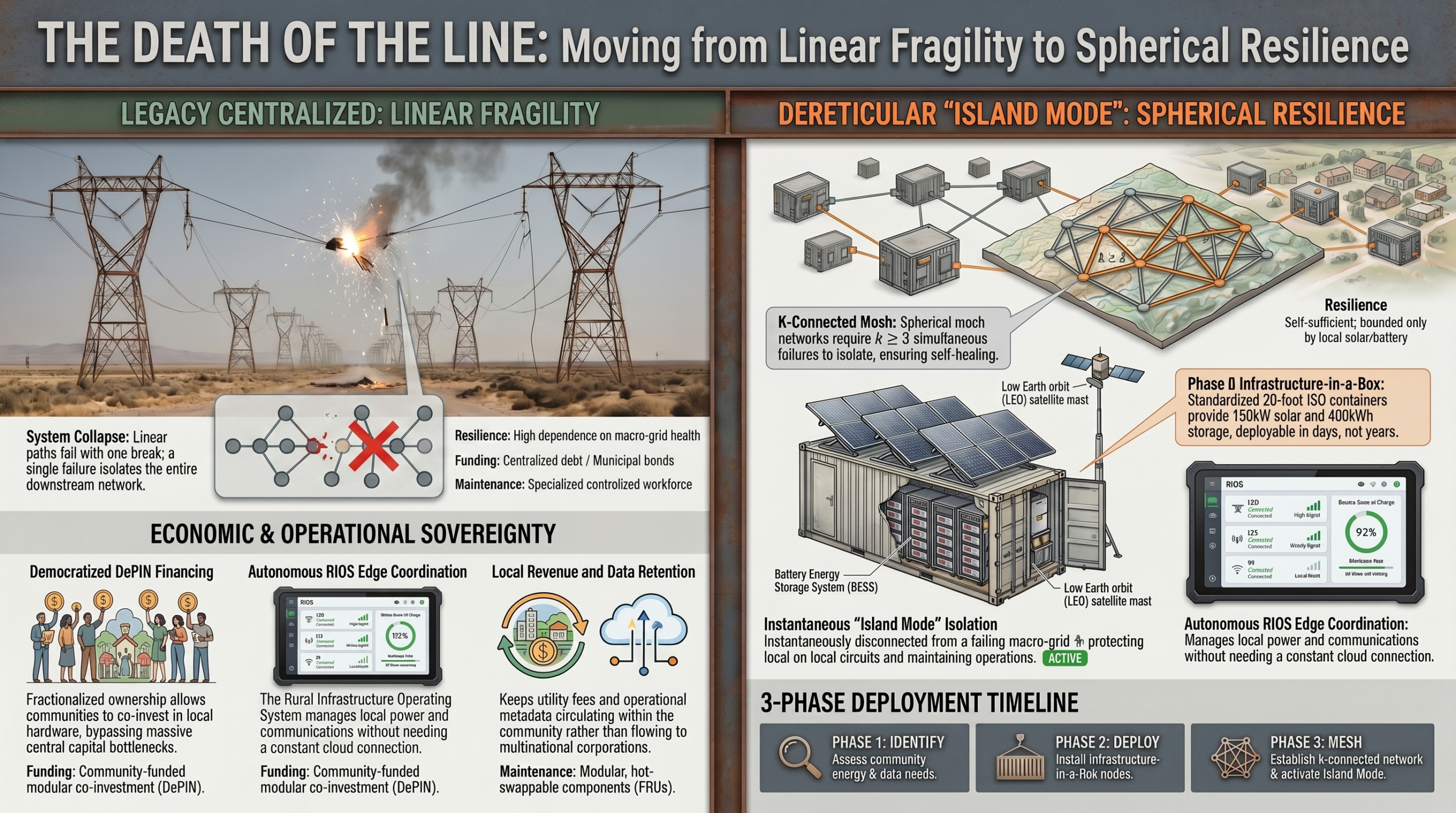
In the current era of volatile systemic disruptions, the historical reliance on linear infrastructure has transitioned from a strategic asset into a profound economic liability. “Linear Fragility” is defined as the fiscal vulnerability inherent in a design paradigm that prioritizes high-capacity, centralized corridors—such as high-voltage transmission lines and long-haul fiber-optic backbones—to deliver essential services. While this model was efficient during the 20th century, it creates single physical points of failure where a disruption at any single juncture cascades downstream, isolating entire regions and freezing economic activity.
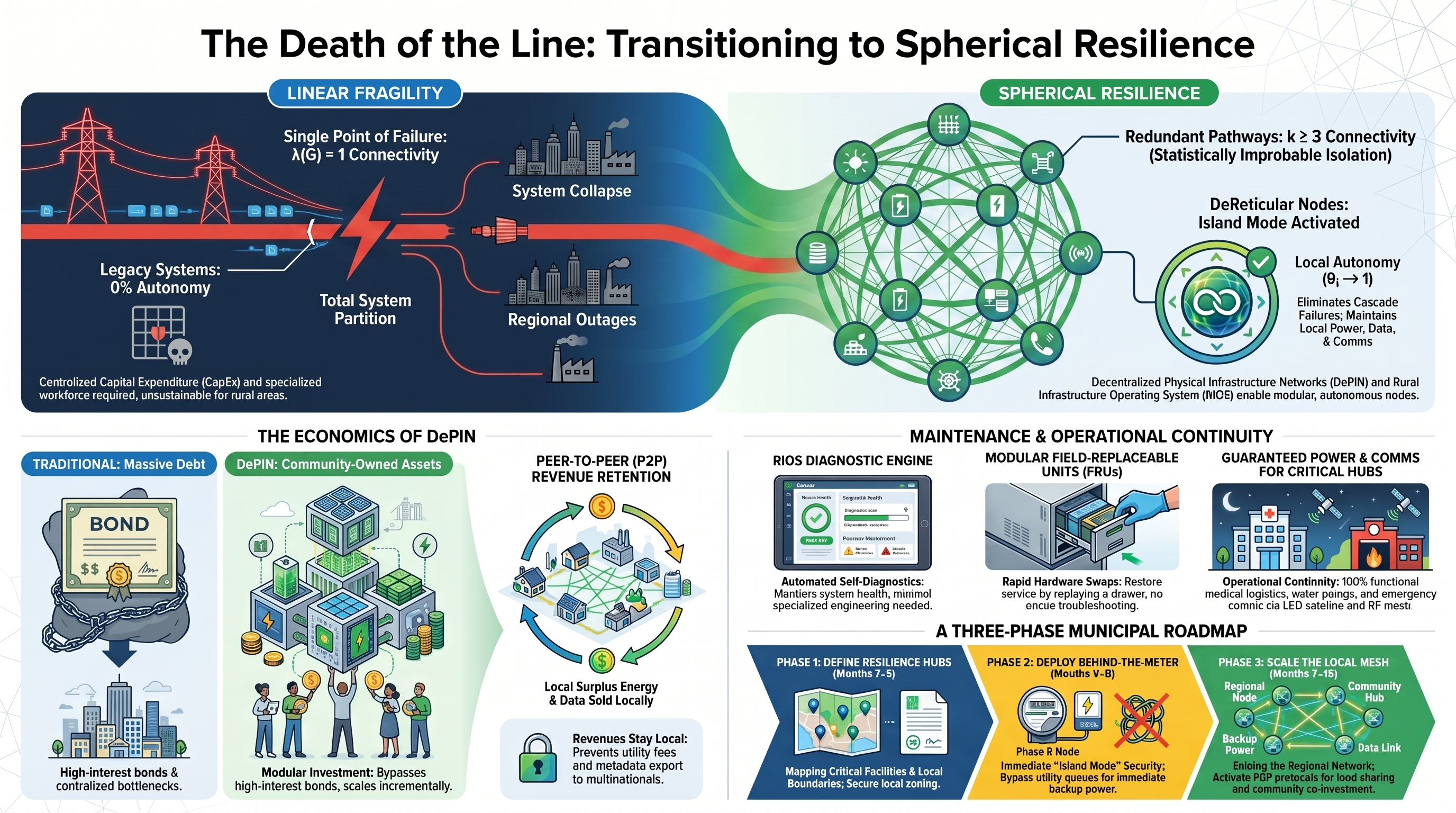
The “Problem of the Line” creates a binary state for regional economies: total connectivity or total system collapse. This fragility is no longer a theoretical risk; empirical insurance and utility data quantify the impact of outages at millions of dollars per day in lost productivity, stagnant emergency services, and supply chain paralysis. For municipal leaders, this necessitates a strategic shift toward “Spherical Resilience,” a model that replaces fragile lines with dense, multi-directional mesh networks. This transition is a fiscal imperative to bound non-linear risk and ensure the continuous preservation of a municipality’s credit rating and economic baseline during macro-grid failures.
podcast
2. Evaluating the Traditional CapEx Utility Model vs. DePIN-Driven MaaS
Traditional utility financing is currently hindered by a “Central Planning Bottleneck” that systematically disadvantages rural and low-density regions. Because centralized models require massive, upfront capital concentration and multi-decade amortization schedules, investment is funneled toward high-density urban centers to maximize return-on-investment (ROI). This leaves rural areas with aging infrastructure and rising insurance premiums due to systemic unreliability.
The following table contrasts the legacy fiscal model with the emerging modular paradigm:
| Dimension | Traditional Centralized Utility Model | DePIN-Driven Microgrid-as-a-Service (MaaS) |
| Capital Source | Sovereign debt, municipal bonds, or hyperscale CapEx. | Community-funded, fractionalized private investment (DePIN). |
| Deployment Speed | Years (due to design, permitting, and studies). | Weeks (via standardized, modular Phase 0 nodes). |
| Scaling Logic | Linear/Hyperscale (requires massive central scale). | Modular/Distributed (scales by adding adjacent nodes). |
| Revenue Destination | Multinational corporations or distant state capitals. | Localized; kept within the regional community/co-op. |
The shift from massive, bond-funded CapEx to modular, community-funded assets via Microgrid-as-a-Service (MaaS) eliminates fiscal paralysis for municipal leaders. By utilizing Decentralized Physical Infrastructure Networks (DePIN), communities can secure risk-adjusted ROI through modular scaling rather than waiting for federal grants that may never arrive. This financial model effectively reduces emergency response liabilities and preserves local economic productivity, providing a tangible link between resilient hardware and municipal fiscal health.
video
3. ‘Phase 0’ Deployment: Modular ROI and Infrastructure-in-a-Box
The “Phase 0” deployment footprint represents a strategic bypass of the regulatory and fiscal barriers that often stall traditional infrastructure. By focusing on modular, self-contained units, municipalities can establish an immediate operational presence and begin the amortization of assets without the multi-year study queues required for massive grid-tied installations.
This deployment is anchored by the “Infrastructure-in-a-Box,” a standardized ISO 20-foot High-Cube shipping container. Key specifications include:
- Power Generation: 150kW deployable bifacial solar arrays.
- Energy Storage: 400kWh Lithium Iron Phosphate (LiFePO4) Battery Energy Storage System (BESS).
- Reliability Support: 30kW hydrogen-ready auxiliary thermal generator for multi-week low-solar events.
- Orchestration: Integrated RIOS (Rural Infrastructure Operating System) for autonomous industrial control.
This modularity enables a “Leapfrog Dynamic” in developing or rural regions. Much like these areas bypassed landline telecommunications for mobile technology, they can now skip the debt-heavy process of building centralized grids. By adopting modular nodes, regions move directly to sovereign, autonomous infrastructure, securing energy and data needs while avoiding the structural vulnerabilities of legacy systems.
4. Mathematical Resilience Proofs: ROI Through Risk Bounding
Modern economic risk assessment in infrastructure requires the application of graph theory to quantify failure probabilities. Traditional utility networks follow a linear or tree topology where edge connectivity (k) is equal to 1. In such a system, the probability of a systemic partition (P_partition) under a random link failure rate p is calculated as:
P_partition = 1 – (1 – p)^|E|
As the network scale grows (|E| to infinity), the probability of failure approaches 100%. Conversely, Spherical Resilience utilizes a k-connected mesh (k >= 3). The probability of isolation for any single node (P_isolation) is reduced to the product of the failure rates of its independent paths:
P_isolation = p1 * p2 * … * pk
where pj is the failure probability of the j-th independent ingress/egress path. The strategic advantage is realized through “Island Mode.” In legacy networks, the autonomy factor of a node (theta_i) is effectively 0 because it cannot function without external synchronization. DeReticular architecture allows theta_i to approach 1. Mathematically, as the autonomy factor approaches 1, the cascade failure probability (P_cascade) approaches zero. For an economic architect, this means setting theta_i to 1 eliminates external dependencies, preserving municipal economic productivity and retaining community revenue even during a total macro-grid collapse.
5. Localized Sovereignty: Data and Energy Revenue Retention
A critical failing of the current centralized model is the erosion of “Infrastructure Sovereignty,” where utility fees and valuable metadata are exported to multinational entities. This results in a continuous drain of economic value from regional borders.
The “DePIN Economic Cycle” reverses this flow by leveraging local investors and cooperatives to fractionalize ownership of physical nodes. RIOS (Rural Infrastructure Operating System) serves as the “fiscal clearinghouse” and auditor for this decentralized ledger. It manages localized sovereignty through:
- P2P Trading: Surplus energy and compute cycles are traded within the regional mesh, keeping value local.
- Signal Fusion: RIOS allows for “disconnected operation,” ensuring localized databases and governance remain functional without external internet connectivity.
This transformation allows communities to define their own operational rules and economic priorities. By using RIOS as the auditor of the decentralized ledger, the software ensures that the infrastructure remains an asset owned and controlled by the community, rather than a service they perpetually rent from distant providers.
6. Gap Analysis and Strategic Transition Roadmap
To move from “Legacy Baselines” to “Spherical Resilience,” a pragmatic roadmap is required to navigate current structural and regulatory deficits. This roadmap prioritizes immediate “Island Mode” security while managing the interoperability friction with legacy SCADA systems.
Actionable Transition Roadmap:
- Phase 1: Define Resilience Hubs: Mapping critical facilities (water pumps, communication towers, emergency shelters) to identify high-impact node locations.
- Phase 2: BTM Phase 0 Deployment: Installing “Behind-the-Meter” (BTM) nodes at facility service points to bypass multi-year interconnection queues and establish immediate resiliency.
- Phase 3: Mesh Scaling: Activating peer-to-peer (P2P) integration and connecting adjacent nodes to form a fully k-connected network.
This strategy utilizes the BTM approach as a bridge to immediate resiliency while waiting for policy modernization, such as California’s AB2175 or the Colorado Microgrid Roadmap. These frameworks are increasingly exempting localized microgrids from the restrictive “electrical corporation” classifications that have historically protected utility monopolies.
7. Strategic SWOT Analysis for Municipal Planners
For regional commissioners and infrastructure economists, evaluating the shift to autonomous systems requires a balanced view of non-linear risk and market dynamics.
Strengths & Opportunities
- Edge-Autonomy: Transitioning to k >= 3 connectivity eliminates single points of failure.
- DePIN Financing: Crowdsourced capital lowers the entry barrier for critical projects.
- Federal Alignment: Federal and regional grants are increasingly targeted at microgrids and rural data sovereignty.
Weaknesses & Threats
- Localized Unit Costs: Distributed nodes carry a higher per-kW cost compared to hyperscale plants.
- Technical Skill Gaps: Rural regions lack specialized engineering personnel for advanced BESS maintenance.
- Utility Monopoly Litigation: Monopolies may use legal challenges to limit local independence.
- Physical Security: Remote, unattended zones face threats from vandalism or theft.
- Supply Chain Volatility: Geopolitical friction affects the availability of LFP battery cells.
Mitigation Framework: DeReticular’s “Infrastructure-in-a-Box” addresses these threats through a modular design. To solve the technical skill gap, the system uses “Field Replaceable Units” (FRUs), shifting the maintenance burden from complex troubleshooting to simple, hot-swappable hardware replacement. To mitigate supply chain risks, the chassis is engineered to be chemistry-agnostic, allowing for future integration of sodium-ion batteries. Finally, physical security is addressed through an 8-gauge corten steel shell and integrated optical/thermal cameras linked to the RIOS monitoring suite.
8. Final Assessment: The Future of Autonomous Economic Ecosystems
The fiscal argument for the shift from linear centralization to Spherical Resilience is conclusive. The foundational technologies required for this shift—Linux, Edge AI, Mesh Networking, and commodity hardware—are mature and deployable today. We are no longer waiting for a technological breakthrough; we are waiting for a shift in organizational coordination.
The final “So What?” for municipal leaders is clear: the organizations and regions that successfully solve the “coordination and governance layers” will become the foundational players in the next generation of autonomous economic ecosystems. By decoupling critical services from the fragile macro-grid, municipalities transform from vulnerable endpoints into resilient, self-sustaining islands of economic productivity, securing their energy, communications, and long-term fiscal future.