
Disruption on Route 66: How MCI and Equal Access Shattered the Ma Bell Monopoly
- The Empire of Ma Bell: Telecommunications Under Central Control
In the early 1960s, American telecommunications existed under the near-total control of a single corporate entity: the American Telephone and Telegraph Company (AT&T), affectionately and colloquially known as “Ma Bell.” Through the vast Bell System, AT&T controlled more than 80% of local telephone lines across the United States and maintained a virtual 100% monopoly over the nation’s long-distance network.
This market dominance was legally protected. Under the Communications Act of 1934, AT&T operated as a naturally sanctioned monopoly. The company’s core defense of its monopoly rested on the concept of end-to-end technical network integrity. AT&T asserted that maintaining unified, single-entity control over every piece of hardware—from ocean-crossing trunk cables down to the physical telephone handsets inside private homes—was technically required to prevent network instability and service disruption.
When third-party competitors attempted to enter the market, AT&T aggressively defended its territory before federal regulators. The corporate titan argued that outside entrants were engaging in “cream-skimming”—selectively building high-margin, high-density commercial routes while ignoring unprofitable regions. Under AT&T’s rate-averaging pricing model, long-distance calls on high-volume commercial corridors were deliberately priced far above cost. These excess revenues directly funded internal cross-subsidies that artificially lowered monthly residential connection fees, keeping local and rural telephone service affordable for average American households. AT&T warned regulators that permitting competitors to siphon off lucrative long-distance traffic would destroy this delicate subsidization framework and force local rates to skyrocket.
While AT&T successfully utilized this regulatory protection to maintain absolute market dominance for decades, its seamless control was soon challenged by a small, practical business problem emerging along Route 66.
- The Route 66 Catalyst: Jack Goeken and the Microwave Solution
In 1963, John D. “Jack” Goeken, a two-way radio salesman operating out of Joliet, Illinois, encountered an operational bottleneck that AT&T refused to address.
- The Problem: Commercial long-haul trucking fleets moving freight between Chicago and St. Louis needed reliable, low-cost dispatch communication with their drivers on the road. Mobile two-way radio signals had a limited operational range of only 30 to 50 miles. AT&T’s point-to-point leased telephone lines were far too expensive for small fleet owners, and AT&T flatly refused to permit third-party two-way radio systems to interconnect with local Bell System landlines.
- The Invention: In December 1963, Goeken founded Microwave Communications, Inc. (MCI). His solution bypassed physical copper wires entirely: build a chain of low-power microwave relay towers along 250 miles of U.S. Highway 66 (Route 66) between Chicago and St. Louis. Trucking companies could position a radio base station near a tower, transmit voice signals via microwave frequencies from tower to tower across the prairie, and maintain long-distance fleet communications at a fraction of AT&T’s leased-line rates.
- The Regulatory Hurdle: Goeken applied to the Federal Communications Commission (FCC) for microwave radio construction permits in December 1963. AT&T, joined by its regional operating subsidiaries Illinois Bell and Southwestern Bell, mounted a fierce legal defense, tying the application up in bureaucratic delays for six years. It was not until 1969 that the FCC issued its landmark MCI Decision (Docket 16509), narrowly granting MCI permission to build its experimental private microwave link by a 4-to-3 vote.
Goeken’s legal battle established a pivotal historical synthesis: microwave spectrum proved that physical copper wire was no longer the sole viable medium for long-haul voice transmission, demonstrating that an alternative frequency could bypass AT&T’s wireline monopoly entirely. However, while Goeken proved the concept along a single highway corridor, MCI still lacked the capital and nationwide legal architecture needed to survive AT&T’s relentless corporate counterattacks.
While Goeken won the right to erect towers, MCI required strategic, legal, and financial aggression to survive AT&T’s retaliation.
- Scaling the Fight: Bill McGowan and the Execunet Breakthrough
In 1968, Jack Goeken met William “Bill” McGowan, a venture capitalist and consultant holding an engineering degree and a Harvard MBA. McGowan realized that Goeken’s Route 66 microwave loop was not merely a niche regional service for trucking fleets, but a strategic blueprint for unbundling the entire Bell System.
McGowan assumed corporate leadership of MCI and systematically reorganized the business:
Corporate Restructuring: McGowan raised fresh venture capital, established 16 regional MCI affiliates to construct microwave links nationwide, and merged them into the MCI Communications Corporation in 1972.
Legal-First Strategy: Recognizing that regulatory bodies and courtrooms were the primary operational battlegrounds, McGowan famously summarized MCI’s lean structure by describing the company as:
“A law firm with an antenna on the roof.”
The Execunet Breakthrough (1975–1978): MCI was initially restricted by regulators to selling dedicated “private line” services—leased point-to-point links between two specific corporate offices. In 1975, MCI disrupted this model by launching Execunet, a shared-switch service. Rather than limiting customers to dedicated corporate links, Execunet converted MCI’s private microwave network into a dynamically routed system. Any subscriber could dial a local phone number, connect to MCI’s microwave switches, and route a call to any telephone connected to the public switched network in another city. This placed MCI in direct competition with AT&T’s core long-distance product, Message Telecommunications Service (MTS).
When the FCC attempted to shut Execunet down at AT&T’s request, MCI counter-sued in federal court. In a series of rulings between 1977 and 1978, the U.S. Court of Appeals for the D.C. Circuit ruled decisively in MCI’s favor, legally forcing AT&T to grant MCI local exchange interconnections for Execunet calls.
Winning the legal right to connect to the network, however, did not guarantee a fair user experience, leading to intentional operational sabotage by AT&T at the last mile.
- The Friction Layer: Two-Stage Dialing vs. Direct Dialing
Even with court orders mandating interconnection, AT&T retained absolute ownership of the physical copper lines running into American homes and businesses—the “last mile.” AT&T weaponized this physical control by imposing severe operational friction and asymmetric technical access on MCI’s customers, creating a starkly unequal playing field.
Operational Feature Comparison: AT&T Native Service vs. MCI Competitor Friction
Dialing Method AT&T: “1+” Direct Dialing requiring only 7 to 11 digits (1 + Area Code + Number).
MCI: Two-Stage Dialing requiring up to 24 digits total (local 7-digit access number + second dial tone + 5 to 7 digit security PIN + 10-digit destination number).
Phone Compatibility AT&T: Native compatibility across all standard telephone sets (Rotary and Touch-Tone).
MCI: Required Touch-Tone (DTMF) capability to transmit authorization PINs; completely useless on standard rotary dial sets without purchasing an external acoustic tone generator.
Audio Quality & Signaling AT&T: High-quality 4-wire trunk interconnections with direct network signaling.
MCI: Routed through inferior local line-side connections (Feature Group A), resulting in severe line noise, lower audio volume, and delayed call setups.
Call Completion & Billing AT&T: Automatic answer supervision providing instant network notification when the called party picked up.
MCI: Manual or imperfect answer supervision, frequently causing billing errors and dropped connections.
The severe degradation in audio quality under Feature Group A was a direct result of physical network design: AT&T connected MCI to local central offices via line-side connections—the standard 2-wire links engineered for individual residential handsets—rather than high-capacity, 4-wire trunk-side lines designed for inter-exchange carrier switching.
This technical disparity and 24-digit dialing requirement served as an operational tollbooth. By degrading signal clarity, introducing billing errors, and forcing users to punch in up to 24 digits per call, AT&T constructed a physical gatekeeper barrier designed to make alternative carriers functionally unusable for average consumers.
Shifting the battle away from this corporate friction required an overarching federal legal intervention to break the last-mile stalemate once and for all.
- The Structural Breakthrough: Judge Greene and “Equal Access”
In November 1974, the U.S. Department of Justice (DOJ) filed a landmark antitrust lawsuit against AT&T (United States v. AT&T), alleging illegal monopolization under Section 2 of the Sherman Act through cross-subsidization and exclusionary interconnection practices. In 1978, the case was assigned to Judge Harold H. Greene of the U.S. District Court for the District of Columbia.
Judge Greene pushed the case to trial in 1981. Late that year, after the government rested its case, AT&T moved to dismiss. Judge Greene issued a stern memorandum denying AT&T’s motion, explicitly noting that government evidence demonstrated AT&T had deliberately used its local distribution monopoly to stifle competition in long-distance markets and telecommunications equipment manufacturing.
Recognizing that they faced a court-mandated asset forfeiture, AT&T Chairman Charles Brown negotiated a settlement with the DOJ. On August 24, 1982, Judge Greene approved the decree with sweeping revisions, issuing the Modification of Final Judgment (MFJ), which took effect on January 1, 1984.
The transition from a single, vertically integrated monopoly to a structurally separated, competitive market is illustrated below:
PRE-1984: THE INTEGRATED BELL SYSTEM MONOPOLY
+———————————————————–+
| AT&T (Ma Bell / Long Lines Division) |
| +—————————————————+ |
| | Western Electric (Equipment Manufacturing) | |
| +—————————————————+ |
| | 22 Bell Operating Companies (Local Exchange Loops) | |
+—+—————————————————+—+
|
(1984 MFJ Breakup)
v
POST-1984: DISSOLVED AND STRUCTURALLY SEPARATED ECOSYSTEM
+———————————————————–+
| AT&T Corp. (Long Distance) | Western Electric / Bell Labs |
+———————————————————–+
+
+———————————————————–+
| 7 Independent Regional Bell Operating Companies (RBOCs) |
| (Ameritech, Bell Atlantic, BellSouth, NYNEX, |
| Pacific Telesis, Southwestern Bell, US West) |
+———————————————————–+
The MFJ reorganized American telecommunications through three mandatory pillars:
- The Divestiture: AT&T was forced to spin off its 22 local Bell Operating Companies (BOCs). These local units were regrouped into seven independent Regional Bell Operating Companies (RBOCs), nicknamed the “Baby Bells” (Ameritech, Bell Atlantic, BellSouth, NYNEX, Pacific Telesis, Southwestern Bell, and US West).
- Structural Separation: The Baby Bells retained local telephone loop monopolies, but were strictly barred from manufacturing equipment or offering long-distance service. Because local operating companies no longer owned long-distance divisions, they lost the incentive to favor a specific long-haul carrier.
- The Equal Access Mandate (Feature Group D / FGD): The Baby Bells were legally required to provide all long-distance carriers (AT&T, MCI, Sprint) with local interconnections that were identical in type, quality, and price. Under the technical standard Feature Group D, local switches implemented 1+ Dialing Parity. Customers received ballots in the mail to select their Primary Interexchange Carrier (PIC). When a consumer dialed “1,” the local switch automatically routed the call through their chosen carrier with crystal-clear trunk quality and zero additional digits.
Standardizing technical connections and eliminating artificial operational friction transformed long-distance calling from a protected luxury into a competitive commodity.
- Synthesizing the Legacy: Golden Era, Reconsolidation, and Modern Parallels
The implementation of Equal Access between 1984 and 1996 triggered an immediate explosion in market competition and infrastructure investment:
- Rate Reductions: Intense price wars between MCI, Sprint, and AT&T drove long-distance calling rates down by more than 60% over the following decade.
- Infrastructure Boom: To win customers on network performance, MCI constructed the world’s first transcontinental single-mode fiber-optic network. Sprint aggressively marketed its “pin-drop clear” all-fiber network, forcing AT&T to digitize and upgrade its own legacy infrastructure.
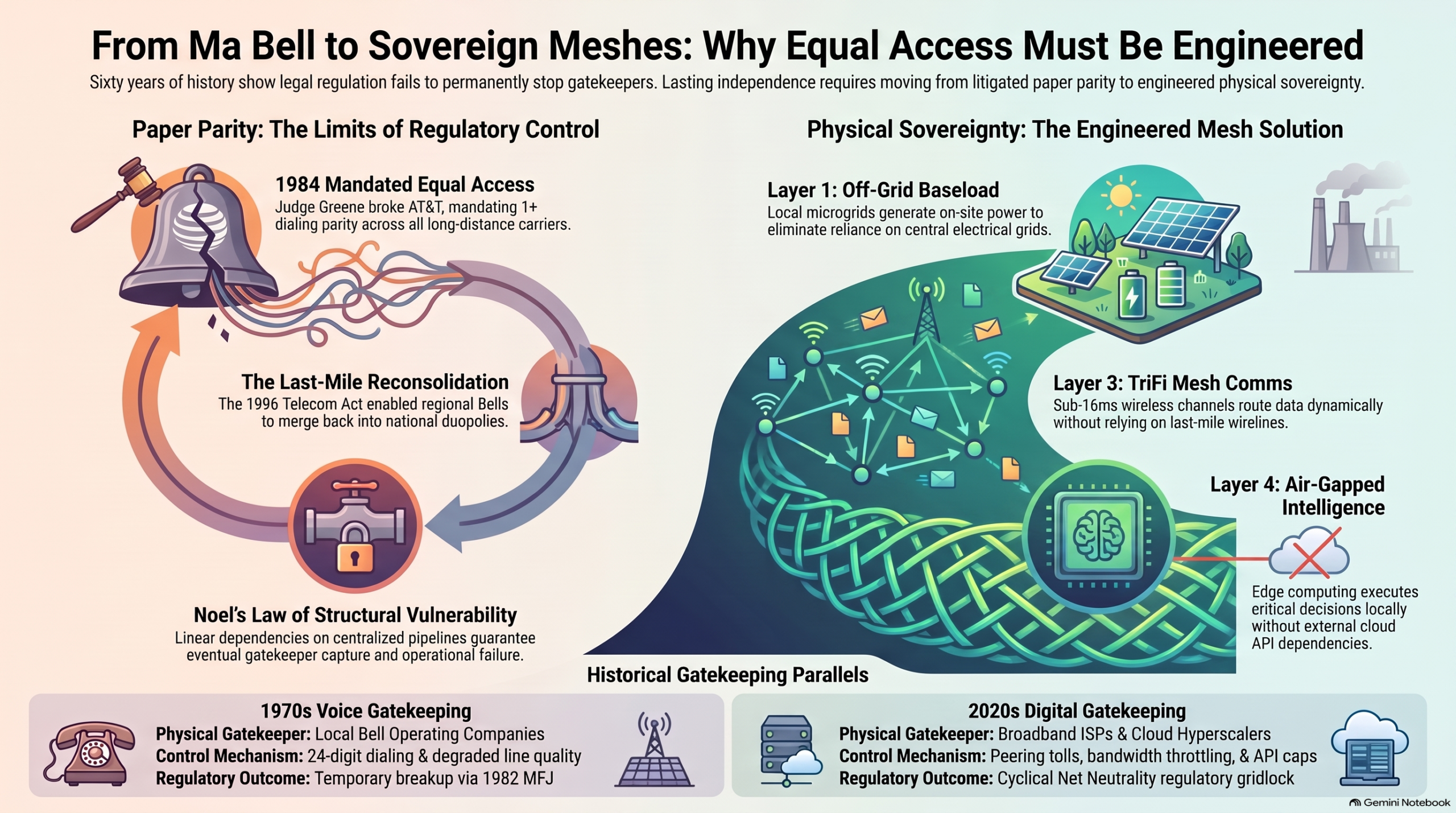
However, voice Equal Access did not endure indefinitely. Passing the Telecommunications Act of 1996 dismantled the MFJ’s structural separations, allowing the Baby Bells to re-enter the long-distance market in exchange for opening local copper loops to competitors. Subsequent federal court rulings (U.S. Telecom Ass’n v. FCC) gutted local loop unbundling mandates, making it economically unviable for competitive local exchange carriers to operate.
What followed was a massive wave of corporate reconsolidation:
- Southwestern Bell (SBC) acquired Pacific Telesis, Ameritech, and BellSouth—and then bought its former parent company, AT&T Corp., in 2005, adopting the name AT&T Inc.
- Bell Atlantic absorbed NYNEX and GTE to form Verizon.
- MCI was acquired by WorldCom in 1998, which collapsed in 2002 due to an $11 billion accounting fraud scandal; Verizon subsequently acquired the remaining assets of MCI in 2006.
This wave of mergers revealed a profound historical irony: MCI, the corporate disrupter explicitly created to dismantle Ma Bell, was ultimately swallowed by Verizon, a primary Bell descendant. By 2007, the competitive long-distance voice industry had ceased to exist, re-consolidating into a nationwide duopoly dominated by reconstituted Bell entities.
Furthermore, circuit-switched long distance suffered technological obsolescence. As voice traffic migrated to Voice over IP (VoIP) and cellular networks—where mobile carriers were never bound by wireline 1+ Equal Access rules—transmission costs dropped to near zero, and long-distance voice ceased to exist as an independent billable service.
Although voice Equal Access faded, its underlying structural conflict moved directly to broadband internet distribution:
1970s Voice Chokepoint Modern Data Chokepoint
Local Bell Loop Gatekeeper Broadband ISP / Mobile Gatekeeper
Feature Group A Degradation Peering Tolls & Throttling
24-Digit Dialing Friction Data Caps / API Limits
Equal Access Mandate Net Neutrality / Common Carriage Debates
Just as AT&T used its physical local loop control to degrade competitors’ voice calls through Feature Group A line-side routing, modern broadband Internet Service Providers face economic incentives to prioritize their own streaming, voice, and cloud services while imposing peering tolls or throttling independent third-party edge providers.
Ultimately, the historical struggle waged by Jack Goeken, Bill McGowan, and Judge Harold Greene demonstrates that controlling the physical conduit determines who possesses true access across any network infrastructure.