Comprehensive Study Guide: DeReticular Sovereign Automation Ecosystem
This study guide provides an exhaustive review of the DeReticular Sovereign Automation product line, covering industrial, municipal, agricultural, and high-security infrastructure solutions. It is designed to facilitate a deep understanding of air-gapped AI, localized mesh networks, and the transition from cloud-dependent services to sovereign “Island Mode” operations.
Part 1: Short-Answer Quiz
Instructions: Answer the following questions in 2–3 sentences based on the provided source context.
- What is the primary risk associated with routing factory telemetry through cloud servers, and how does the “Sovereign Forge” mitigate this?
- How does the “Digital Nervous System” Core Bundle utilize AI to manage municipal IT security?
- In the “Main Street” Commerce Bundle, what are the specific functions of the “Scribe” and “Archivist” modules?
- Explain the “Proof of Existence” concept within the “Sovereign Fortress” Asset Protection Package and its benefit to insurers.
- What role does the “Industrial Foreman” agent play in the “Resilient Microgrid” Utility Bundle?
- How does the “Sovereign Harvest” Agro-Industrial Package address the “Right to Repair” issue for commercial farmers?
- Describe the difference in scale and redundancy between the “City Infrastructure” Nexus and the “Urban Hub” Infrastructure packages.
- What is “Spectral Provenance,” and why is it used in high-security environments like the “Municipal Citadel”?
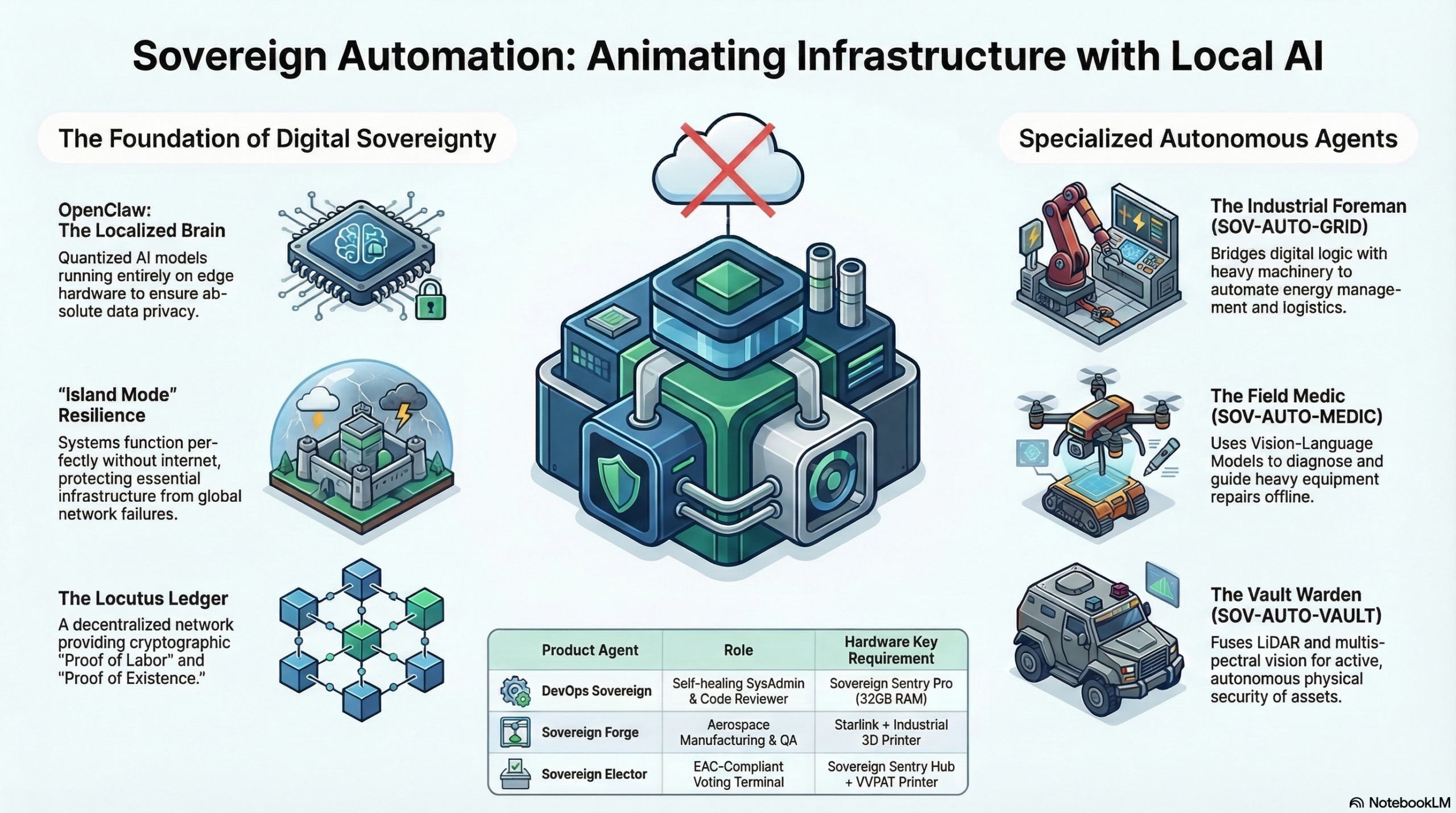
- What is “Island Mode,” and why is it a central theme across all DeReticular product bundles?
- How does the “Village Infrastructure” Genesis Package ensure that a breach of a public visitor kiosk does not compromise sensitive medical or legal data?
——————————————————————————–
Part 2: Answer Key
- Cloud Risk and Mitigation: Routing data through external servers introduces unacceptable latency for high-speed robotics and creates significant intellectual property vulnerabilities for proprietary CAD models. The Sovereign Forge mitigates this by providing a 100% air-gapped, localized AI operating system that processes all telemetry and Digital Twin simulations on-site.
- DNS AI Security: The Digital Nervous System uses the “Deep Admin” (DevOps Sovereign) AI to ingest server logs from across a town and analyze them via a localized Large Language Model. The AI identifies threats like ransomware, autonomously patches vulnerabilities, and can even null-route malicious IPs or restart failing services without human intervention.
- Scribe and Archivist Modules: The Scribe uses localized Whisper AI to transcribe voice interactions and extract intent for CRM logging, allowing for hands-free administrative work. The Archivist utilizes OCR technology to digitize, rename, and automatically file paper records, such as supplier invoices or legal briefs, into a local database.
- Proof of Existence: This concept involves a dedicated daemon that publishes cryptographic heartbeats for physical assets to a local ledger, verifying their presence and safety without exposing their specific location. This provides insurers with an immutable, verifiable audit trail, which can lead to significant reductions in insurance premiums.
- Foreman in Microgrids: The Industrial Foreman acts as a protocol translator that unifies disparate solar inverter and battery brands into a single grid state. It also serves as a P2P negotiator that autonomously routes excess energy to “dump loads,” such as community water heaters or battery banks, based on real-time mesh data.
- Agro-Industrial Right to Repair: The Sovereign Harvest package intercepts and manages machinery codes locally, allowing farmers to clear codes and maintain their equipment without being locked out by proprietary manufacturer software. This removes the dependency on cellular-reliant Big Ag cloud services that often restrict self-repair.
- Scale and Redundancy: The City Nexus is designed for 1,000–3,000 residents with dual-cluster redundancy and a 36-node mesh, whereas the Urban Hub scales for 3,000–10,000 residents. The Urban Hub increases infrastructure to tri-redundant clusters, 100 mesh nodes, and expanded professional nodes for 10 clinics and 5 law offices.
- Spectral Provenance: This is a security method using multispectral cameras to analyze assets at a microscopic level, verifying pigment density, weave patterns, or molecular signatures. In the Municipal Citadel, it is used to ensure that high-value items or historical documents have not been swapped for clever forgeries.
- Island Mode: Island Mode refers to the ability of a system to operate in total isolation from the macro-internet and centralized cloud providers. It is central to DeReticular’s philosophy because it ensures that critical infrastructure, privacy, and operational capability remain intact during internet outages or cyberattacks.
- Kiosk Security: The package utilizes cryptographic sub-netting and hardware roots of trust to ensure that the public kiosk exists on a mathematically isolated portion of the mesh. The medical and legal nodes are programmed to drop any packet not signed by their specific Sub-CA, rendering them functionally invisible to the kiosk.
Part 3: Essay Questions
Instructions: Use the Source Context to develop comprehensive responses for the following prompts. (Answers not provided).
- The Socio-Economic Impact of Localized AI: Discuss how the “Village,” “City,” and “Urban” packages attempt to keep local wealth within a community by replacing middleman SaaS platforms (like Airbnb or Expedia) with localized LLM booking engines.
- The Evolution of Physical Security: Compare and contrast the “Municipal Citadel” and the “Sovereign Fortress.” Analyze how the integration of 3D LiDAR and Digital Twin technology changes the response time and “verifiability” of security protocols compared to traditional CCTV.
- Decentralization and Infrastructure Anti-Fragility: Using the “Resilient Microgrid” and “Sovereign Harvest” as examples, argue how peer-to-peer (P2P) negotiation and “Tractor-as-a-Relay” mesh networking contribute to a community’s resilience against macro-grid failures.
- Privacy and Professional Ethics in the AI Era: Examine the “Professional Pillar” (Medical and Legal nodes) found in the municipal bundles. How does the DeReticular architecture address the “Privacy Paradox” faced by doctors and lawyers who require AI efficiency but are bound by HIPAA and Attorney-Client privilege?
- The Digital Twin as an Operational Hub: Analyze the role of the Digital Twin in the “Sovereign Forge” and “Sovereign Fortress.” How does a 1:1 real-time simulation improve both industrial optimization and emergency response capabilities in high-stakes environments?
——————————————————————————–
Part 4: Glossary of Key Terms
| Term | Definition |
| AGV | Automated Guided Vehicle; autonomous material handlers used in factory and vault logistics for transporting inventory. |
| Air-Gapped | A security measure that ensures a computer or network is physically and digitally isolated from all external networks, including the internet. |
| CAN Bus / ISOBUS | Specialized industrial and automotive communication standards that allow microcontrollers and devices to communicate within a vehicle or machine without a host computer. |
| Deep Admin | The “DevOps Sovereign” OpenClaw agent responsible for autonomous IT management, log analysis, and cyber-defense. |
| Digital Twin | A real-time, 3D virtual simulation of a physical facility or production line that is perfectly synced via LiDAR and IoT telemetry. |
| Dump Load | A mechanism in microgrids where excess energy is routed to non-critical appliances (like water heaters) to prevent waste when batteries are full. |
| Foreman | The “Industrial Foreman” OpenClaw agent; manages industrial logic, protocol translation (Modbus/Profinet), and autonomous machinery steering. |
| Island Mode | The operational state where a localized network functions entirely on its own, independent of the macro-internet or cloud dependencies. |
| LiDAR | Light Detection and Ranging; a sensing method that uses pulsed laser light to measure ranges and create high-resolution 3D maps of physical spaces. |
| LoRaWAN | A Long Range Wide Area Network protocol designed to allow low-powered sensors to communicate over long distances (miles) with minimal power. |
| Nomad Mesh-Point | Ruggedized hardware that creates a decentralized, peer-to-peer Wi-Fi and LoRaWAN network canopy over a business or municipality. |
| OCR | Optical Character Recognition; technology used to convert different types of documents, such as scanned paper documents or PDFs, into editable and searchable data. |
| OpenClaw | The overarching brand for DeReticular’s AI agents (Executive, Foreman, Vault Warden, Deep Admin). |
| Root CA | Root Certificate Authority; the master cryptographic identity that issues and validates the security certificates for every node in a private mesh network. |
| Sovereign Executive | The “Office Edition” OpenClaw agent; handles administrative tasks like voice-to-text, scheduling, and document sorting. |
| Spectral Provenance | The use of multispectral imaging to verify the authentic “molecular signature” of an asset to protect against forgeries or swaps. |
| Vault Warden | The security-focused OpenClaw agent that manages LiDAR volumetric mapping and multispectral vision AI. |
| Whisper AI | A localized voice-to-text engine used for hands-free dictation and CRM logging without cloud exposure. |