
Comprehensive Briefing: The Sovereign Node Ecosystem and Rural Re-industrialization
Executive Summary
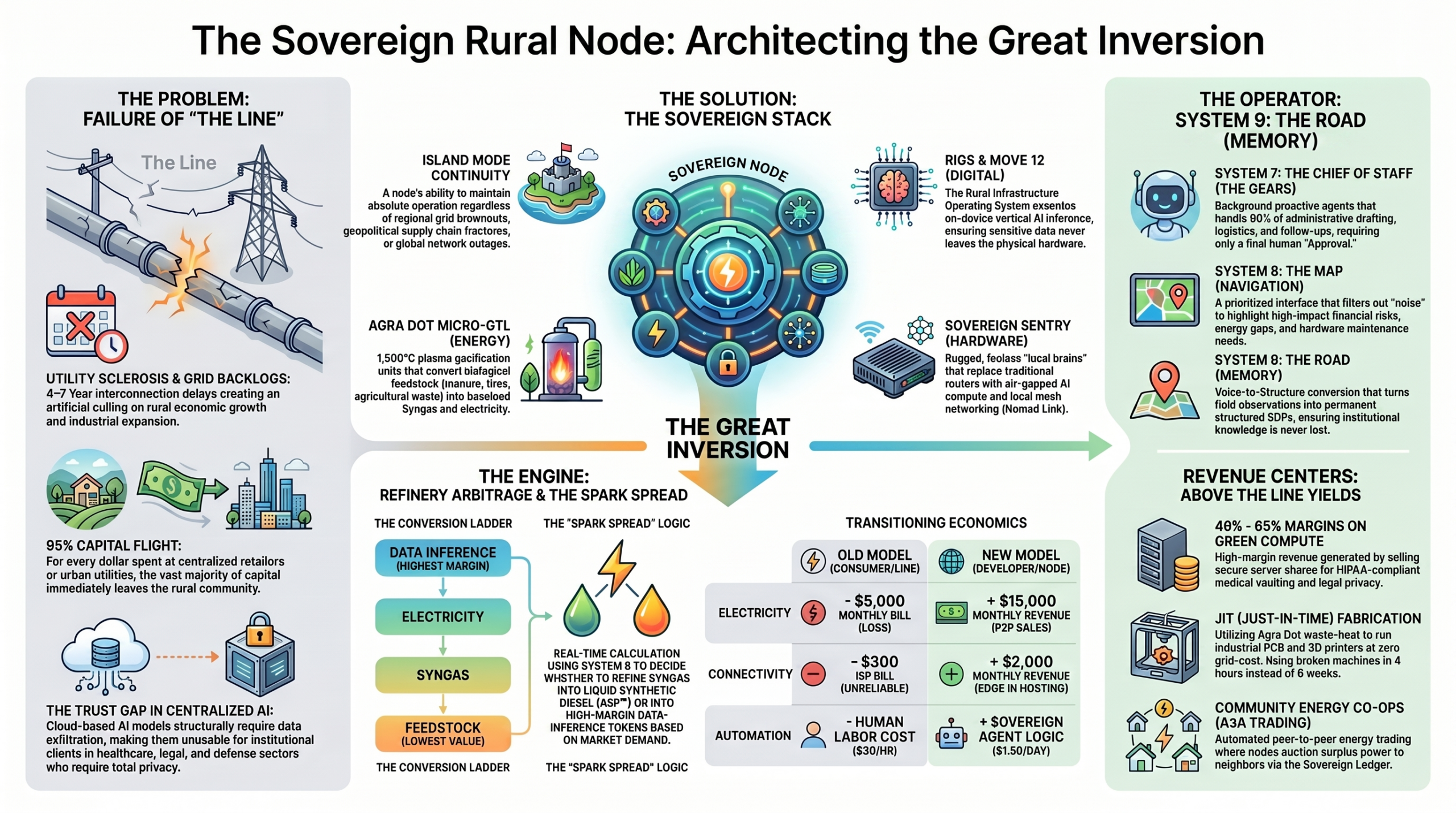
The Sovereign Node ecosystem, developed through the synergy of DeReticular, Agra Dot Energy, and Sovereign Automation, represents a structural shift in industrial infrastructure. Termed “The Death of the Line,” this paradigm rejects centralized, fragile systems (the “Line”) in favor of localized, self-powered, and air-gapped hubs (the “Node”). By integrating advanced plasma gasification with high-density AI compute, these nodes resolve the “Utility Sclerosis” currently stalling rural development—specifically the 4–7 year wait times for grid expansion.
podcast
Critical Takeaways:
- The Inversion: Rural areas are transitioning from the “tail end” of the consumer chain to the “refinery node” of the producer chain, leveraging land, biological feedstock, and strategic isolation.
- “Island Mode” Reliability: Nodes provide “Civilization-as-a-Service,” maintaining operations regardless of global grid, internet, or geopolitical failures.
- Above the Line Moat: The business focuses on un-commoditizable industrial trust, utilizing “Move 12” (on-device vertical AI) to ensure data never leaves the physical hardware.
- The Editor Paradigm: By utilizing Systems 7, 8, and 9, a rural hub can achieve Fortune 500 administrative efficiency with a headcount of fewer than three full-time equivalents (FTEs).
- Financial Viability: Seed-to-Series-A investment targets for a single node range from $1.5M to $3.0M, with projected 31-month payback periods and an Internal Rate of Return (IRR) of 44.5%.
——————————————————————————–
I. Core Philosophies and Strategic Frameworks
1. The Death of the Line vs. The Sovereign Node
Legacy infrastructure—centralized grids, cloud-dependent AI, and urban data centers—is defined as the “Line.” This model is characterized by sequential vulnerability: a failure in an urban center cascades to rural outposts. The “Node” model replaces this dependency with self-contained industrial islands.
| Feature | The Centralized Line (Legacy) | The Sovereign Node (Future) |
| Connectivity | Fiber/Cloud dependent; high latency | Air-gapped; miles-wide mesh canopy |
| Power | Grid-dependent; utility sclerosis | 24/7 Baseload autonomy (Micro-GTL) |
| Efficiency | High-headcount bureaucracy | Lean “Editor” model (<3 FTEs) |
| Data Privacy | Data exfiltration for AI training | “Move 12” local privacy |
2. “Above the Line” vs. “Below the Line”
- Below the Line: Commodity services vulnerable to disruption and price-dropping (e.g., ChatGPT, utility power, public cloud storage).
- Above the Line: Strategic moats based on localized trust and physical sovereignty (e.g., local energy production, Move 12 medical privacy, JIT manufacturing).
3. The Great Inversion
This strategic pivot recognizes that the resources of the 2026 economy—energy-rich feedstock and land—are abundant in rural areas. Rural nodes become the source of civilization, while cities become the “tail end” of the chain.
——————————————————————————–
video
II. Technical Architecture: The RIOS Ecosystem
The Rural Infrastructure Operating System (RIOS) serves as the baseline kernel for all node operations, integrating three specialized divisions:
1. Agra Dot Energy (The Heart)
Provides 24/7 baseload power through Micro-GTL (Gas-to-Liquids) systems.
- Plasma Gasification: Uses 1,500°C heat to convert waste (manure, tires, biomass) into high-value Syngas.
- Refinery Arbitrage: Known as the “Spark Spread,” this is the strategic calculation of whether to convert syngas into liquid Synthetic Fuel (ASF™) or into electricity for AI compute clusters.
2. Sovereign Automation & OpenClaw (The Brain)
A localized suite of AI agents designed for harsh or disconnected environments.
- Sovereign Sentry: Rugged, air-gapped stationary units that replace traditional routers with local AI compute.
- Move 12 Strategy: Executing AI inference on-device. This “Green-Air-Gapped Compute” targets firms (legal, healthcare) that cannot risk data leakage to the public cloud.
- Specialized Agents:
- The Field Medic: Local diagnostics and HIPAA-compliant data isolation.
- The Industrial Foreman: Manages machinery diagnostics and overrides proprietary OEM software locks.
- The Vault Warden: High-precision security using LiDAR/LAR for site lockdown.
3. Mesh Connectivity (The Infrastructure)
- Nomad Link: Decentralized mesh networking tools that create a miles-wide intranet canopy, ensuring operational continuity during internet brownouts.
- Sovereign Deck: A sunlight-readable tactical field terminal for machine authentication and signal visualization.
——————————————————————————–
III. The “Editor” Operating Paradigm
To maintain lean operations, entrepreneurs must transition from a “Doer” (manual laborer/bottleneck) to an “Editor” (strategic quality control). This is achieved through the System 7, 8, 9 Framework:
- System 7 (The Gears – Chief of Staff): A proactive background agent that triages tasks to 90% completion. It handles contextual drafting, document preparation, and follow-ups, requiring only a final “Approved” from the human operator.
- System 8 (The Map – Navigation): An interface that filters “noise” to present prioritized navigation. It highlights high-impact decisions, such as energy supply-demand gaps or critical equipment maintenance.
- System 9 (The Road – Memory): Uses Voice-to-Structure technology. As an operator dictates observations in the field, System 9 automatically generates structured Standard Operating Procedures (SOPs) and updates the node’s permanent documentation.
——————————————————————————–
IV. Economic Models and Revenue Streams
The Sovereign Node functions as a “Resilient Revenue Refinery” with three primary service lines:
- Revenue Stream A: Green-Air-Gapped Compute
- Renting secure server space and agentic inference tokens to institutional clients.
- Margins: 40% – 65% (due to near-zero marginal energy costs from waste).
- Revenue Stream B: Synthetic Fuel (ASF™) & Electricity
- On-site creation of fuel for regional logistics and Peer-to-Peer (P2P) energy sales to neighboring nodes via the Sovereign Ledger.
- Revenue Stream C: Localized Sovereign Services
- JIT Fabrication: Producing specialty industrial parts (PCB/CNC) on-site in under four hours using Move 1 (Prompt to Product) logic.
- Secure Healthcare/Voting: Air-gapped medical vaulting and voter verification services.
10-Year Pro Forma Financial Summary
| Fiscal Metric | YR 1-2 (Setup) | YR 3-5 (Expansion) | YR 6-10 (Retention) |
| Initial CAPEX | ($1,200,000) | ($250,000) | ($400,000) |
| Gross Revenue | $450,000 | $2,100,000 | $3,800,000 |
| EBITDA | $270,000 | $1,880,000 | $3,490,000 |
| Margin % | 60% | 89% | 91.8% |
——————————————————————————–
V. SWOT Analysis and Risk Mitigation
Strengths
- Zero-Cost Inputs: Transforming biological waste into high-margin compute.
- “Island Mode” Reliability: Un-killable operations during grid or network failure.
- Fortune 500 Efficiency: High leverage via System 7/8/9.
Weaknesses
- Initial CAPEX: High front-loaded investment ($1.5M – $3.0M for full hubs).
- Cognitive Learning Curve: Requires a psychological shift from “Doer” to “Editor.”
Opportunities
- Utility Sclerosis: Exploiting the 4-7 year grid-wait times to provide immediate power.
- Regulatory Incentives: Federal programs (IRA/USDA) offering 30–50% cash rebates for green hardware.
Threats
- Regulatory Chokepoints: Utility lobbying against P2P energy trading.
- Big Tech Down-Market Moves: Potential commoditization of edge computing.
Risk Mitigation: The Regulatory Hedge
Nodes are strategically positioned as “Critical Emergency Preparedness Infrastructure.” By providing life-support and community resilience during grid events, nodes secure municipal “Right to Exist” protections that override utility-monopoly trade barriers.
——————————————————————————–
VI. Key Operational Glossary
- Agentic Sovereignty: The technical ability of a local node to authorize machine functions without external approval.
- Island Mode: The state of operating a facility with zero external network or utility connectivity.
- Permission Gap: The structural vulnerability created when local assets require a remote “OK” signal from a central server to function.
- Sovereign Ledger: A decentralized, local accounting system for tracking kilowatt swaps and transactions within a mesh.
- Spark Spread: The calculated margin between local energy production costs and the market value of energy-intensive outputs (e.g., Synthetic Diesel vs. AI Compute).
——————————————————————————–
VII. Concluding Strategic Objective
The ultimate goal of the Sovereign Node ecosystem is the implementation of the “Civilization Reflex.” While centralized systems scale “wide and thin,” Sovereign Nodes scale “deep.” They empower rural entrepreneurs to bypass the permission-based growth models of legacy banks and utilities, transforming them into the primary sources of energy and intelligence for their regions. As the “Line” continues to fail, these nodes function as the resilient backbone of a decentralized industrial future.