
Briefing on Uganda’s Sustainable Industrialization and the Project Octagon Network
Executive Summary
This briefing synthesizes two interconnected strategic initiatives: Uganda’s foundational policy shift towards sustainable industrialization via its 2024 Eco-Industrial Park (EIP) Guidelines, and the immediate application of this framework through the Kaabong PLASMA Project, a key component of a global initiative known as Operation Octagon. The 2024 Guidelines, developed by the Government of Uganda with GGGI and UNIDO support, are a direct response to the systemic failures of previous industrial park models, which saw only 3 of 22 planned parks become operational. The new framework mandates a rigorous, evidence-based approach centered on the EIP model, which integrates principles of circular economy, industrial symbiosis, and Resource Efficient and Cleaner Production (RECP) to achieve shared economic, social, and environmental benefits.
The Kaabong PLASMA Project, a partnership between Agra Energy Uganda and the U.S.-based DeReticular, serves as a pioneering case study. It is legally bound to operate in “strict accordance” with the 2024 EIP criteria, aiming for “Green Special Economic Zone” status. The project’s core technology is plasma gasification, designed to achieve zero-waste-to-landfill operations and generate reliable, waste-to-energy power.
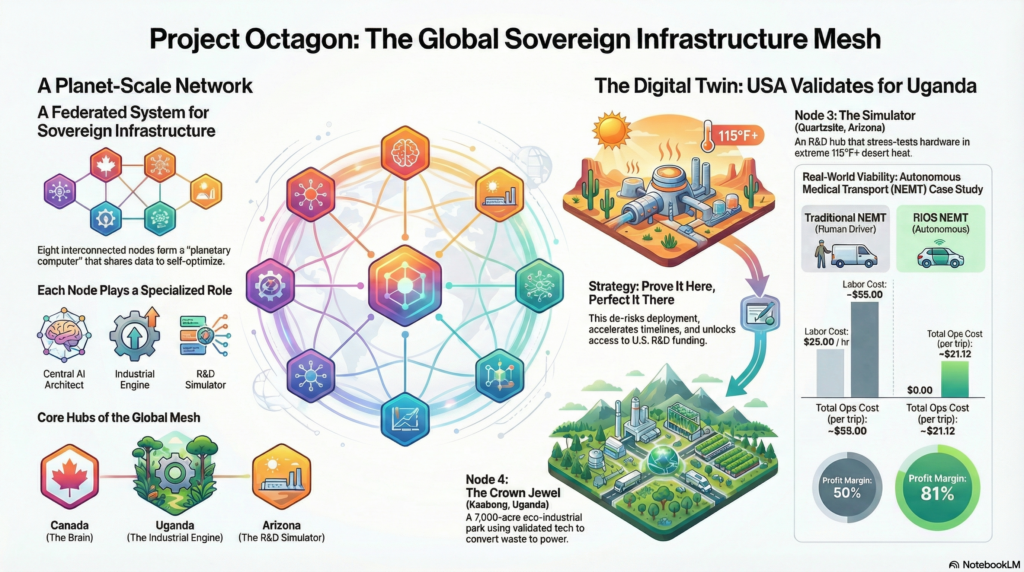
Strategically, the Kaabong project is not a standalone endeavor but is designated “The Crown Jewel” (Node 4) and “The Hospitality Anchor” (Node 1) within DeReticular’s “Operation Octagon.” This global, 8-node network is a “distributed planetary computer” designed to deploy sovereign, off-grid infrastructure. The network operates on a “Federated Learning” model, where data from one node—such as extreme heat stress in Arizona—informs and optimizes the entire global mesh. A critical component is Node 3 in Quartzsite, Arizona, which functions as the “Digital Twin” for the Ugandan site. It serves as an R&D and de-risking hub, validating all hardware in a similar desert climate before deployment to Africa, while simultaneously developing independent, high-margin revenue streams through autonomous Non-Emergency Medical Transportation (NEMT) and the sale of unique “Desert Stress Data” to technology manufacturers. The entire ecosystem is designed to be a closed-loop, self-replicating model for deploying cash-flow positive, sovereign infrastructure that blends industrial scale, humanitarian impact, and commercial viability.
Part 1: The Ugandan Framework for Eco-Industrial Parks (EIPs)
The “Guidelines for Developing Uganda’s Industrial Parks and Free Zones 2024” represent a strategic overhaul of the nation’s industrial policy, designed to operationalize high-level strategies like the Industrial Policy 2020 and Vision 2040.
1.1 Context: Addressing Systemic Failures in Industrial Policy
The new framework was necessitated by significant performance issues and systemic challenges in Uganda’s existing industrial park system. These failures have limited industrial growth and economic transformation. Key challenges identified include:
- Lack of Approved Standards: No formal guidelines previously existed for the development and management of industrial parks.
- Poor Operational Performance: Of 22 parks planned in 2007, only 3 were operational, with the Auditor General’s 2015 report noting general underperformance in productivity and job creation.
- Low Investor Activity: Only 13% of investors (45 out of 343) allocated land in the parks are currently in operation.
- Infrastructure and Coordination Deficits: Inadequate coordination between key state agencies (UIA, URA, UMEME, NWSC) has hindered the development of essential infrastructure.
- Unharmonized Policies: Inconsistent tax policies and incentives have created management and operational inefficiencies.
- Economic Stagnation: The manufacturing sector’s share of GDP has remained stagnant at 8-10%, and Uganda’s ranking in the World Bank’s Doing Business report fell to 127th in 2019.
1.2 The EIP Model: Core Principles and Definitions
The guidelines are built upon Green Growth principles, aiming to decouple economic growth from environmental impacts. The Eco-Industrial Park (EIP) is the primary instrument to achieve this.
| Term | Definition from Source Context |
| Eco-Industrial Park (EIP) | An earmarked area for industrial use that promotes collaboration among resident firms for shared environmental, economic, and social benefits. Key characteristics include cleaner production, resource efficiency, industrial symbiosis, shared infrastructure, and responsible business practices. |
| Resource Efficient and Cleaner Production (RECP) | The continuous application of an integrated preventive environmental strategy to processes, products, and services to increase efficiency and reduce risks to humans and the environment. |
| Industrial Symbiosis | The use of a previously disposed waste (solid, liquid, or gas) from one facility by another facility to provide a valuable by-product. |
1.3 Key Components of the 2024 Guidelines
The framework is structured to ensure comprehensive and sustainable park development.
A. Planning & Business Case Development The guidelines mandate a rigorous, evidence-based planning process for any new “greenfield” park, requiring a convincing business case with seven key steps:
- Project Description, Ownership, and Management
- Market Analysis (local, national, regional)
- Technology, Business Model, and Growth Strategy
- Financial Overview and Investment Proposal
- Identification and Mitigation of Risks (political, climate, financial, etc.)
- Social, Environmental, and Gender Impact (including a Gender Impact Assessment)
- Conclusion summarizing strengths and investment appeal. This process is supported by analytical tools like the extended Cost Benefit Analysis (eCBA) to quantify social and environmental costs and benefits.
B. Park Models & Governance The guidelines recommend modern, flexible models, such as the Hybrid Green SEZ, which subdivides a zone into a general area and an export-processing area to foster linkages between domestic and export-oriented firms. A UNIDO review identified effective park management as the single most critical factor for success, stressing the need for autonomous management structures with control over budgets and staffing.
C. Financing & Incentives The framework promotes financial sustainability by moving away from providing free land, which can lead to lack of accountability. Instead, it advocates for:
- Cost Recovery: Implementing cost-based land allocation and robust cost-recovery models for services.
- Diverse Revenue Streams: Encouraging EIPs to develop income beyond land leases, including fees for common services, waste valorization, consulting, and carbon finance mechanisms under Article 6 of the Paris Agreement.
- Green Incentives: Shifting incentives to reward green performance, such as tying tax reductions to meeting targets from the EIP performance framework.
D. Performance Monitoring A comprehensive Monitoring & Evaluation framework provides clear Key Performance Indicators (KPIs) to track progress.
| Category | Example KPI | Target Example |
| Park Management | Firms’ willingness to pay for services by management. | 90% of management budget submitted to tenants’ contributions. |
| Economic | Ratio of rented space to total available space. | 50% average occupancy rate. |
| Environmental | Total renewable energy use. | Equal to or greater than the annual national average energy mix. |
| Environmental | Proportion of solid waste reused, recycled, or upcycled. | >50% of solid waste. |
| Social | % of women in management positions. | >= 20%. |
| Social | % of total workers employed who live within daily commuting distance. | 90%. |
Part 2: Case Study: The Kaabong PLASMA Project (Project Umoja)
The PLASMA Project in Kaabong, Uganda, serves as a direct application of the 2024 Guidelines.
2.1 Project Overview and Strategic Alignment
- Partners: Agra Energy Uganda (AEU) and Biz Builder Mike LLC (dba DeReticular) of Arizona, USA.
- Legal Commitment: An addendum to their MOU states the project “shall be designed and operated in strict accordance with the Eco-Industrial Park (EIP) criteria outlined in Chapter 3 of the 2024 Guidelines.”
- Strategic Goal: To formally target “Green Special Economic Zone” status by integrating RECP principles and establishing “zero-waste-to-landfill operations.”
- Core Technology: The project will use plasma gasification to convert biomass and agricultural waste into “reliable, sovereign, waste-to-energy power.”
2.2 Phased Development Timeline
The project follows a modular scaling strategy from initial site readiness to full industrial operation.
| Phase | Timeline | Key Milestones and Activities |
| Phase 0 | Months 1–6 | Deployment of a 150 kW solar array and 400 kWh battery buffer for initial site power. Installation of Starlink Business Kits. |
| Phase 1 & 2 | Months 7–36 | Month 12: Deployment of the 1 MW “bridge” power plant. Cultivation of a pilot hemp harvest (50-100 acres). Procurement of 20 rugged electric vehicles. |
| Phase 3 & 4 | Months 18–48+ | Months 18-48: Commissioning of the Umoja Compute Core (UCC-1) to generate AI/HPC revenue. Year 4: Launch of commercial autonomous ride-hailing services. Year 5: Completion and commissioning of the main 10 MW power plant, creating an N+1 redundant microgrid. Scaling to full 7,000-acre capacity. |
2.3 Historical Context and Formalization
- August 2023: Exploratory discussions began.
- October 15, 2025: Original Memorandum of Understanding (MOU) was executed.
- November 7, 2025: Foundational documentation, including the Master Business Plan, was finalized.
- December 3, 2025: DeReticular issued a Private Placement Memorandum to raise $1,000,000 for Operation Octagon.
- January 2026: A “Pilot Explorer” unit was scheduled for shipment to Kaabong, marking the full activation of the global mesh.
Part 3: The Global Strategic Framework: Operation Octagon
The Kaabong project is an anchor within a larger global strategy by DeReticular to deploy a planetary mesh of “Sovereign Infrastructure.”
3.1 Overview: A Federated Learning Mesh
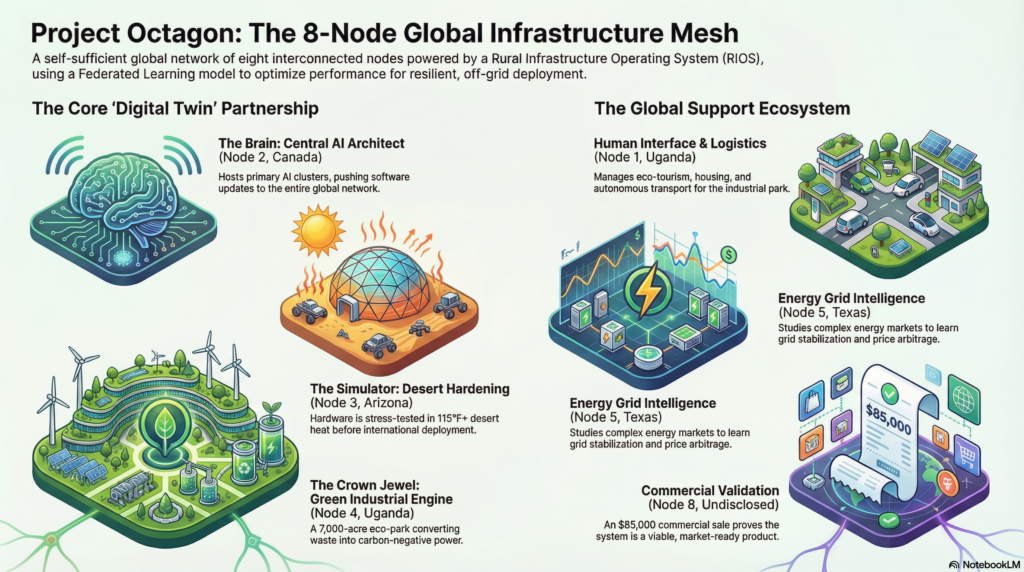
Operation Octagon has evolved from a theoretical framework into a live, “distributed planetary computer.” It is structured as an 8-node mesh that uses a Federated Learning system, where data from one node (e.g., heat stress in Arizona) instantly updates the operating logic of its “Digital Twin” (e.g., Uganda) without compromising local data sovereignty. The network is designed for the deployment of RIOS (Rural Infrastructure Operating System) Pilot Command Centers globally.
3.2 The 8-Node Network: Roles, Functions, and Evolution
The network’s topology has undergone strategic realignments to prioritize the Ugandan nodes and establish a centralized “Brain” in Canada.
| Node | Name / Moniker | Location | Sponsor / Lead | Core Mission & Function | Historical Shift |
| 1 | The Welcome Mat / The Concierge Layer | Kaabong, Uganda | Mike Tumwesigye | Logistics & Hospitality. Manages eco-tourism, housing, and stakeholder travel. Serves as the “soft power” entry point and logistical hub for Node 4. | Realigned from “Industrial Anchor” to focus on the human element. |
| 2 | The Brain / The Architect | Canada | Ash Aly | Systems Architect HQ. Hosts primary AI clusters, pushes global OTA updates for the RIOS stack, and manages Federated Learning models. Home of the DeReticular Academy. | Elevated from a replication node to the central “Brain” of the network. |
| 3 | The Simulator / The Blast Furnace | Phoenix/Quartzsite, AZ | Trifi Wireless | Connectivity & Autonomy HQ. The permanent “Digital Twin” for Kaabong. Conducts “Desert Hardening” stress tests on hardware in 115°F heat. Functions as the Network Operations Center (NOC). | Relocated from Canada (“Arctic Test”) to mirror the Ugandan climate. |
| 4 | The Crown Jewel / The Engine | Kaabong, Uganda | Linda Abeja (Agra Energy) | Green Industrial Engine. A 7,000-acre Smart Eco-Industrial Park. Uses plasma gasification for 10-11 MW of carbon-negative power. Primary revenue generator via energy and carbon credits (verified by zkVerify). | Reassigned from Minnesota (“Urban Mesh”) to be the project’s industrial core. |
| 5 | The Energy Student / Grid Independence | Fort Worth, TX | N/A | Urban Energy Lab. Studies the Texas grid (ERCOT) to validate waste-to-energy and energy arbitrage models. Serves as the network’s “University” for grid instability. | Relocated from Minnesota; previously the “Geopolitical Node” in Jerusalem. |
| 6 | Governance & Education / UN 2.0 | TBD (Scholarship Slot) | N/A | Global Impact. Focuses on “Human Software,” training “Township Managers.” Proves a “Humanitarian Aid as a Service” model by installing permanent RIOS power/connectivity infrastructure. | Replaced previous diplomatic plans for Jerusalem. |
| 7 | The R&D Mobile Unit / The Pop-Up | Quartzsite, AZ | Michael Noel | Desert Hardening. A mobile command center that validates the “Expeditionary” capability of RIOS, proving rapid deployment from a shipping container in tactical or remote environments. | Designated as a mobile “Pop-Up” unit from its original “R&D Alpha” status. |
| 8 | The Business Case / The Commercial Validator | Undisclosed Client Site | N/A | Financial Proof of Concept. A fully paid commercial deployment (sold for $85,000) using the RIOS Pilot Expeditionary (Tier 1) hardware stack, demonstrating market viability to investors. | Consistently maintained as the project’s financial proof of concept. |
3.3 Leadership and Ecosystem Roles
- Mike Tumwesigye (The Operator): Manages the “boots on the ground” logistics and tourism at Node 1 in Uganda.
- The Architect (Node 2 AI): The automated system managing the network’s data logic and software updates.
- Biz Builder Mike: Represents the economic logic, ensuring every node is designed to be cash-flow positive and not dependent on charity.
Part 4: Deep Dive: Node 3 – The Arizona Hub
Node 3 in Quartzsite, Arizona, is a strategic lynchpin for the entire Operation Octagon network, serving as a de-risking hub, R&D center, and a profitable entity in its own right.
4.1 Strategic Imperative: The “Digital Twin” and Funding Hub
The establishment of “Project Umoja Quartzsite” serves multiple strategic goals. It acts as a “living laboratory” to test, harden, and validate every component of the RIOS and energy systems in a controlled environment before shipment to Uganda, dramatically reducing deployment risk. Crucially, by operating as a U.S. entity (DeReticular USA), the project unlocks access to the U.S. federal grant system, a massive pool of non-dilutive R&D funding.
4.2 Core Technical Functions & Partnerships
- Desert Hardening: Tests battery thermal management, enclosure seals, and NVIDIA A2 GPU performance in sustained temperatures exceeding 115°F.
- Sovereign Connectivity: Functions as the Network Operations Center (NOC), testing Starlink bonding with Trifi Wireless vSIMs to create an unbreakable “Global Mesh Protocol.”
- Autonomous Logistics: Serves as the R&D headquarters for Kurb Kars, utilizing Arizona’s favorable regulations to test autonomous vehicles on the NVIDIA Drive platform for logistics and mobility services.
4.3 The U.S. Grant Landscape Opportunity
Project Umoja Quartzsite is positioned to secure significant non-dilutive funding by aligning its R&D with the missions of major U.S. federal agencies.
| Grant Agency | Program Examples | Relevance to Project Umoja Quartzsite |
| NSF | Partnerships for Innovation (PFI) | Testbed for fundamental research on circular economies, AI in microgrids, and sovereign infrastructure, ideal for university partnerships (e.g., ASU). |
| SBIR / STTR | All participating agencies | Perfect fit for funding R&D of specific components (e.g., AI control system, new gasifier sensor) with the explicit goal of commercialization. |
| DOD | DARPA, ONR, RCCTO | The Umoja model is a blueprint for a resilient, off-grid Forward Operating Base (FOB), creating opportunities to fund ruggedization and militarization of the technology. |
| DOE | ARPA-E, EERE | A primary target for grants related to cutting-edge waste-to-energy technology, intelligent microgrids, biofuels, and hydrogen production. |
| USAID | Development Innovation Ventures (DIV) | A powerful angle to secure grants to test and validate technology in the U.S. that is explicitly designed to solve developmental challenges in Africa. |
4.4 The Quartzsite Marketplace: A Sovereign Business Model
Node 3 leverages the unique demographics of Quartzsite to create a self-funding operational model.
A. Local Demographics and Market Gap The area has a permanent population of ~1,805 with a median age of 71.2, creating high demand for healthcare services. This is compounded by a massive seasonal surge of over 1,000,000 “snowbird” visitors, which strains local infrastructure. A critical gap exists in Non-Emergency Medical Transportation (NEMT), with the nearest major hospital 32 miles away and local transit operating only one day a week.
B. The RIOS NEMT Vertical RIOS and autonomous Kurb Kars are deployed to solve the NEMT crisis. By removing the driver—the largest variable cost—the model achieves significant operational efficiencies and can offer 24/7 service.
| Metric | Traditional NEMT (Human Driver) | RIOS NEMT (Kurb Kars) |
| Labor Cost | $25.00/hr | $0.00 |
| Fuel/Power Cost (per mile) | $0.22 (Gasoline) | $0.08 (Solar/Microgrid) |
| Maintenance/Ins. (per mile) | $0.15 | $0.25 (High-tech AV) |
| Total Ops Cost (64 mi trip) | ~$55.00 | ~$21.12 |
| Profit Margin | 50% | 81% |
4.5 Financial Projections and Trajectory
Node 3 is designed to be profitable from its first year by targeting multiple revenue streams.
A. Revenue Streams
- NEMT Services: High-margin medical transport reimbursed by Arizona Medicaid (AHCCCS).
- Academy Tuition: Hands-on “Desert Hardening” certifications for students.
- Seasonal Surge Mesh: Selling high-speed, Starlink-bonded data passes to visitors during peak season.
- Data Arbitrage: Selling high-value “Extreme Heat” battery performance and degradation data to hardware manufacturers.
B. Pro Forma Income Statement
| Revenue Category | 2026 (Pilot Phase) | 2027 (Growth Phase) | 2028 (Scale Phase) |
| 1. NEMT Services | $264,000 | $792,000 | $1,320,000 |
| 2. Academy Tuition | $87,500 | $262,500 | $525,000 |
| 3. Seasonal Surge Mesh | $250,000 | $500,000 | $1,000,000 |
| 4. Data Arbitrage Sales | $25,000 | $150,000 | $600,000 |
| TOTAL REVENUE | $626,500 | $1,704,500 | $3,445,000 |
| TOTAL EXPENSES | $315,000 | $656,000 | $1,250,000 |
| NET INCOME (EBITDA) | $311,500 | $1,048,500 | $2,195,000 |
| Net Margin | 49.7% | 61.5% | 63.7% |
C. Strategic Analysis The financial model shows Node 3 becoming the Cash Flow Anchor for Project Octagon in North America. It proves profitability in Year 1 by solving an immediate medical need. By 2028, it becomes an “Industrial Data Powerhouse,” selling essential battery degradation data to global EV and storage manufacturers, with a projected net margin of 63.7%.