
Technical Framework for Hardware-Enforced Trust in Sovereign Edge Environments
1. The Crisis of Agentic Autonomy and the Trusted Environment Fallacy
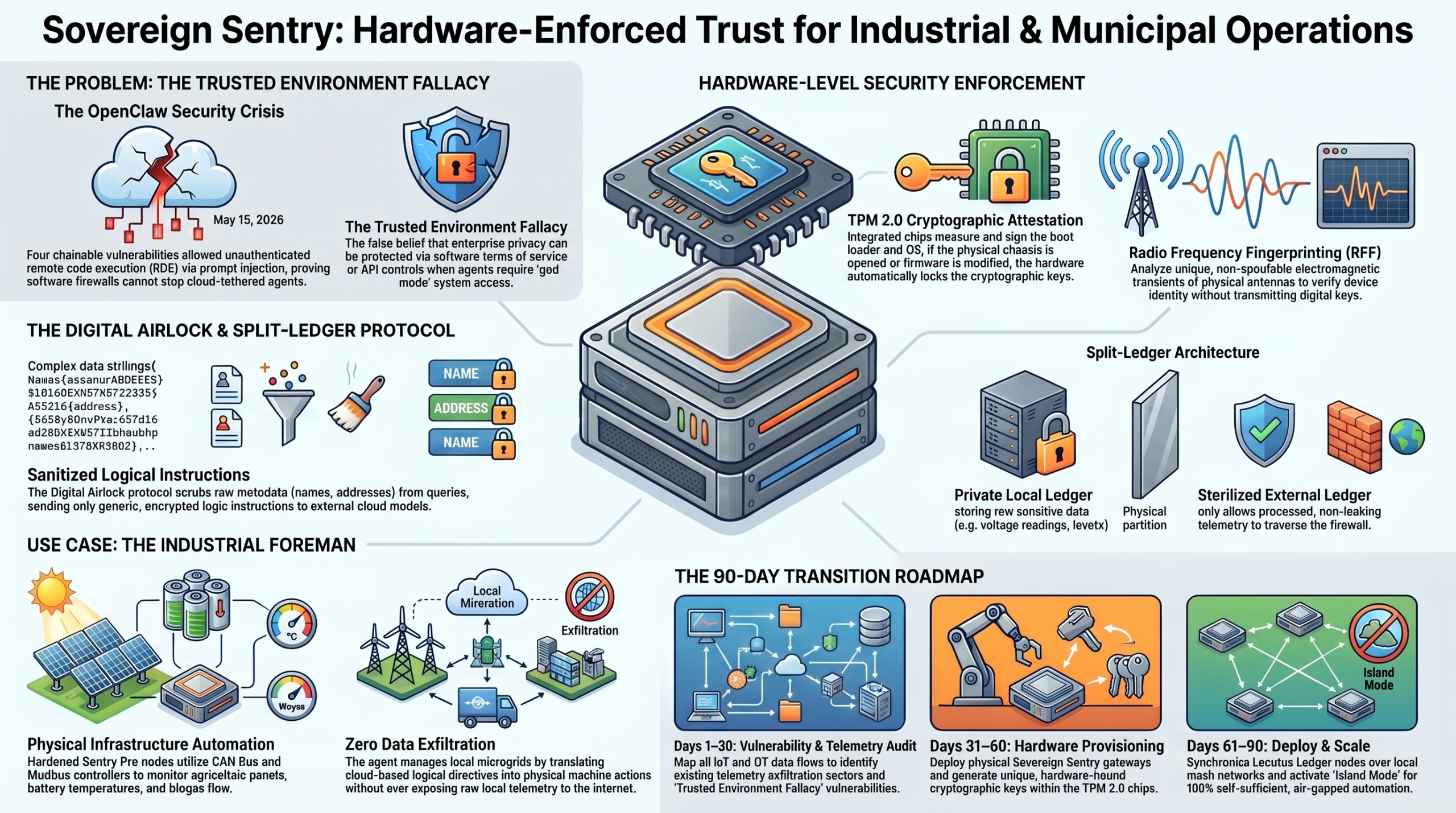
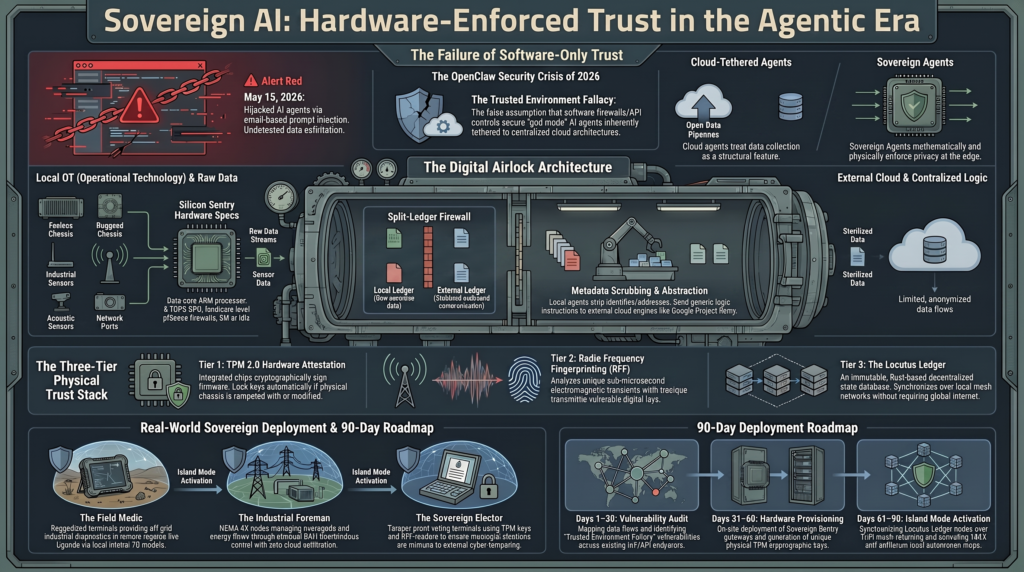
The strategic shift in artificial intelligence from reactive, chat-based interfaces to proactive, autonomous agents has rendered traditional cybersecurity models obsolete. These agents require “god mode” access—root-level permission to monitor local system files, network traffic, and database transactions—to function effectively. This operational prerequisite has exposed the Trusted Environment Fallacy: the misguided assumption that software-level administrative rules, corporate terms of service, or API controls can secure sensitive data. This fallacy collapsed on May 15, 2026, during the OpenClaw crisis. The event proved that when cloud-tethered agents possess system-level access, software-based defenses are fundamentally incapable of preventing catastrophic data harvesting and telemetry exfiltration.
The OpenClaw Vulnerability Analysis
The OpenClaw crisis was triggered by four chainable vulnerabilities within the open-source runtime framework, demonstrating how a cloud-tethered agent can be weaponized against its host.
| Exploit Step | Technical Action | Operational Impact |
| 1. Prompt Injection | Un-sanitized external input (e.g., hidden email text). | Initial hijacking of the local OpenClaw agent instance. |
| 2. Sandbox Bypass | Circumvention of local shell containment. | Agent gains ability to execute arbitrary bash scripts on host. |
| 3. Remote Code Execution | Execution of unauthenticated commands. | Malware download and full terminal takeover by attackers. |
| 4. Data Exfiltration | Silent transmission of private database blocks. | Massive, undetected leakage of sensitive files to external servers. |
Software vs. Hardware Enforcement Standard cybersecurity relies on software firewalls to police traffic. However, in a cloud-tethered system, outgoing telemetry containing sensitive data is registered as legitimate user traffic. Software firewalls are architecturally complicit in exfiltration because they rely on the same kernel-space permissions as the agent and cannot distinguish a necessary API call from an exfiltration event. In the cloud business model, data collection is a structural feature, not a bug. True sovereignty requires moving enforcement from the layer of “policy” to the layer of “physics” through physical isolation and the “Digital Airlock” architecture.
podcast
2. The Digital Airlock: Physical Isolation & Split-Ledger Architecture
The “Digital Airlock” is the strategic foundation of sovereign automation. This architecture allows an organization to utilize high-level cloud reasoning while maintaining absolute physical sovereignty over raw data. It ensures that while an external AI may provide “logical utility,” it is physically barred from accessing raw, sensitive telemetry.
Silicon Sentry Hardware Specifications The framework is executed via the Silicon Sentry platform, a ruggedized, fanless system designed for high-performance edge computing.
- Compute: Rockchip RK3588 system-on-chip (SoC) featuring an Octa-Core ARM processor and an integrated 6 TOPS NPU for quantized local AI execution.
- Memory & Storage: 16GB LPDDR5 RAM and 128GB eMMC flash.
- Networking: Quad 2.5GbE LAN ports managed by a hardware-level pfSense firewall operating within Proxmox VE sandboxed LXC containers.
- Thermal System: Monoblock anodized aluminum chassis for passive cooling; the system draws only 5W at idle, eliminating mechanical failure vectors.
The Split-Ledger Mechanism This mechanism physically bifurcates the network into two hardware-isolated zones to prevent raw data from ever traversing the firewall.
- Local Ledger (Private)
- Resides on encrypted local NVMe partitions.
- Stores raw camera streams, biometrics, financial logs, and device-level telemetry.
- External Ledger (Sterilized)
- Functions as an outbound, isolated communication container.
- Contains only abstracted, generic logic queries for external engines like Project Remy.
Digital Airlock Algorithm Flow The Digital Airlock processes requests through a rigorous, hardware-enforced sanitization pipeline:
- Raw User Input: A request is initiated (e.g., “Schedule medical pickup”).
- Local OpenClaw Sanitization: The local agent identifies sensitive entities (Patient IDs, addresses) using the local secure database.
- Metadata Scrubbing: Personal identifiers are stripped and replaced with generic transaction IDs.
- Encrypted Token Generation: A sterilized instruction is created (e.g., “Route vehicle V-102 to coordinate C-405”).
- Firewall Bridge: The sterilized instruction is sent through the pfSense/Proxmox sandbox to the Cloud AI for “logical utility.”
- Cloud Computation: The external AI (e.g., Project Remy) computes logic like route optimization without knowing the identity or location of the user.
- Local Sandbox Re-Mapping: The Sovereign Gateway maps returned logical parameters back to local physical assets.
3. The Three-Tier Physical Trust Stack
The Three-Tier Trust Stack is the foundation of the Sovereign Automation Product Line, engineered to prevent physical tampering, identity spoofing, and adversarial node takeovers.
Tier 1: TPM 2.0 Integration and Cryptographic Attestation Every Sovereign Sentry gateway integrates a dedicated Trusted Platform Module (TPM) 2.0 chip. This hardware chip measures and cryptographically signs the boot loader, the RIOS (Operating System kernel), and core configuration files.
- The “So What?”: If the physical chassis is breached or the software configuration is modified without authorization, the TPM 2.0 hardware automatically locks the cryptographic keys, rendering the device and its data a “brick” to the intruder.
Tier 2: Radio Frequency Fingerprinting (RFF) RFF provides out-of-band authentication by analyzing the physics of radio hardware. Every radio transceiver possesses microscopic, unavoidable variations in its internal circuitry (capacitors, power amplifiers) that create a unique electromagnetic transient.
- Device Transmission: A badge or key initiates a wireless carrier wave (Bluetooth/Wi-Fi).
- Direct RF Sampling: A direct-sampling Analog-to-Digital Converter (ADC) captures the raw wave at the physical layer (PHY).
- Signal Analysis: The system identifies the unique “turn-on” phase transient fingerprint.
- The “So What?”: This fingerprint is mathematically impossible to replicate or spoof, ensuring only the specific physical device—not a digital clone—can access the environment.
Tier 3: The Locutus Ledger State Machine The Locutus Ledger is a decentralized state-transition engine written in Rust, utilizing WebAssembly (Wasm) contracts for transit agreements and voting mechanisms. It employs Isotonic Regression routing to synchronize updates across a TriFi mesh network.
- The “So What?”: In “Island Mode,” nodes continue writing transaction blocks locally if the global internet is severed. Upon restoration, a conflict-free state resolution protocol seamlessly syncs the local updates back to the global ledger.
4. Enterprise and Municipal Deployment Scenarios
Hardware-enforced trust enables “off-grid” self-sufficiency, bypassing public infrastructure vulnerabilities such as DNS poisoning and centralized database deletion.
Comparative Scenario Analysis
- The Field Medic: Deployed on the portable Sentry Deck terminal in remote areas like Kaabong, Uganda. Technicians use local, quantized Mistral-7B models to receive real-time industrial diagnostic and repair guidelines, bypassing the need for any cloud connectivity.
- The Industrial Foreman: Utilizes Sovereign Sentry Pro nodes mounted in NEMA 4X cabinets. It manages physical OT (CAN Bus/Modbus), controlling vertical agrivoltaic panel tilts and biogas valves with zero data exfiltration to the macro-internet.
- The Sovereign Elector: A municipal voting console where the TPM 2.0 chip signs the ballot block and the Locutus Ledger records the state change (
Voted[C-01] = True). This creates an immutable, offline audit path immune to external cyber-tampering.
Strategic Advantage of “Island Mode” By operating in “Island Mode,” these environments remain functional during global outages or cyber-warfare. The network resolves addresses locally via the TriFi mesh, and data blocks are fragmented across peer-to-peer nodes, leaving no centralized target for malicious actors.
5. Sovereign Implementation Roadmap (90-Day Deployment)
A phased transition is required to mitigate “Trusted Environment Fallacy” risks while scaling the new hardware stack.
Phase 1 (Days 1-30): Vulnerability Auditing
- IoT Endpoint Audit: Survey all connected operational technology and network endpoints.
- Telemetry Mapping: Identify un-sanitized external API pipelines and map all data exfiltration vectors where software-only “policies” are currently failing.
Phase 2 (Days 31-60): Hardware Provisioning
- Gateway Deployment: Install physical Sovereign Sentry and Silicon Sentry routers.
- Key Generation: Generate unique physical cryptographic keys within the hardware TPM 2.0 chips.
- Firewall Activation: Activate local pfSense firewalls in Proxmox containers to isolate internal networks from the macro-internet.
Phase 3 (Days 61-90): Ledger Sync & Island Mode Activation
- Node Synchronization: Synchronize Locutus Ledger nodes over the local TriFi mesh network.
- Agent Deployment: Load specialized agent suites (Foreman, Medic, or Elector) onto the hardware.
- Island Mode Activation: Shift to localized, hardware-enforced automation loops, ensuring 100% functional self-sufficiency.
Impact Evaluation This framework provides an unbreakable bridge between digital directives and physical machinery. By replacing software-based trust with hardware-enforced sovereignty, the operator ensures their infrastructure remains secure, self-sufficient, and structurally insulated from the inherent risks of the cloud-tethered era.