
Economic Impact Assessment: Transitioning from Centralized Utility Models to DePIN Frameworks
1. The Fragility of Linear Concentration: A Baseline Economic Analysis
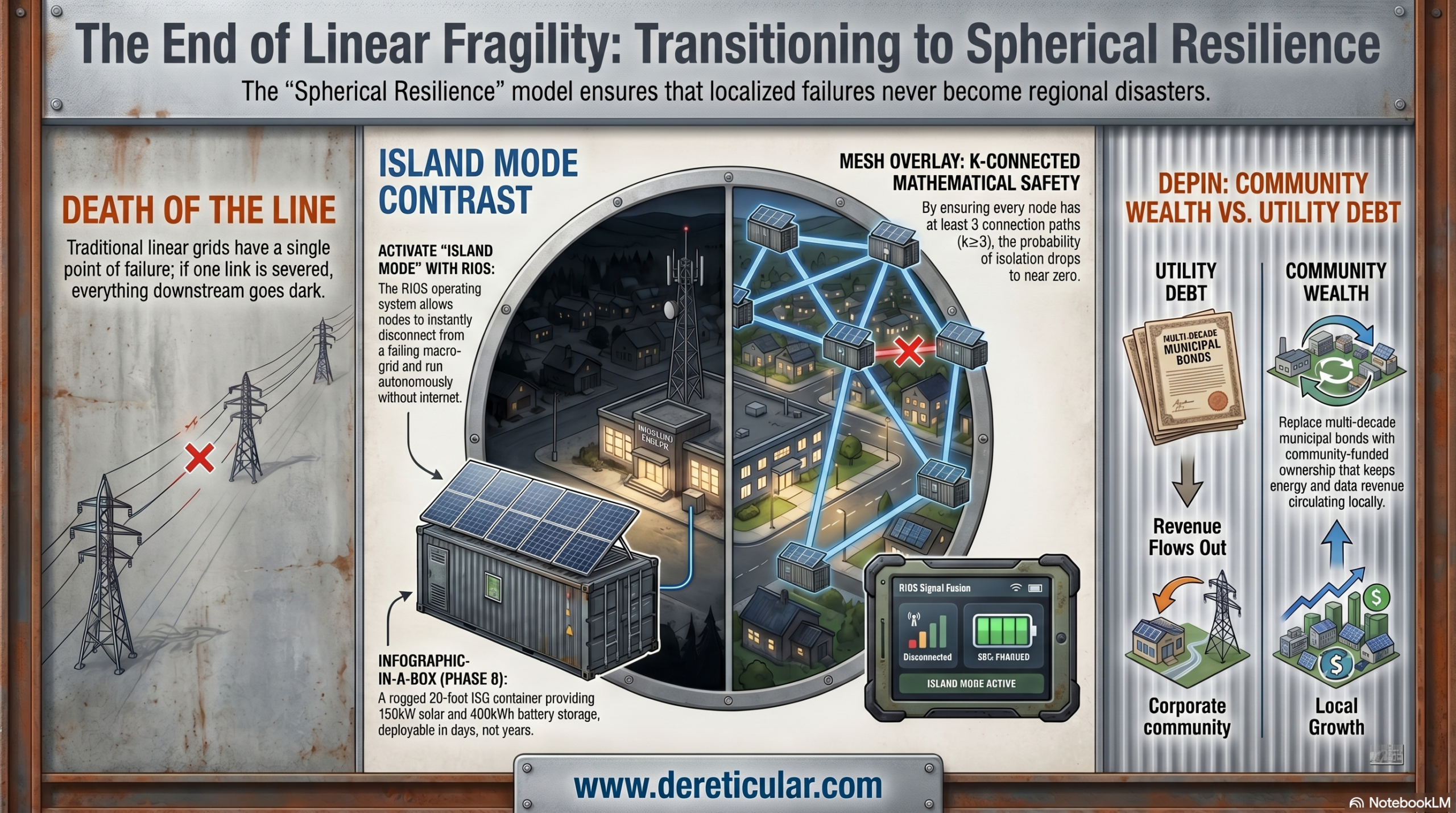
For over a century, the economic rationale for centralized infrastructure was predicated on the pursuit of economies of scale through “linear concentration.” By aggregating generation and routing it through high-capacity, non-redundant corridors—such as high-voltage transmission lines and long-haul fiber-optic backbones—municipalities minimized per-unit costs during periods of relative stability. However, in the current landscape of climate anomalies and cyber-physical threats, this model has transitioned into a strategic liability: “Linear Fragility.” A single severance in these rigid chains can isolate entire regional economies, transforming a localized fault into a systemic collapse.
The following table contrasts the mathematical and physical resilience of legacy topologies against the proposed decentralized mesh architecture:
| Metric | Linear/Tree Topology (Legacy) | Spherical Resilience (K-Connected Mesh) |
| Edge Connectivity (\lambda(G)) | \lambda(G) = 1; relies on a non-redundant route. | \lambda(G) \ge 3; multiple independent pathways. |
| Failure Propagation | High; single severances cascade downstream. | Low; “Island Mode” bounds failures to the node of origin. |
| Probability of Systemic Partition | $P_{\text{partition}} = 1 – (1 – p)^{ | E |
The economic consequences of this fragility are no longer theoretical; empirical insurance and utility data indicate that prolonged outages cost municipal economies millions of dollars per day in lost productivity, disrupted emergency services, and supply chain stagnation. This paralysis is exacerbated by the fact that legacy nodes possess a local autonomy factor of \theta_i \approx 0. Because these systems require constant “synchronization clock signals” and voltage references from the macro-grid to function, the loss of transmission results in immediate local service cessation. To address these vulnerabilities, we must move from the physical fragility of the “line” to a more resilient financial and operational model.
——————————————————————————–
2. The Capital Barrier: Evaluating the Shift from Centralized Debt to DePIN
The strategic transition toward resilient infrastructure is historically throttled by the capital barriers inherent in centralized funding. Traditional municipal bonds and sovereign debt models are optimized for high-density urban centers where the return-on-investment (ROI) is easily modeled. This leaves rural and marginalized regions in a state of chronic underinvestment. By shifting to Decentralized Physical Infrastructure Networks (DePIN), municipalities can leverage “CapEx Democratization,” utilizing modular, community-driven investment to bypass central planning bottlenecks.
The Municipal DePIN Economic Cycle:
- Local Investors/Co-ops: Regional stakeholders and cooperatives provide the initial capital, localizing the financial benefits.
- The Node as a Physical Asset: Ownership of the hardware (energy and data nodes) is fractionalized and represented on transparent, tamper-resistant ledgers, ensuring auditability and community trust.
- Incremental Expansion: Unlike multi-megawatt central plants that require all-or-nothing funding, the DePIN model supports modular growth. A city can secure a single critical facility—such as a water treatment plant—before scaling the network as capital becomes available.
- Localized Revenue Flow: Utility revenues and token rewards circulate within the community, turning the infrastructure into a wealth-retention vehicle rather than a capital drain to multinational corporations.
This democratization of capital provides the necessary foundation for the Microgrid-as-a-Service (MaaS) operational model, which further mitigates financial risk for the municipality.
——————————————————————————–
3. Transforming Infrastructure Costs: Microgrid-as-a-Service (MaaS) and OpEx Agility
Modernizing infrastructure often triggers budget paralysis due to massive upfront Capital Expenditure (CapEx). DeReticular’s architecture enables a transition to an Operating Expense (OpEx) model through service-based frameworks, allowing municipalities to pay for utility reliability as a service rather than a debt-heavy asset.
The “Phase 0” deployment model utilizes “Infrastructure-in-a-Box”—a standardized ISO container housing 150kW of solar and a 400kWh Battery Energy Storage System (BESS). This “Physical Seed” is deployed “Behind-the-Meter” (BTM), allowing it to bypass the multi-year utility study queues that often delay grid-tied projects for years.
The “MaaS” Framework:
- Hardware Durability and Depreciation: The systems are built for a 15-to-20-year depreciation cycle, utilizing LiFePO4 battery chemistry (rated for >6,000 cycles) and a 30kW hydrogen-ready auxiliary generator for continuous baseload support.
- Leasing and Service Contracts: Local cooperatives lease the hardware to the municipality via Power Purchase Agreements (PPAs), ensuring predictable, fixed utility fees.
- OpEx Reduction via RIOS: The Rural Infrastructure Operating System (RIOS) includes an advanced diagnostic engine. By utilizing “Field-Replaceable Units” (FRUs), maintenance is simplified; local technicians can swap modular components without the high cost of specialized external engineers.
This modular approach ensures that utility expenditures are converted into long-term community wealth retention rather than external debt service.
——————————————————————————–
4. Local Wealth Retention: Utility Revenue and Data Sovereignty
The shift toward “Sovereign Autonomous Infrastructure” is a move to keep metadata and energy revenues within regional borders. Under legacy models, regional intelligence and utility payments are exported, leaving the community both economically and operationally dependent on distant entities.
Data Sovereignty and Networking Protocols: The DeReticular model utilizes the Babel and OLSRv2 protocols to establish a peer-to-peer (P2P) mesh network. These protocols ensure that the local network maintains 100% functionality for intranodal services—including local telephony, emergency dispatch, and municipal database synchronization—even if the national fiber backhaul or satellite links are severed. This maintains the “Sovereignty” of regional communications during macro-scale failures.
Micro-Utility Revenue Opportunities: Municipalities can monetize surplus capacity within the mesh:
- Surplus Energy: Excess solar generation can be traded P2P between municipal buildings or local businesses.
- Localized Telecom: The mesh network can monetize its localized telecommunication routing and edge-compute cycles, creating new revenue streams for the municipality.
By securing these revenue and data streams locally, a community creates a practical roadmap for closing the structural gaps between legacy fragility and future resilience.
——————————————————————————–
5. Gap Analysis and the Strategic Roadmap to Resilience
Transitioning to spherical resilience requires a phased approach to bridge the technical and regulatory “deltas” inherent in legacy infrastructure.
| Dimension | Current State (Legacy) | Path to Resolution (Intervention) |
| Grid Topology | Linear/Tree configuration; single point of failure. | Deploy Phase 0 BTM nodes to establish immediate “Island Mode” capacity. |
| Asset Finance | Centralized debt (bonds); favors high-density urban areas. | Implement DePIN and MaaS frameworks for fractionalized community ownership. |
| Regulatory Compliance | Strict PUC oversight; multi-year interconnection study queues. | Leverage policies like California’s AB2175 or Colorado’s Microgrid Roadmap to bypass backlogs. |
Actionable Transition Roadmap (Months 1–18):
- Phase 1: Resilience Hubs (Months 1-3): Identify and map critical civil nodes (water, emergency, comms) and verify local regulatory boundaries.
- Phase 2: BTM Phase 0 Deployment (Months 4-6): Install “Infrastructure-in-a-Box” units behind the meter. This strategically bypasses the multi-year interconnection study queues imposed by investor-owned utilities (IOUs).
- Phase 3: Mesh Scaling (Months 7-18): Activate Babel/OLSRv2 protocols to link nodes into a k-connected regional mesh, enabling load-sharing and P2P data sovereignty.
This phased approach minimizes fiscal and regulatory risk while building an incrementally resilient regional network.
——————————————————————————–
6. Synthesis of Economic Risks and Benefits (SWOT Integration)
Objective feasibility analysis is critical when presenting decentralized models to utility commissioners. The transition must be framed as a risk-mitigation strategy.
Strategic Synthesis & DeReticular Action Plan:
- Challenge: High Initial CapEx: Mitigated by the DePIN model, which fractionalizes upfront costs through local investors and community cooperatives.
- Challenge: Technical Skill Deficits: Mitigated by the RIOS diagnostic engine and modular “Field-Replaceable Units” (FRUs), allowing local operators to maintain the system with minimal specialized training.
- Challenge: Regulatory & Supply Chain Hurdles: Mitigated by BTM deployment to avoid utility bottlenecks. Furthermore, the Infrastructure-in-a-Box chassis is “chemistry-agnostic,” allowing for the integration of alternative storage (e.g., sodium-ion batteries) if LFP supply chains face volatility.
The Leapfrog Dynamic: Rural and developing regions are uniquely positioned to “leapfrog” the centralized cloud phase entirely. Just as these regions skipped landlines for mobile telephony, they can now skip fragile, centralized grids in favor of autonomous economic ecosystems. This transition avoids the sunk costs of legacy systems and moves directly to a resilient, low-carbon future.
Final Summary: The transition to “Island Mode” architectures is a comprehensive upgrade to a Sovereign Autonomous Stack. By integrating a resilient physical layer, the RIOS operating system, and decentralized networking, communities decouple themselves from the “fragile line.” This secured energy, communications, and financial sovereignty ensures the municipality remains operational regardless of macro-grid health, securing its long-term economic future.