DeReticular Stationary (Sentry) Tier Strategic and Technical Overview
Executive Summary
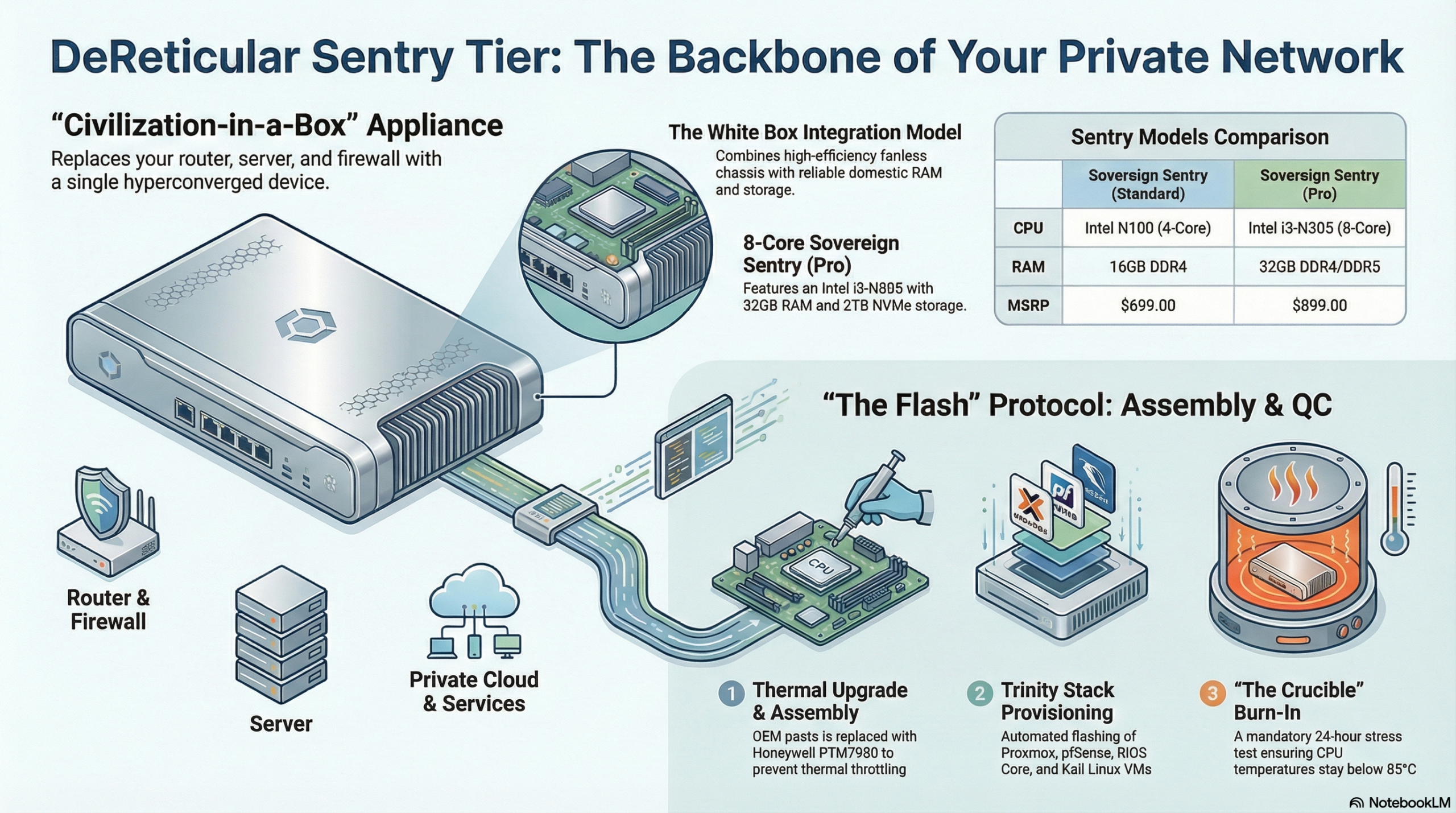
The DeReticular Stationary (Sentry) tier serves as the “Backbone” of the DeReticular network architecture. Unlike its mobile counterparts, the Sentry tier is engineered as a “Civilization-in-a-Box” appliance, prioritizing high availability, significant compute power, and robust network security. These units function as hyperconverged devices, replacing traditional routers, servers, and firewalls with a unified hardware-software stack.
Currently in its pilot phase (as of March 2026), the Sentry tier utilizes the RIOS “Trinity” Stack—comprising pfSense, RIOS Core, and Kali Linux—running on a Proxmox VE 8.x hypervisor. The product line follows a “White Box Integration Model,” leveraging high-performance fanless chassis from Shenzhen OEMs paired with domestically sourced, high-reliability components. Central to the Sentry’s value proposition is its rigorous assembly and testing protocol, “The Flash,” conducted at Node 3 in Arizona to ensure thermal stability and identity security through TPM 2.0 and Sovereign Key integration.
Product Architecture and Specifications
The Sentry tier is divided into three primary hardware configurations, ranging from entry-level nodes to high-performance “Deep Admin” powerhouses.
Sentry Product Matrix
| Feature | Sovereign Sentry (Standard) | Sovereign Sentry (Pro) | Mesh Beacon (Extender) |
| SKU | RIOS-SS-STD | RIOS-SS-PRO | RIOS-EXT-01 |
| Role | Entry-Level Node / Router | “Deep Admin” Powerhouse | Wireless Range Extender |
| CPU | Intel Processor N100 (4-Core) | Intel Core i3-N305 (8-Core) | ARM Cortex (Qualcomm/MediaTek) |
| RAM | 16GB DDR4 (3200MHz) | 32GB DDR4/DDR5 | 512MB – 1GB (Embedded) |
| Storage | 1TB NVMe SSD (Gen 3) | 2TB NVMe SSD (Gen 3/4) | N/A (Firmware Only) |
| Networking | 4x Intel i226-V 2.5GbE LAN | 4x Intel i226-V 2.5GbE LAN | Wi-Fi 6 (AX3000) + LoRaWAN |
| Cooling | Passive (Fanless Aluminum) | Passive (Heavy Finned Chassis) | Passive (IP67 Sealed) |
| Identity | TPM 2.0 Machine ID | TPM 2.0 + Sovereign Key | Hardware MAC ID |
| MSRP | $699.00 | $899.00 | $189.00 |
Supply Chain and Manufacturing Strategy
The Sentry tier employs a “White Box Integration Model” designed to balance cost-efficiency with component reliability.
- Chassis and Motherboards: Sourced from Shenzhen-based OEMs (CWWK, Topton, Protectli). This allows the project to leverage global economies of scale regarding fanless manufacturing.
- Memory and Storage: Sourced from USA-based distributors (Samsung, Crucial, Western Digital). This ensures localized warranty support and component reliability.
- Assembly and Integration: All final assembly, including the critical application of thermal interface materials and software flashing, is centralized at the Node 3 facility in Arizona.
Sovereign Sentry (Pro) Bill of Materials (BOM)
The Pro model features a specific selection of high-grade components:
- Chassis: Fanless i3-N305 with 4x i226-V ports.
- RAM: 32GB DDR4 3200MHz SODIMM (Crucial/TeamGroup).
- Storage: 2TB NVMe M.2 SSD (Samsung 970 EVO / WD Black).
- Thermal Management: Honeywell PTM7950 Phase Change Material (replacing standard OEM paste).
- Security: YubiKey 5C NFC (White Labeled as the “Sovereign Key”).
- Power: UL Listed 12V 5A DC Adapter.
Operational Workflow: “The Flash” Protocol
Fulfillment is executed through a five-station linear workflow at the Node 3 workshop to ensure every unit meets the “DeReticular Class 1 Node” standard.
Station A: Intake & Quality Control
Initial receipt involves a visual inspection of cooling fins and IO shield alignment. A POST test is conducted without RAM or SSD to verify motherboard health before proceeding.
Station B: Assembly and Thermal Upgrade
This station handles the critical mechanical integration. A key requirement is the removal of stock OEM thermal paste, replaced by Honeywell PTM7950 Phase Change Material. This upgrade is essential to prevent thermal throttling on the 8-core i3-N305 processor. Following thermal application, RAM and NVMe SSDs are seated and the chassis is sealed.
Station C: Provisioning (The Flash)
Units are connected to an imaging rack where an automated script (deploy_sentry.sh) executes the following:
- BIOS Flashing: Enables VT-d Virtualization and sets the unit to “Restore on AC Power Loss.”
- Hypervisor Installation: Deploys Proxmox VE 8.x.
- VM Deployment: Restores “Golden Image” snapshots for pfSense (Gatekeeper), RIOS Core (Ledger), and Kali Linux (Auditor, Pro version only).
- Security Provisioning: Generates unique Node UUIDs, SSH Host Keys, and burns the DeReticular Root Certificate to the TPM 2.0 chip.
Station D: The Crucible (Burn-In)
Every unit undergoes a 24-hour stress test using stress-ng and iperf3. Technicians monitor thermal sensors to ensure the CPU does not exceed 85°C and the chassis surface remains below 50°C. Units failing these benchmarks are returned to Station B for thermal re-servicing.
Station E: Kitting and Outbound
Final units are cleaned, labeled with tamper-evident serial numbers, and packed with a VESA mount, power supply, and a “Deep Admin” Rescue Drive (USB). Pro units include the pre-registered Sovereign Key. The package is sealed with holographic “DeReticular Class 1 Node” tape.
Software Stack and Security
The Sentry tier utilizes the RIOS “Trinity” Stack, which virtualizes three distinct environments to provide comprehensive network management:
- pfSense (Gatekeeper): Manages firewalling and perimeter security.
- RIOS Core (Ledger): Handles the core DeReticular networking and ledger protocols.
- Kali Linux (Auditor): Provided on Pro models for network auditing and security testing.
Security is anchored in hardware through the TPM 2.0 chip and the Sovereign Key, ensuring a verifiable and immutable machine identity.
Risk Register and Mitigation
The project identifies several technical and operational risks, addressed through specific hardware and software configurations.
| Risk ID | Description | Severity | Mitigation Strategy |
| R-THERM-01 | Thermal Throttling: Fanless i3-N305 overheating under AI load. | High | Mandatory Honeywell PTM7950 application; vertical placement recommended. |
| R-SOFT-01 | User Error: Corruption of Proxmox configuration. | Medium | Inclusion of a Rescue Drive (USB) for factory resets without data loss. |
| R-NET-01 | Port Confusion: Incorrect WAN/LAN cabling. | Low | Color-coded port identification (Blue for WAN, Yellow for LAN). |
| R-BIOS-01 | Power Loss: Unit failing to restart after blackout. | Medium | BIOS configuration “Restore on AC Power Loss” enforced during “The Flash.” |