Sustainability Monetization Strategy Project Umoja Kaabong
1. The Sovereign Industrial Stack: A Strategic Framework for Carbon Negativity
The Sovereign Industrial Stack is not merely a technical configuration; it is an institutional-grade risk-mitigation layer designed to insulate high-value industrial operations from the volatilities of fragile national grids and fragmented supply chains. By synthesizing agricultural biomass, advanced thermal conversion, and trustless digital verification, Project Umoja Kaabong establishes “Island Mode” sovereignty. This framework ensures that value generation is localized and deterministic, transforming regional resources into bankable, carbon-negative global assets.
The synergy of this stack is partitioned into the “Muscle,” the “Motion,” and the “Mind,” providing a redundant and optimized operational flow.
| Component | Branding | Strategic Sustainability Output | Digital Architecture |
| The Muscle | Agra Dot Energy | Baseload Waste-to-Energy via Plasma Gasification (10-11 MW). | IoT Sensor Mesh for real-time feedstock/energy telemetry. |
| The Motion | Kurb Kars | Autonomous logistics and NEMT (Non-Emergency Medical Transportation). | Agentic Workflows for robotic task allocation and fleet optimization. |
| The Mind | RIOS | Operating System for “Sovereign Stack” control and optimization. | Federated Learning Mesh: Node 3 (AZ) thermal data optimizing Node 4 (Uganda) performance. |
Node 4 functions as the “Green Industrial Engine,” a 7,000-acre Smart Eco-Industrial Park (SEIP) in Kaabong, Uganda. Its mission is the total transformation of raw biomass into high-value carbon assets within a circular economy. By internalizing the entire value chain—from cultivation to cryptographic verification—Node 4 eliminates “White Elephant” risks and establishes the bio-industrial engine as a self-sustaining utility heartbeat.
PODCAST – https://mikeh69.podbean.com/e/the-umoja-project
2. The Bio-Industrial Engine: Quantifying the Sequestration Pipeline
Industrial hemp coupled with plasma gasification represents the most scalable carbon sink currently available for institutional investment. Unlike traditional combustion or low-heat gasification, the ADE-GC-200 reactor dissociates molecules at the atomic level, ensuring complete carbon capture and high-purity syngas production without the parasitic pollutants associated with linear waste-to-energy models.
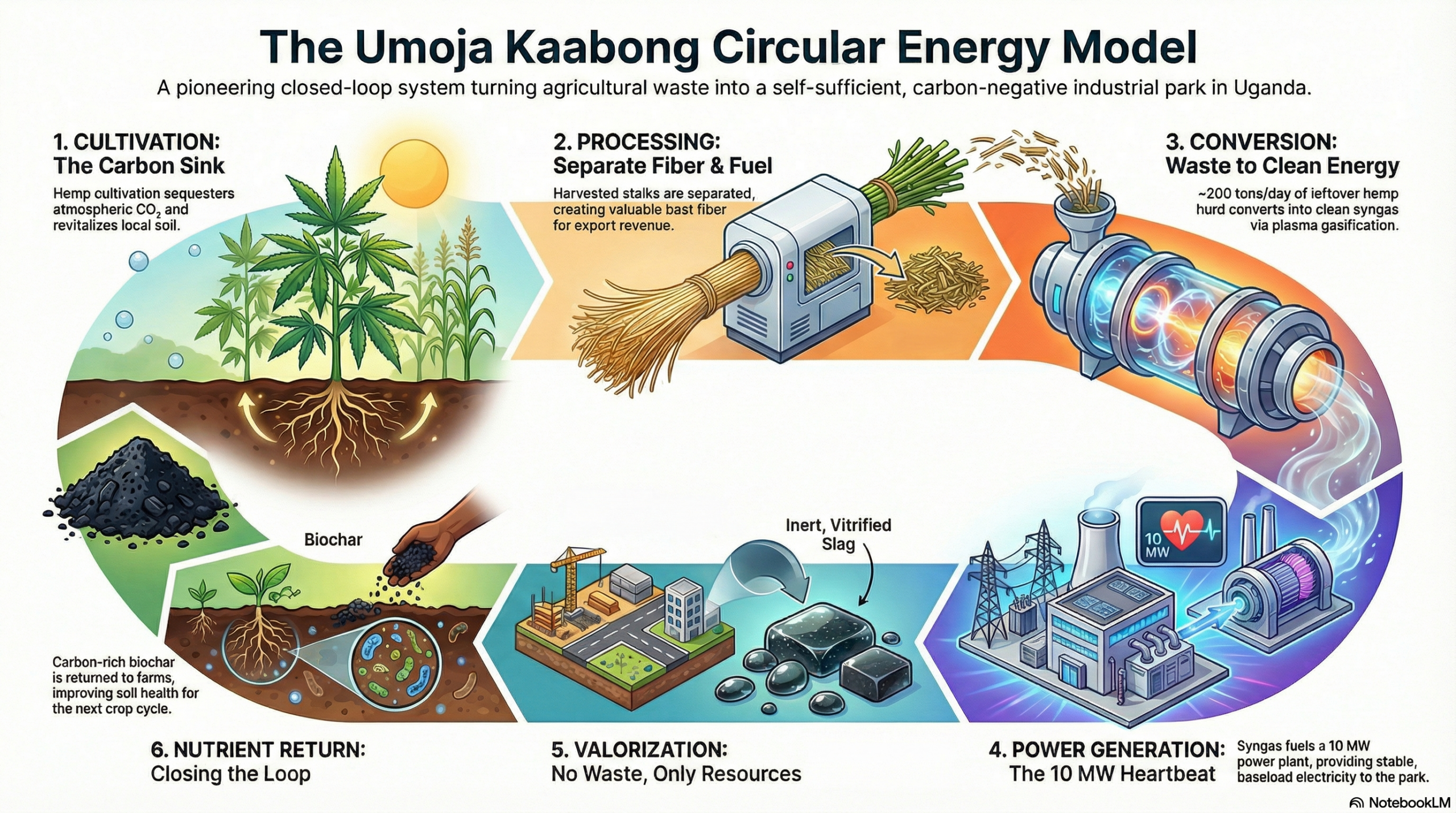
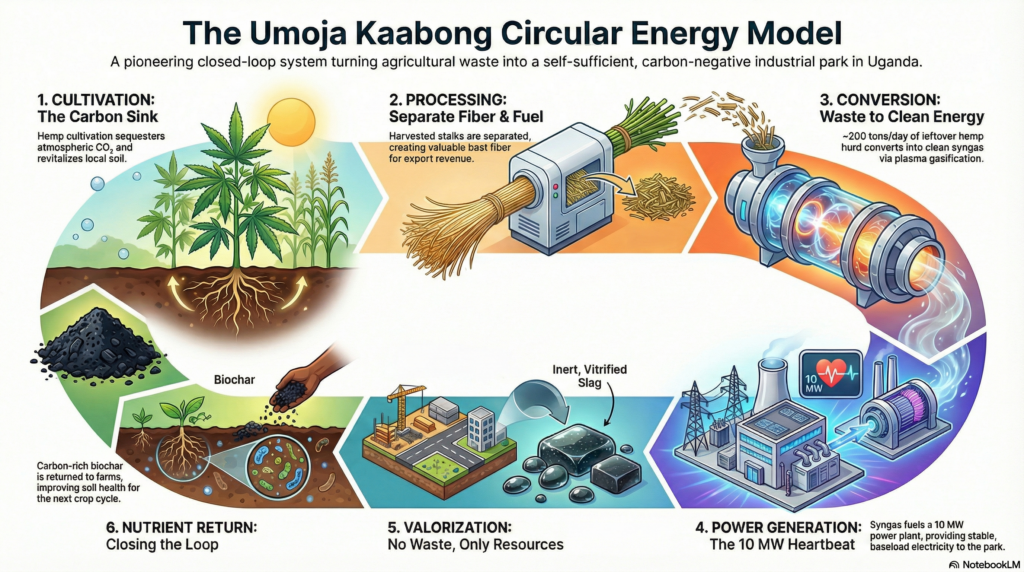
The sequestration architecture is defined by a Six-Stage Loop that ensures zero-waste-to-landfill integrity:
- Cultivation (The Carbon Sink): Industrial hemp yields a conservative 3.5 short tons of dried hurd per acre. Crucially, the hurd constitutes 65% of the dry weight of the stalk, representing a high-density carbon-negative feedstock.
- Harvest & Processing (Value Separation): Stalks are separated into high-value Bast Fiber and 200 tons/day of dried hurd.
- Thermal Conversion (The Alchemical Core): The ADE-GC-200 utilizes a 1.5 MW plasma reactor (Zirconia-lined) achieving temperatures exceeding 5,000°C. This dissociation prevents tar formation at the molecular level.
- Power Generation & Distribution: Clean syngas (H₂ + CO) fuels industrial gas engines to generate ~86,400 MWh of baseload electricity annually.
- Byproduct Valorization: Vitrified, non-leachable slag is repurposed as road aggregate, while surplus heat powers on-site processing.
- Nutrient Return: Carbon-rich ash and composted organic material are returned to the agricultural cooperative to revitalize soil health and enhance future yields.
The technical validity of this feedstock is confirmed by independent research:
“The analysis of hemp hurd confirms a Lower Heating Value (LHV) of 15.72 MJ/kg at 10% moisture. To achieve peak cold gas efficiency (estimated at 59.5%), the gasification process requires an Equivalence Ratio (ER) of 0.3 for tar-free operation.” — Pedrazzi et al., University of Modena and Reggio Emilia.
Plasma Gasification (ADE-GC-200) provides a two-layer solution to the “tar problem” identified in the Pedrazzi research: first, the >5,000°C plasma environment physically shatters complex polycyclic aromatic hydrocarbons (PAHs); second, the ADE-CO-500 control system maintains a deterministic ER of 0.3. This ensures a clean carbon profile that is ready for cryptographic verification.
3. The zkVerify Framework: Cryptographic Hashing of Environmental Truth
In the global ESG market, the zkVerify framework resolves the fundamental tension between operational privacy and institutional transparency. Through Zero-Knowledge Proofs (zk-proofs), Project Umoja Kaabong provides mathematical attestation of carbon-negative status without disclosing proprietary thermal recipes or internal logistics.
The ADE-CO-500 (“The Conductor”) manages this trustless verification pipeline:
- AI Digital Twins & Data Vaults: A real-time digital replica monitors feedstock density and reactor temperatures. Data is stored in secure, off-grid Data Vaults, preventing capital flight to centralized cloud providers and ensuring data sovereignty.
- Federated Learning: Optimization is not isolated; high-heat performance data from Node 3 (Arizona) is utilized via Federated Learning to optimize the efficiency of the Node 4 mesh in Uganda’s equatorial climate.
- Measurement, Reporting, and Verification (MRV) Protocol:
- Sensors quantify biomass input and energy output in real-time.
- Data is hashed via RIOS to create an immutable cryptographic record.
- A Regulator Dashboard allows for automated compliance auditing by government entities (UIA/UFZA) and international insurers.
This cryptographic MRV transforms “Natural Capital” into “Bankable Assets,” ensuring every ton of sequestered carbon is verified and deterministic.
4. Monetization Mechanisms: From Stranded Energy to Tradable Assets
The $30M investment is de-risked through a Diversified Revenue Stack (Streams A-D). While Stream A (Commodities) and Stream B (Energy Sales) provide local liquidity, the global upside is captured through Stream D (Carbon Credits) and the Green Compute model.
The Umoja Compute Core (UCC-1), a high-performance AI cluster consuming 1.8 MW of baseload power, converts “Stranded Energy” into “Global Data Revenue.” By processing AI workloads at a $0.07/kWh transfer price, the project bypasses national grid limitations.
| Feature | Standard Carbon Credits | Umoja Premium Verified Assets |
| Verification Method | Manual/Periodic Audits | Real-time zkVerify (zk-proofs) |
| Data Integrity | Estimated/Probabilistic | Cryptographically Proven/Deterministic |
| Value Drivers | Low-grade offsets | Biochar byproduct, Green SEZ, UCC-1 Integration |
| Market Value | Commodity Pricing | Premium Institutional Pricing (Article 6 Compliant) |
The internal rate of return (IRR) is further enhanced by Ugandan Green Special Economic Zone (SEZ) incentives, including VAT exemptions on green equipment imports and reduced Corporate Income Tax (CIT). These incentives are unlocked by the Extended Cost Benefit Analysis (eCBA) mandated by 2024 Ugandan Guidelines and verified by the RIOS Regulator Dashboard.
5. Institutional Certification and Risk Mitigation
Alignment with the Paris Agreement Article 6 and Verra standards is a prerequisite for Tier-1 investment. Project Umoja Kaabong achieves this through “Geological Truth”—drone-supported surveys using MagArrow magnetometers and Medusa MS 1000 gamma-ray sensors to map soil composition and biomass density. This data justifies the eCBA and ensures that carbon modeling is site-specific and scientifically beyond reproach.
SWOT Analysis: Monetization & Operational Strategy
| Strengths | Weaknesses |
| Complete energy and feedstock sovereignty. | High system complexity and interdependence. |
| Trustless zk-verification for premium pricing. | Specialized Human Capital requirement. |
| Opportunities | Threats |
| Global demand for “Green Compute” assets. | Climate-related agricultural risks (drought). |
| Ugandan Green SEZ tax and regulatory incentives. | Market volatility for Bast Fiber/Byproducts. |
Institutional Readiness GAP Analysis
- Offtake Agreement Development: Finalizing binding agreements for 100% of Bast Fiber and Vitrified Slag output.
- MRV Protocol Launch: Deployment of the automated Regulator Dashboard for real-time verification access.
- Human Capital Pipeline: Launching the Umoja Kaabong Scholars Program and the RCT-Professional certification path via the DeReticular Academy to ensure operational continuity.
6. Strategic Roadmap: Phased Deployment of the Energy Heartbeat
The deployment utilizes the “Infrastructure-in-a-Box” model to prevent industrial failure and ensure self-funding scalability.
- Phase 0: Site Readiness (Q2, Year 1): Deployment of 150 kW Solar array and 400 kWh BESS (Battery Energy Storage System) to establish a powered construction laydown area.
- Phase 1 & 2: The Bridge Plant (Q4, Year 2): Commissioning of the 1 MW modular plant (ADE-SPS-1MW-NA). This unit acts as a Commercial Validator, generating empirical data for the final capital call while powering initial processing.
- Phase 3 & 4: Full Scale (Q4, Year 5): Activation of the 10 MW main plant and the Umoja Compute Core (UCC-1). Transition to an N+1 redundant microgrid for full commercial operation.
Project Umoja Kaabong is more than a power plant; it is the “Heartbeat of Umoja”—an alchemical process rooted in Ugandan soil that converts agricultural waste into the world’s most secure digital and physical assets. This is the blueprint for sovereign, carbon-negative industrialization. The data is live, the infrastructure is landing, and the future of institutional ESG is here.