
Sovereign Legal Shielding: Understanding Wyoming DUNA and Cryptographic Charters for Decentralized Startups
- The Legacy Corporate Friction and the General Partnership Trap
Modern decentralized startups, Web3 protocols, and autonomous digital communities face structural legal and financial friction when launching within industrial-era commercial frameworks. Historically, founders seeking legal recognition were forced into centralized structures like Delaware C-Corporations. However, when decentralized organizations attempt to operate without a formal legal wrapper, they fall directly into a major judicial hazard known as the General Partnership Trap.
Under common law and statutory legal frameworks such as the Uniform Partnership Act, any association of two or more persons engaging in joint business activities for profit defaults automatically to an unincorporated General Partnership. In seminal federal enforcement actions and court rulings—such as CFTC v. Ooki DAO (2023) and Snek v. bZx DAO—courts established two alarming legal precedents:
- Decentralized Autonomous Organizations (DAOs) operating without an incorporated wrapper are legally classified as general partnerships.
- Every individual token holder who casts a governance vote, submits a proposal, or participates in community discussions incurs joint and several personal liability for all protocol debts, software exploits, regulatory infractions, and legal judgments facing the entity.
This legal default exposes governance voters to personal bankruptcy, as a creditor or regulatory body can seize the personal assets (homes, bank accounts, savings) of any individual participant to satisfy 100% of the protocol’s total obligations.
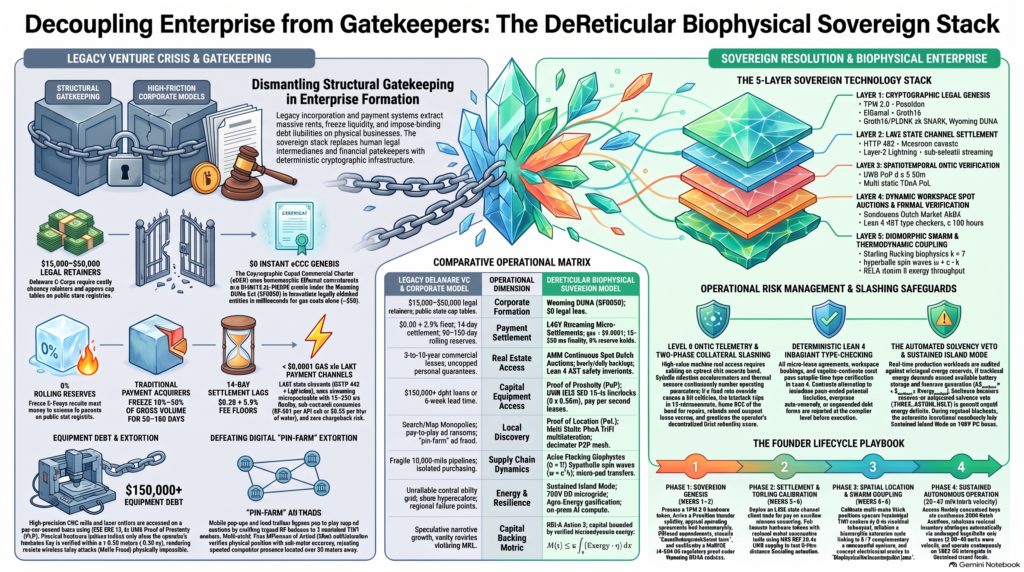
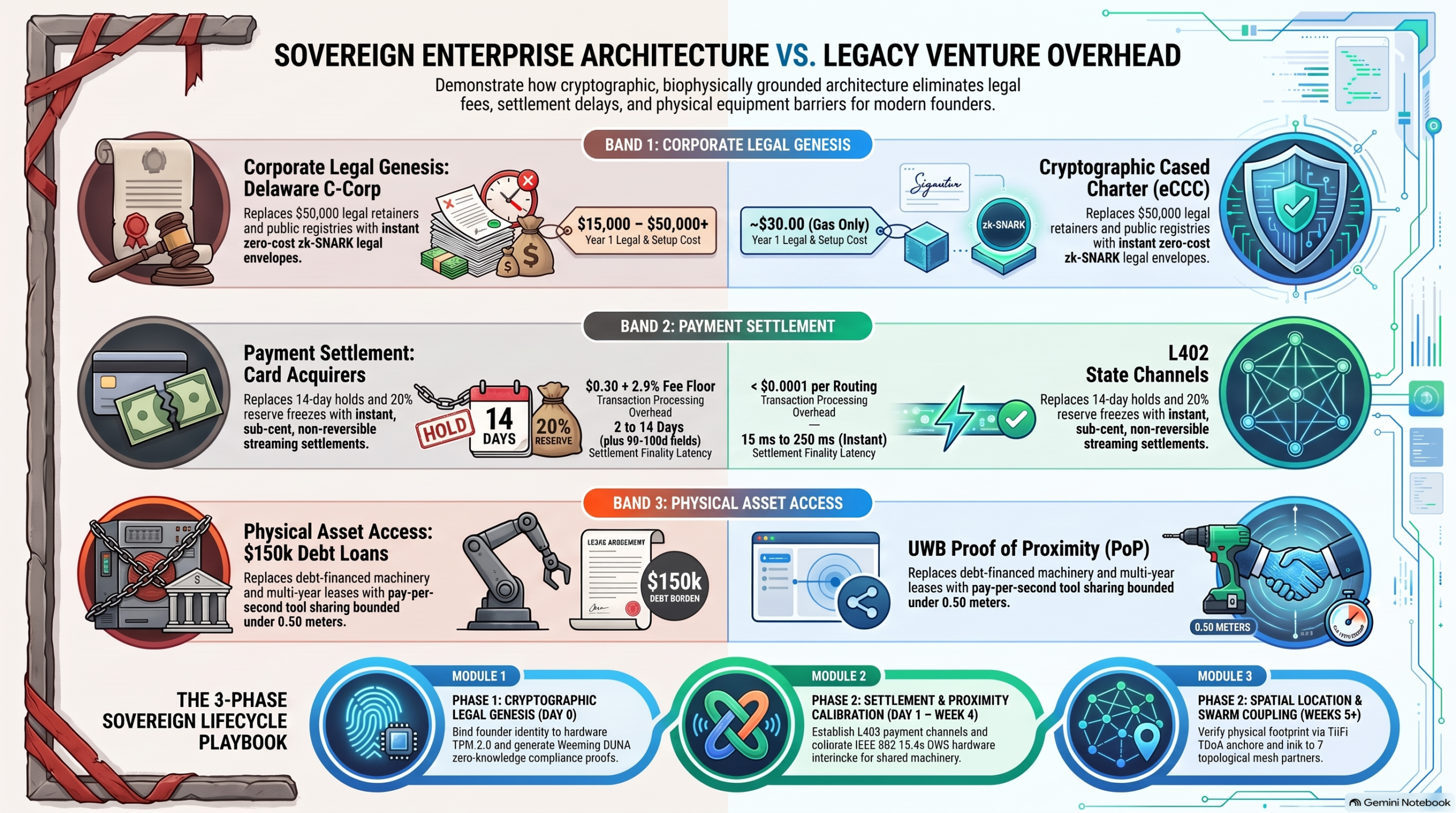
Conversely, attempting to wrap a Web3 startup in a legacy corporate structure introduces a crippling Venture-Legal Tax. Standard incorporation in jurisdictions like Delaware requires high initial legal retainers ($15,000 to 50,000+), ongoing maintenance fees (5,000 to $15,000 annually for CPAs, registered agents, and franchise taxes), continuous software subscription costs for equity management (e.g., $3,000+ per year for Carta or Pulley), and total exposure to public cap table surveillance on state registries.
To understand why traditional frameworks fail modern Web3 builders, consider the structural vulnerabilities contrasting legacy corporations with unwrapped DAOs:
- Unwrapped DAO Default (General Partnership):
- Liability Boundary: Zero personal protection; joint and several liability exposes individual participants’ personal assets to all protocol losses and judgments.
- Governance Mechanics: Algorithmic voting recognized legally as partner decisions, creating vicarious liability for every voter.
- Setup & Maintenance Overhead: Zero dollar initial fee, but introduces existential risk of catastrophic legal liability.
- Privacy & Disclosure: Completely transparent on-chain trails that dox individual voters to legal discovery without providing legal entity protection.
- Legacy Delaware C-Corporation:
- Liability Boundary: Strong personal corporate veil protection, but mandates rigid, hierarchical management (Boards of Directors, corporate secretaries, physical shareholder meetings).
- Governance Mechanics: Requires manual natural-language paper contracts, wet signatures, and human legal intermediaries that cannot execute at machine speed.
- Setup & Maintenance Overhead: Heavy financial drain ($24,800 to $60,000+ in Year 1) that starves early-stage ventures of operational capital.
- Privacy & Disclosure: Cap tables exposed to legal counsel, SaaS platforms, state corporate registries, and targeted commercial intelligence gathering.
Because legacy corporate wrappers impose prohibitive overhead and unwrapped DAOs expose founders to personal ruin, decentralized startups require a Web3-native statutory entity shield to anchor their on-chain operations.
- The Statutory Anchor: The Wyoming DUNA Act (SF0050) Unpacked
Enacted as Wyoming Senate File SF0050, the Wyoming Decentralized Unincorporated Nonprofit Association (DUNA) Act (codified at Wyo. Stat. § 17-31-101 et seq.) provides a Web3-native statutory shield. It provides decentralized protocols with legal recognition without forcing them into legacy corporate hierarchies.
The DUNA Act rests on three foundational statutory pillars:
- Entity Shielding and Separate Legal Personality (Wyo. Stat. § 17-31-104): A DUNA is recognized as a distinct legal person separate from its token holders and members. It holds the independent statutory capacity to enter into contracts, sue and be sued, acquire and hold real or personal property, open bank accounts, and own intellectual property.
- Comprehensive Limited Liability Protection (Wyo. Stat. § 17-31-106): The statute explicitly dictates that any debt, obligation, or liability of the association belongs solely to the association itself. Individual members, administrators, and governance voters are fully protected from personal liability solely by reason of participating in the association.
- Consensus Protocols as Governing Principles (Wyo. Stat. § 17-31-102(a)(iv)): The Act legally recognizes software protocols, smart contracts, and distributed consensus mechanisms as valid, legally binding “governing principles.” An organization’s formal bylaws can exist entirely as code deployed on a public ledger.
The “Nonprofit” Misconception
A common point of confusion is the term “Nonprofit” in the DUNA statute. A DUNA is not a 501(c)(3) public charity. Under Wyo. Stat. § 17-31-105, a DUNA is explicitly permitted to engage in commercial, for-profit operations, collect transaction fees, run decentralized exchanges or compute networks, generate net revenue, and accumulate commercial capital reserves.
What makes the entity “nonprofit” under Wyoming law is the non-distribution constraint: the association cannot pay raw net profits or direct cash dividends straight to passive token holders purely in their capacity as equity holders.
[ PROHIBITED ] Direct Net Profit ───► Passive Dividend ───► Token Holder Account
Instead, the statute explicitly outlines allowed value transfer mechanisms that reward active contribution and ecosystem growth:
Allowed Value Transfer Mechanisms under Wyoming DUNA (§ 17-31-105):
- Service Compensation: Reasonable payment for active work rendered (e.g., developer grants, security audits, administrative tasks).
- Infrastructure & Goods Payments: Direct compensation for physical assets, server capacity, or energy (e.g., microgrid power, compute leasing).
- Expense Reimbursements: Refunding operational costs incurred by members on behalf of the association.
- Staking & Liquidity Rewards: Programmatic yield and rewards paid to network participants in exchange for active protocol security, liquidity provision, or network maintenance.
- Common-Purpose Funding: Allocating treasury resources toward the growth of the shared ecosystem (e.g., open-source software development, legal defense reserves).
Taxation Architecture
The DUNA framework solves the historical “DAO tax deadlock”—where DAOs were unable to file taxes without exposing every member to pass-through audits on their individual tax filings.
Under federal tax regulations (Treas. Reg. § 301.7701-3), a domestic DUNA can file IRS Form 8832 to elect corporate tax status:
- Subchapter C C-Corporation Election (IRS Form 1120): The DUNA pays federal income taxes on its net commercial margins directly from its on-chain corporate treasury. This entity-level tax settlement isolates individual members from unexpected personal tax burdens.
- Subchapter T Cooperative Taxation (IRC §§ 1381–1388): For associations structured as decentralized producer networks (e.g., shared machine shops or GPU compute clusters), the entity can elect cooperative taxation. Under Subchapter T, “patronage dividends” paid out to members based on their active business volume with the cooperative are tax-deductible from the DUNA’s gross taxable income, eliminating double taxation.
While the Wyoming DUNA Act provides an essential legal shield under state law, running a decentralized startup requires wrapping this legal baseline inside a technical cryptographic container to manage on-chain operations.
- The Technical Container: Cryptographic Cased Commercial Charters (eCCC)
The Cryptographic Cased Commercial Charter (eCCC) draws its design from an ancient legal invention: the Mesopotamian cased clay tablet used in third-millennium BCE Babylonian commerce.
ANCIENT BABYLONIAN CASED TABLET CRYPTOGRAPHIC CASED CHARTER (eCCC)
┌───────────────────────────────────────┐ ┌───────────────────────────────────────┐
│ OUTER CLAY ENVELOPE: │ │ OUTER ENVELOPE (T_env) – zk-SNARK: │
│ Public abstract, magistrate seal, │ ───► │ Public validity proof (Groth16/PLONK) │
│ witness hashes; protects core tablet. │ │ Proves legal/tax statutory compliance.│
│ ┌─────────────────────────────────┐ │ │ ┌─────────────────────────────────┐ │
│ │ INNER CORE TABLET: │ │ │ │ INNER CORE (T_core) – ElGamal: │ │
│ │ Full cuneiform agreement, debt, │ │ │ │ Encrypted cap table, bylaws, │ │
│ │ interest, and trade secrets. │ │ │ │ operating rules, & IP claims. │ │
│ └─────────────────────────────────┘ │ │ └─────────────────────────────────┘ │
└───────────────────────────────────────┘ └───────────────────────────────────────┘
In antiquity, an original legal instrument was written on an inner clay tablet and then encased in an outer clay envelope containing a summary and magistrate seal. If a dispute arose, a magistrate examined the outer envelope; if tampering was suspected, the outer casing was broken to verify the untouched inner core.
The eCCC transposes this dual-envelope concept to public blockchains:
- The Inner Core (T_{\text{core}}): Represents the private operating reality of the venture (\mathcal{O}), generated via an additive homomorphic commitment scheme (such as Exponential ElGamal over an elliptic curve group \mathbb{G} of prime order q with generator g and public key h = g^x): T_{\text{core}} = \operatorname{Enc}(\mathcal{O}, r) = \left( g^r, h^r \cdot g^{\mathcal{O}} \right) \quad \text{for random scalar } r \in \mathbb{Z}_q
- The Outer Envelope (T_{\text{env}}): A non-interactive zero-knowledge proof (\pi) synthesized over an arithmetic constraint circuit \mathcal{C}{\text{DUNA}}: \pi \leftarrow \operatorname{Prove}\left( \text{CRS}, \vec{x}{\text{public}}, \vec{w}_{\text{private}} \right)
Where the circuit parameter vectors are explicitly defined as:
- Public Inputs (\vec{x}{\text{public}}): \vec{x}{\text{public}} = \left{ \text{Hash}(T_{\text{core}}), \text{TaxEscrowCommitment}, \text{DUNA_Statutory_ID}, \text{EpochTimestamp} \right}
- Private Witnesses (\vec{w}{\text{private}}): \vec{w}{\text{private}} = \left{ \mathcal{O}, r, \sigma_{\text{TPM_Founders}}, \text{SolvencyBalance} \right}
- Circuit Predicate: \mathcal{C}{\text{DUNA}}(\vec{x}{\text{public}}, \vec{w}{\text{private}}) = 1 \iff \begin{cases} \operatorname{VerifySignature}(\sigma{\text{TPM}}, \mathcal{O}) = 1 \ \operatorname{SumEquity}(\mathcal{O}) == 100% \ \text{SolvencyBalance} \ge \text{MinimumTaxReserve} \ \text{GovernanceStructure} \in {\text{DUNA}, \text{DAO_LLC}, \text{RicardianCoop}} \end{cases}
Evaluation Criteria Inner Core (T_{\text{core}}) Outer Envelope (T_{\text{env}})
Cryptographic Primitive Additive Homomorphic Commitments (Exponential ElGamal / Pedersen over prime-order group \mathbb{G}) Non-Interactive Zero-Knowledge Proofs (zk-SNARKs via Groth16 or PLONK)
Data Content Confidential operating reality (\mathcal{O}): exact equity share counts, vesting schedules, internal margins, voting polynomials, IP rights Proof of statutory compliance (\pi), tax escrow funding status, valid founder hardware signatures (\sigma_{\text{TPM}})
Visibility & Access Private and encrypted; stored on-chain as ciphertexts \left( g^r, h^r \cdot g^{\mathcal{O}} \right) Fully public and readable on-chain by any smart contract, verifier, or regulatory authority
Verification Mechanism Homomorphic state transformations and threshold secret key decryption On-chain arithmetic constraint circuit verification (\mathcal{C}_{\text{DUNA}}) evaluated in milliseconds
Machine-Readable Invariant Verification via Lean 4
To eliminate the ambiguity of human legal language, the eCCC subjects its operational bylaws to formal verification before contract deployment. Using Abstract Syntax Trees (ASTs) inside the Lean 4 interactive theorem prover, the charter’s rules are mathematically checked to guarantee safety bounds.
The Lean 4 verification gate defines structural properties, an evaluation predicate, and an executable formal theorem proving charter validity:
— Lean 4 Formal Verification Gate for Sovereign Charters
structure CasedCharterInvariant where
total_equity_basis_points : Nat
founder_liability_bounded : Bool
tax_escrow_funded : Bool
statutory_code : String
def verify_charter_safety (c : CasedCharterInvariant) : Prop :=
c.total_equity_basis_points = 10000 ∧
c.founder_liability_bounded = true ∧
c.tax_escrow_funded = true ∧
c.statutory_code = “WYO_STAT_17_31_DUNA”
theorem charter_is_valid (c : CasedCharterInvariant)
(h1 : c.total_equity_basis_points = 10000)
(h2 : c.founder_liability_bounded = true)
(h3 : c.tax_escrow_funded = true)
(h4 : c.statutory_code = “WYO_STAT_17_31_DUNA”) :
verify_charter_safety c := by
dsimp [verify_charter_safety]
exact ⟨h1, h2, h3, h4⟩
By committing the compiled cryptographic digest of this formal Lean 4 proof to the blockchain, the startup mathematically proves that contradictory, circular, or predatory clauses cannot exist within its deployed legal structure.
Beyond casing the corporate charter, a sovereign startup must also manage its capitalization table on public ledgers without exposing sensitive equity data.
- Privacy-Preserving Equity: Homomorphic Capitalization Tables
Publishing an enterprise cap table in raw plaintext on a public smart contract introduces severe commercial vulnerabilities:
- Hostile Commercial Intelligence: Market competitors can track exact token balances, founder vesting milestones, and treasury reserves to execute economic attacks, short-sell tokens ahead of unlocks, or exploit upcoming dilution events.
- Targeted Coercion and Phishing: Doxing key executives and investors on-chain exposes them to targeted spear-phishing, SIM-swapping, physical extortion, and kidnap-and-ransom risks.
- Data Privacy Non-Compliance: Unshielded public cap tables permanently link investor metadata to immutable ledgers, violating global data privacy regulations like the European Union’s GDPR (“Right to be Forgotten”) and California’s CCPA.
Mechanics of Additive Homomorphic Encryption
To resolve these vulnerabilities, startups utilize a Homomorphic Capitalization Table. Let the share balance of member i be s_i \in \mathbb{Z}q. The encrypted on-chain balance tuple is represented as: \mathbf{C}i = (c{i,1}, c{i,2}) = \left( g^{r_i}, h^{r_i} \cdot g^{s_i} \right)
- Encrypted Balance Transfers: If member i transfers an encrypted quantity of shares \Delta s to member j, the network calculates updated balances directly on the ciphertexts using scalar division and multiplication without decrypting the underlying values: \mathbf{C}i’ = \mathbf{C}i \oslash \operatorname{Enc}(\Delta s) = \left( \frac{c{i,1}}{g^{r{\Delta}}}, \frac{c_{i,2}}{h^{r_{\Delta}} \cdot g^{\Delta s}} \right) = \operatorname{Enc}(s_i – \Delta s) \mathbf{C}j’ = \mathbf{C}j \odot \operatorname{Enc}(\Delta s) = \left( c{j,1} \cdot g^{r{\Delta}}, c_{j,2} \cdot h^{r_{\Delta}} \cdot g^{\Delta s} \right) = \operatorname{Enc}(s_j + \Delta s)
- Pro-Rata Dilution (Scalar Exponentiation): When new capital is raised and an issuance factor \alpha = (1 – \text{dilution_rate}) is applied, every stakeholder’s equity balance is scaled simultaneously across the encrypted space: \mathbf{C}i^{\text{diluted}} = (\mathbf{C}i)^\alpha = \left( (c{i,1})^\alpha, (c{i,2})^\alpha \right) = \left( g^{\alpha r_i}, h^{\alpha r_i} \cdot g^{\alpha s_i} \right) = \operatorname{Enc}(\alpha \cdot s_i)
Zero-Knowledge Invariant Proofs
To prevent bad actors from secretly minting phantom shares or creating negative equity balances, every state transition requires an accompanying zk-SNARK proof asserting three mathematical invariants:
┌────────────────────────────────────────────────────────────────────────┐
│ ZERO-KNOWLEDGE INVARIANT PROOFS │
├────────────────────────────────────────────────────────────────────────┤
│ 1. NON-NEGATIVITY RANGE PROOF (π_range) │
│ π_range ⊢ s_i ∈ [0, 2^32 – 1] (No underflows / negative equity) │
├────────────────────────────────────────────────────────────────────────┤
│ 2. CONSERVATION OF SHARE SUPPLY (π_conservation) │
│ π_conservation ⊢ ∑ s_i == TotalAuthorizedShares (No phantom minting)│
├────────────────────────────────────────────────────────────────────────┤
│ 3. ACCREDITED IDENTITY PROOF (π_identity) │
│ π_identity ⊢ Poseidon(DID, Salt) == AuthorizedNullifier (Passed KYC)│
└────────────────────────────────────────────────────────────────────────┘
- Non-Negativity Range Proof: Proves that an account balance remains positive: \pi_{\text{range}} \vdash s_i \in [0, 2^{32} – 1]
- Conservation of Share Supply: Proves that transfers do not inflate the total equity base: \pi_{\text{conservation}} \vdash \sum_{i=1}^N s_i = \text{TotalAuthorizedShares}
- Accredited Entity Membership: Confirms compliance without leaking real-world identities: \pi_{\text{identity}} \vdash \operatorname{Poseidon}(\text{DID}, \text{Salt}) = \text{AuthorizedNullifier}
Selective Disclosure via (k, n)-Threshold Decryption
To satisfy statutory tax audits and corporate filing requirements (such as annual IRS Form 1120 filings), the master private key x (where h = g^x) is split using Shamir’s Secret Sharing into n polynomial key shares.
      ┌──────────────────────────────────────────────────┐
      │ MASTER PRIVATE DECRYPTION KEY (x)                │
      └─────────────────────────┬────────────────────────┘
                                │
           Splits via Shamir Secret Sharing (k-of-n)
                                │
 ┌──────────────────┬───────────┴───────────┬──────────────────┐
 ▼                  ▼                       ▼                  ▼
┌─────────┐ ┌──────────────┐ ┌─────────────────┐ ┌──────────────┐
│ Share 1 │ │ Share 2 │ │ Share 3 │ │ Share 4 │
│ DUNA │ │ Enterprise │ │ Decentralized │ │ Sovereign │
│ Contract│ │ CPA / Auditor│ │ Arbitration Panel│ │ Multisig │
└─────────┘ └──────────────┘ └─────────────────┘ └──────────────┘
These key shares are distributed across n distinct entities:
- The DUNA automated compliance smart contract
- The startup’s Certified Public Accountant (CPA)
- A decentralized dispute arbitration panel
- The enterprise sovereign multisig
When a formal tax or regulatory audit is legally required, k of these key holders collaborate to reconstruct the master key or generate partial decryptions via Lagrange interpolation: x = \sum_{j=1}^k \lambda_j x_j \pmod q
This unlocks the plaintext cap table strictly for the requested historical snapshot, satisfying legal requirements without revealing ongoing operational data to the public ledger.
These cryptographic cap tables, when combined with Wyoming DUNA statutory shielding, form a complete operational stack that can be evaluated against legacy corporate structures.
- Architectural Comparison: Legacy vs. Offshore vs. Sovereign eCCC + DUNA Stack
When evaluating entity formation options, startups historically had to choose between rigid domestic corporate wrappers or complex offshore foundation structures. The Sovereign eCCC + Wyoming DUNA Stack provides a third path designed natively for decentralized operations:
Evaluation Dimension Traditional Delaware C-Corp Model Offshore Foundation Model (Cayman / Panama) Sovereign eCCC + Wyoming DUNA Stack
Statutory Basis DGCL (8 Del. C. § 101 et seq.) Special Economic Zone Acts / Trust Laws Wyo. Stat. § 17-31-101 et seq. (SF0050)
Legal Personality & Entity Shield Yes (Traditional corporate legal person) Yes (Orphan foundation / company structure) Yes (Full statutory entity shielding, § 17-31-104)
Personal Liability Protection Yes (Protected via corporate veil) Variable (Shielded via external trust structure) Yes (Statutory liability shield, § 17-31-106)
Year 1 Setup & Maintenance Cost $24,800 – 60,000+ (15k–$50k legal retainers + fees) $55,000 – 130,000+ (40k–$100k setup + retainers) ~$30 Total (Gas-only deployment via factory)
Cap Table Privacy None (Exposed on state registries and SaaS platforms) Low (Subject to offshore registry disclosures) Absolute (Homomorphic FHE ciphertexts + ZK proofs)
Tax Filing Capability High (Standard IRS Form 1120 C-Corp filing) Extremely Complex (CFC / PFIC tax reporting traps) Standardized (Elects Form 1120 or Subchapter T)
Machine-to-Machine / AI Agent Readiness Impossible (Requires wet signatures and human directors) Minimal (Requires human nominee councils) Native (Executes via smart contracts & L402 state channels)
Regulatory Verification Speed Weeks (Manual legal discovery and stock ledger audits) Months (Letters rogatory and cross-border subpoenas) Sub-second (Algorithmic zk-SNARK validity proofs)
Financial Efficiency Highlight
The economic difference between these models is stark. Traditional Delaware formations demand between $15,000 and 50,000 in upfront legal retainers, alongside thousands in annual maintenance, registered agent, and cap table management subscriptions. Offshore foundations require even greater capital reserves (40,000 to $100,000+ initially).
By contrast, the Sovereign eCCC + DUNA Stack compiles directly through open-source factory smart contracts. The entire Year 1 legal and operational deployment cost drops from tens of thousands of dollars down to ~$30 in network execution gas fees, delivering institutional-grade legal protection at virtually zero marginal cost.
With this structural architecture understood, founders can execute the concrete steps needed to deploy a sovereign startup instance.
- Founder Execution Roadmap: 4-Stage Sovereign Initialization
To deploy a legally shielded, cryptographically cased entity, founding teams follow a sequential, four-stage implementation plan:
┌────────────────────────────────────────────────────────────────────────┐
│ SOVEREIGN INITIALIZATION TIMELINE │
├────────────────────────────────────────────────────────────────────────┤
│ STAGE 1: IDENTITY INSCRIPTION (DAY 1) │
│ • Provision TPM 2.0 enclave & derive Poseidon identity nullifiers. │
├────────────────────────────────────────────────────────────────────────┤
│ STAGE 2: CHARTER SPECIFICATION & PROOF SYNTHESIS (DAY 1) │
│ • Write YAML manifest, run Lean 4 verification, generate Groth16 proof.│
├────────────────────────────────────────────────────────────────────────┤
│ STAGE 3: ON-CHAIN FACTORY DEPLOYMENT (DAY 2) │
│ • Execute CasedDUNACharter.sol, bind statutory hashes, mint instance.│
├────────────────────────────────────────────────────────────────────────┤
│ STAGE 4: LIQUIDITY & OPERATIONAL COUPLING (DAY 2 ONWARD) │
│ • Connect L402 state channels, automate 21% tax escrow, issue equity. │
└────────────────────────────────────────────────────────────────────────┘
Stage 1: Identity Inscription (Day 1)
- Hardware Enclave Provisioning: The founder initializes an on-chip TPM 2.0 hardware security element or workstation secure enclave.
- Poseidon Nullifier Derivation: An asymmetric keypair is generated over elliptic curves, and a zero-knowledge identity nullifier is derived: \text{Nullifier} = \operatorname{Poseidon}(\text{PrivateKey}, \text{Salt}) This establishes immutable on-chain cryptographic identity while protecting real-world personal data from public registry surveillance.
- Threshold Key Setup: Secret scalar key shares are derived and distributed to setup participants for future threshold cap table auditing.
Stage 2: Charter Specification & Proof Synthesis (Day 1)
- Manifest Parameterization: The team specifies corporate bylaws, initial equity allocations, and management rules in a structured manifest (CharterManifest.yaml).
- Lean 4 Formal AST Verification: The bylaws are compiled through the Lean 4 type-checker to formally verify safety invariants (confirming equity sums to 10,000 basis points, founder liability is bounded, and tax escrow rules are active).
- Compliance Proof Generation: Using local zk-SNARK toolchains (e.g., snarkjs or bellman), the team generates the Groth16 zero-knowledge compliance proof (\pi_{\text{compliance}}) against the Wyoming DUNA arithmetic circuit.
Stage 3: On-Chain Factory Deployment (Day 2)
- Smart Contract Execution: The founder broadcasts a single transaction to the Layer-2 contract factory to instantiate CasedDUNACharter.sol.
- Statutory Binding: The transaction transmits public inputs, compliance proof (\pi_{\text{compliance}}), inner homomorphic commitment (T_{\text{core}}), and statutory code hash linking directly to Wyoming law (statutoryCodeHash = keccak256(“WYO_STAT_17_31_DUNA”)).
- Instance Minting: The factory contract verifies the ZK proof and mints the active eCCC instance on-chain. The startup is now legally operational with full statutory limited liability.
Stage 4: Liquidity & Operational Coupling (Day 2 Onward)
- L402 Payment Channel Integration: The enterprise treasury links to Layer-2 L402 state channels (HTTP 402 Payment Required + Lightning Network) for pay-as-you-flow micro-transactions (gas overhead < $0.0001, settlement finality in 15–250 ms).
- Automated Tax Escrow Reservations: Inbound operational revenue streams arriving through streamOperatingRevenue() automatically trigger programmatic tax withholding. Configured via corporateTaxRateBasisPoints = 2100 (21% flat federal corporate rate), the contract routes 79% of gross revenue to active operational liquidity vaults while 21% is automatically reserved in an escrow vault (accumulatedTaxEscrow). When taxes are due, remitTaxEscrow() discharges liabilities directly to certified tax authority addresses.
- Encrypted Cap Table Distributions: Contributor and investor equity allocations are issued as encrypted ElGamal commitments on the homomorphic cap table, enabling private, automated equity management without recurring SaaS subscription costs.
Strategic Impact Summary:
By uniting the statutory limited liability of the Wyoming DUNA Act with the cryptographic privacy of Cased Charters and Homomorphic Cap Tables, modern startups eliminate 15,000–50,000 in legacy legal fees, protect governance voters from personal bankruptcy, and run automated, private operations directly on public ledgers. Corporate formation is shifted from human-administered legalese into deterministic, computationally verifiable software infrastructure.